Dubai's 16 Unicorns Are Worth $66.6B. Can It Hit 30 by 2033?
25 November 2026•

Sixteen. That's how many companies in Dubai have hit a $1 billion valuation while still private. Together they're worth at least $66.6 billion, about double the totals for Riyadh or Istanbul.
We track every one of them in the Lucidity Insights Unicorn Tracker. Twelve are still active unicorns, in a global club of only about 1,400. Four have graduated through an acquisition or an IPO. And the city has set itself a bold target: 30 unicorns by 2033.
So how close is Dubai? Let's get into it.
Dubai’s First Unicorns
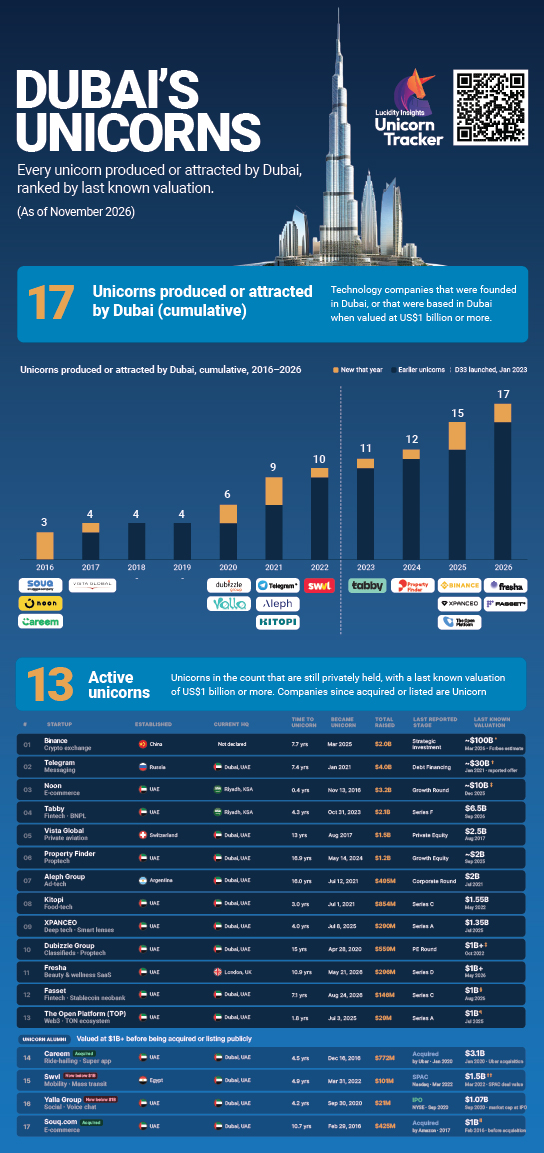
Souq.com was the region's first official unicorn. In February 2016 it reportedly closed a funding round that valued it at more than $1 billion. A year later, Amazon bought it for $580 million. That gap tells you something every founder should remember: a private valuation is a snapshot of investor optimism on one day, not a guaranteed price tag.
Still, the deal mattered enormously to Dubai and the entire MENA region. It showed that a global giant would buy a platform built in Dubai. Uber's $3.1 billion purchase of Careem, completed in January 2020, made that point again, louder.
The newest members of the unicorn club are XPANCEO, which makes smart contact lenses (July 2025), Fresha (May 2026) and Fasset (August 2026).
Several have become unicorn alumni by listing on public stock exchanges. But going public doesn't guarantee a happy ending either. Yalla Group and Swvl both listed at above $1 billion valuations, and both now trade below it. Swvl's shares lost more than 99% of their value within a year of its Nasdaq debut. The lessons are everywhere. Reaching a billion is hard; holding on to your valuation can be even harder.
Read Also: Lessons from SWVL’s Fall from Grace for the Next Generation of Entrepreneurs
The same applies to Anthropic’s listing last week. In its first 6 days, Anthropic’s valuation plummeted by $980 billion (49%). Public markets can be volatile.
Dubai’s Top 3 Unicorns Valued at $46.5 billion
Telegram, Noon, and Tabby hold about 70% of the group's combined value.
- Telegram (~$30B)
Telegram has never sold a share to outside investors. It reportedly turned down a $30 billion offer in 2021, and founder Pavel Durov says investors value it at more than that. The company pays for its growth with bonds. - Noon (~$10B)
The region's answer to Amazon is the most valuable Dubai-born company on the list, and it is edging toward decacorn status. It has raised about $3.2 billion, including a $500 million round backed by Saudi Arabia's Public Investment Fund in December 2025. Founder Mohamed Alabbar has said an IPO could follow within two years. - Tabby ($6.5B)
MENA's most valuable venture-backed fintech raised $233 million in September 2026, nearly doubling its valuation in 19 months. Tabby has been open about its ambition to list on the Saudi Exchange (Tadawul). It moved its headquarters to Riyadh in 2023 partly to prepare, has hired HSBC, JPMorgan and Morgan Stanley to advise, and its management has pointed to a listing as early as late 2025 or 2026. With fresh capital in hand, the question now is when the BNPL player will finally go public.
What about Binance? The world's largest crypto exchange has famously never named a global headquarters, but some argue Dubai is its home in all but name: much of its global leadership is based in the UAE, and it hosts its flagship Binance Blockchain Week here. Forbes estimates it is worth around $100 billion, which would make it the most valuable company in this story.
Officially, though, its global platform runs through three entities licensed in Abu Dhabi's ADGM since January 2026. Its parent company, Binance Holdings, is incorporated in the Cayman Islands, with other entities registered in the Seychelles and the British Virgin Islands, so it sits outside our Dubai count.
Transplants-in and transplants-out
Twelve of the 16 unicorns were born in Dubai. Nine are still headquartered here, in businesses as different as property portals, cloud kitchens, smart contact lenses and digital finance. But the full picture is about movement, in both directions.
Transplants-in. Four companies founded elsewhere chose Dubai as their home. Telegram runs its headquarters and operations from here. Argentina's Aleph Group set up its Dubai holding company in 2020 and was valued at $2 billion a year later. Vista Global launched in Dubai in 2018 around Swiss-born VistaJet. Cairo's Swvl made Dubai its base before listing. What draws them is a combination few cities can match: no personal income tax, easy company set-up, a deep pool of international talent, flights to a third of the world's population within four hours, and a location that keeps them close to fast-growing markets without being tied to any one of them.
Transplants-out. Three Dubai-born unicorns now lead their growth from elsewhere, and the reasons are practical. The first is the customer. When Tabby moved to Riyadh, 80% of its users were in Saudi Arabia. Fresha, founded in the UAE in 2015, now runs its expansion from London to be closer to its European customers, and it is already profitable. The second is the market itself. Saudi Arabia offers a far bigger domestic economy, deep pools of capital and its own stock exchange, and its regional headquarters programme ties government contracts to a Riyadh base. Noon, was simultaneously born in Dubai and Riyadh, though it seems to lead its growth from its largest consumer market.
Startups moving around the globe is inevitable - for some, it will make sense to be closer to their customers, or closer to their suppliers; others will move for financial, talent or legal reasons. Each of them carries a "made in Dubai" badge into a bigger market, and each proves that what starts here can scale anywhere.
A Healthy Unicorn Map
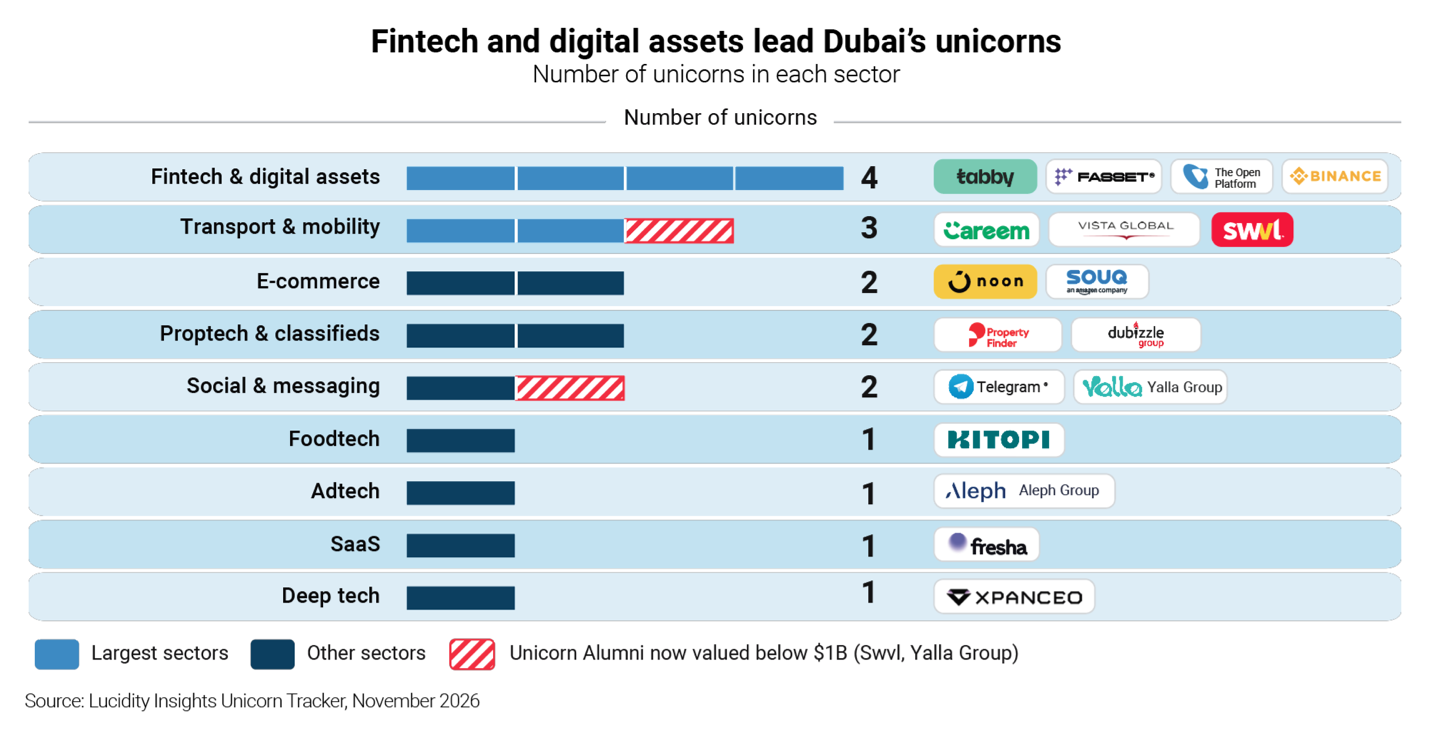
Dubai's 16 unicorns are spread across nine sectors, and no single sector has more than three. Fintech and digital assets sit alongside transport and mobility at the top. E-commerce, proptech and social platforms have two each, and the newest arrivals add business software, advertising technology and deep tech.
That balance is what a healthy ecosystem looks like. Dubai isn't a one-trick market riding a single trend. Its unicorns mirror the breadth of the region's tech economy, from how people shop and pay to how they move, find a home and connect. Several also compete globally, in messaging, private aviation and consumer hardware. If one sector cools, most of the map stays standing.
There is still white space on it. Healthtech, edtech and climate tech have yet to produce a Dubai unicorn, and I expect the next cohort to fill those gaps.
Small Market, Outsized Results
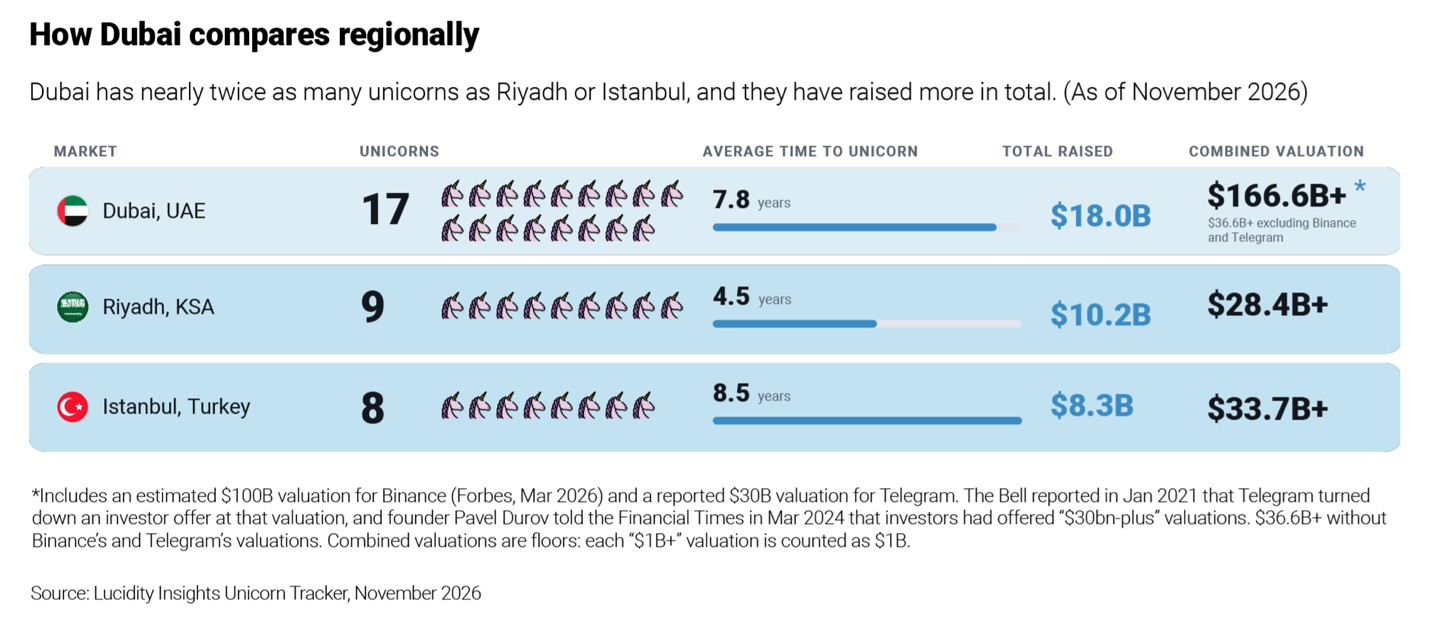
Dubai beats Riyadh and Istanbul on number of unicorns, capital raised and total value, and it does so from a much smaller home market. The UAE has about 11.5 million people, against roughly 35 million in Saudi Arabia and 86 million in Turkey. Founders in those countries can grow at home first. Here, you have to build for the whole region from day one.
The Power of Ten
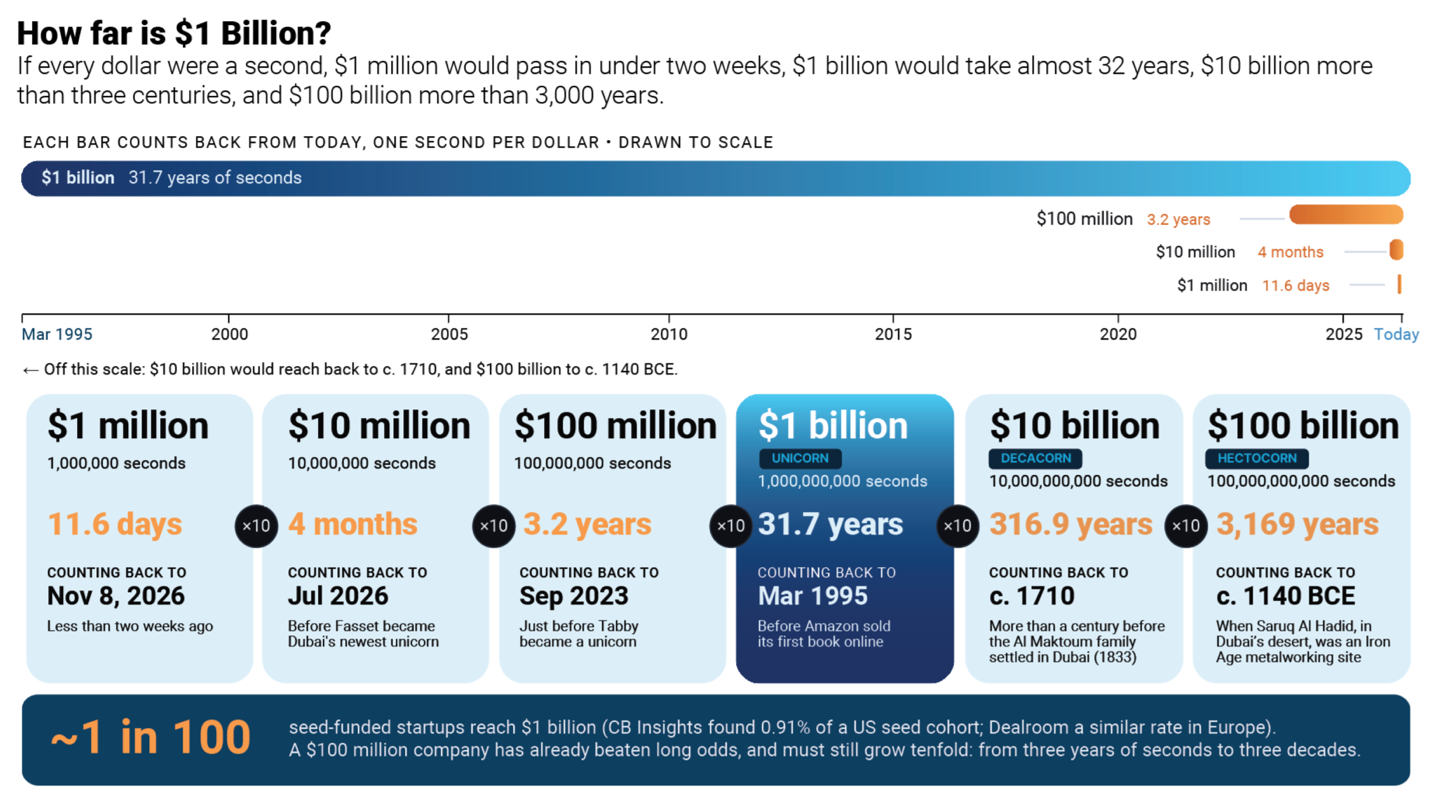
Only about 1 in 100 seed-funded startups ever reach a $1 billion valuation. Why is it so rare? Because every step is ten times bigger than the last. Count it in seconds: a million seconds is 11 days, a billion is 32 years, and a trillion is nearly 32,000 years. It’s exponential growth, and not every sector, not every business idea, not every founder - is capable of achieving this feat. There are only 14,000 unicorns in the entire world!
The good news is that the climb is getting faster. Startup Genome found that AI startups now reach $1 billion in 2.5 years, down from seven years in 2019. XPANCEO got there in four years. The Open Platform did it in under two.
The Road to 30 Unicorns
Six unicorns have been minted since the Dubai Economic Agenda D33 launched in January 2023: Tabby, Property Finder, XPANCEO, The Open Platform, Fresha, and Fasset. At about one and a half a year, Dubai reaches the mid-20s by 2033. To hit 30, it needs about two a year.
The groundwork is there. Dubai Founders HQ has already onboarded 500 startups, Dubai AI Campus has already signed on 505 AI Startups in just two years. With AI shortening the road to billion dollar valuations, my bet is that Dubai's next unicorns will arrive faster than the last ones did. And we'll be tracking every last one of them.