
PAPARA: Turkey’s $1B Fintech Unicorn Was Built on $2M — Then Its Founder Was Arrested
09 April 2026•
%2Fuploads%2Fturkey-unicorn-2026%2Fspotlights%2Fpapara%2Fpapara-team.png&w=3840&q=75)
%2Fuploads%2Fturkey-unicorn-2026%2Fspotlights%2Fpapara%2Fpapara-logo.jpg&w=3840&q=75)
Between 2016 and 2023, Papara processed $32 billion in transactions for 16 million users. That's the math behind Turkey's first fintech unicorn: seven years of profitable growth, minimal marketing spend, and a relentless focus on solving a problem traditional banks couldn't fix — financial access for Turkey's unbanked population. By the end of 2023, Papara had crossed a billion-dollar valuation without a single institutional investor.
By the end of 2025, its founder had been remanded in custody pending trial, the company had been placed under state trusteeship, its licence had been revoked and later reinstated following a court-ordered stay, and the Turkish government was attempting to sell the entire business at auction.
This is the story of both those things.
The Founder Who Built Four Companies Before 30

Papara's public filings describe Ahmed Faruk Karslı as Founder and Chairman since 2015, with a track record that reads more like a serial entrepreneur playbook than a typical fintech founder profile. Karslı launched his first company at 17, sold it for over $1 million at 19, and spent the next decade building ventures across telecom, retail, and technology. He's also a practicing lawyer — Bahçeşehir University law degree, Istanbul University master's — and an avid book collector with over 1,000 antique volumes.
Co-founding Papara alongside him from the start was İlker Diker, who brought deep institutional payments experience (a decade at Garanti Bank and TEB, followed by a consultancy at BKM, Turkey's Interbank Card Center). Diker served as Papara's first CEO from the company's operational launch in April 2016 through April 2020, overseeing the early product build and initial user growth. He subsequently transitioned to Co-Founder, Vice President of the Executive Board, and honorary Chief Product Officer — as Karslı assumed the CEO position. That combination of legal and entrepreneurial instinct from Karslı, and deep payments infrastructure knowledge from Diker, shaped everything about how Papara was built.
That founding logic was precise. In a 2022 interview, Karslı framed it plainly: "Before Papara I realized that people were willing to pay their bills in shops dedicated to paying bills for a fee just because they did not have a bank account. Later the authorities released the data, that about 63% of adults in Turkey were unbanked." If the goal was to build financial infrastructure for a country, you need to think in longer timelines.
Building Trust Before Features
Papara was founded in 2015 and received its electronic money institution licence from Turkey's Banking Regulation and Supervision Agency in April 2016, launching operations that August. The $2 million seed round from Galata Business Angels and Aslanoba Capital would prove to be the only significant external capital Papara would ever raise. Everything else — product, infrastructure, expansion — was built from operating revenue.
The early product strategy was simple: free 24/7 money transfers between banks, prepaid cards (physical and virtual), and bill payments. The "free" part was strategic. Traditional Turkish banks charged transaction fees; Papara didn't. Turkish banks required documentation and in-person visits; Papara offered instant digital onboarding. By 2017 — just one year after launch — Papara became profitable.
The company used what Karslı calls a "Robin Hood pricing model": free services for 90% of users, monetisation from the top 10% and corporate clients. Companies like Uber, Yandex, and Binance used Papara for payment processing, generating revenue while retail users enjoyed zero-fee transfers. By 2019, Papara had joined Visa's partner network and appeared on KPMG's Global Fintech 100 list. By 2020, the user base had hit 4 million. Then COVID-19 accelerated everything.
When Papara Was the Only Option
In 2020 and 2021, when Turkey locked down and traditional banks struggled to offer remote services, Papara was the sole provider in Turkey offering fully online account creation and physical card delivery to users' homes. "We were the only option," CEO Emre Kenci later recalled. That moment of market necessity supercharged user growth. By 2021, Papara reached 9 million users, more than doubling in a year.
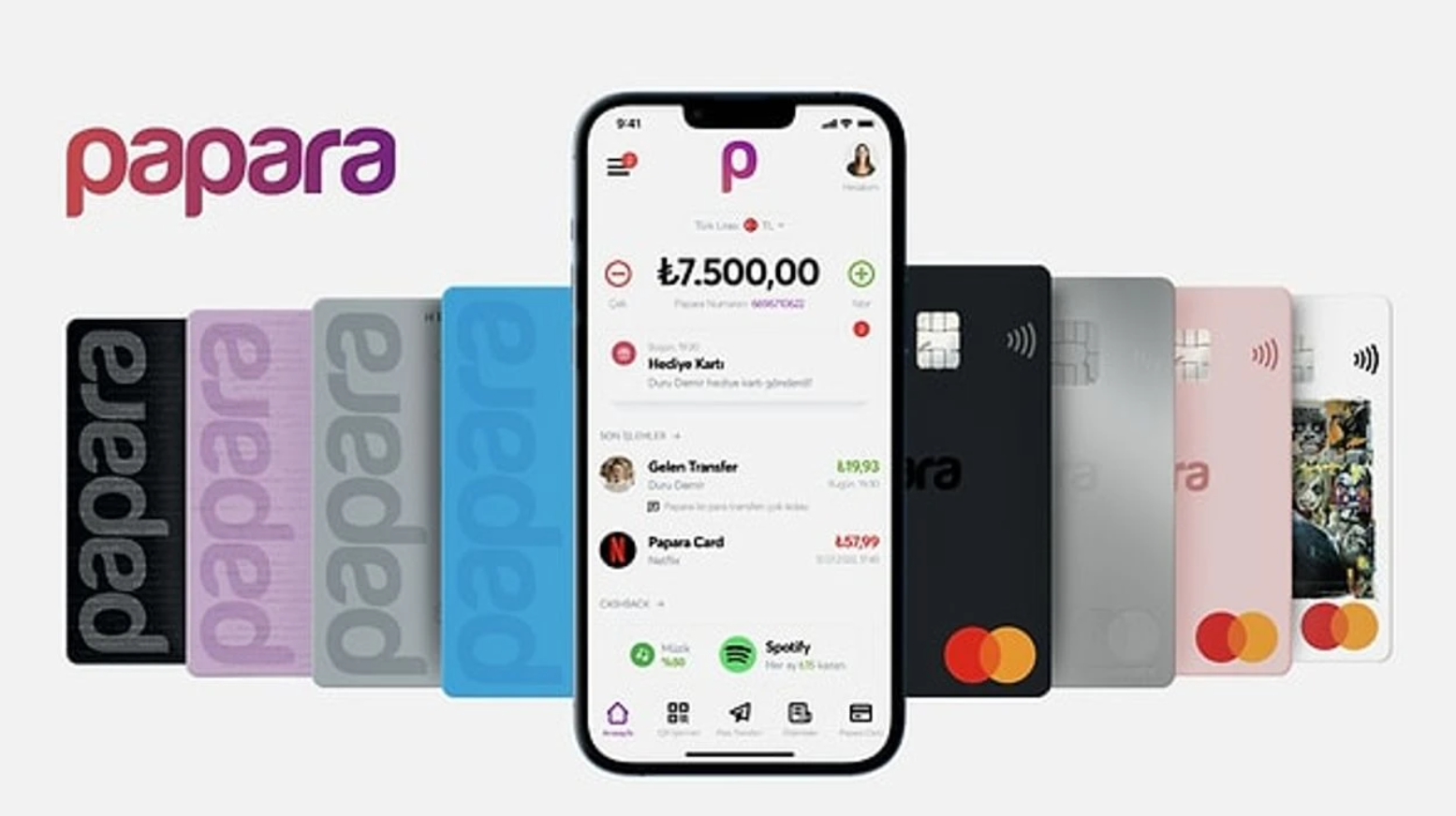
Remarkably, Papara didn't manufacture this urgency through marketing spend. By its own account, the company spent "almost nothing" on marketing. Instead, it built operational capabilities — instant onboarding, home delivery, 24/7 customer service — that became critical when external circumstances changed. The company also established PPR Holding in 2021 to manage strategic investments and acquisitions. By 2022, Papara had moved beyond payments into insurance (pet, home, travel, mobile) and launched the Voice Card: a Bluetooth-enabled debit card for visually impaired users that announces transaction amounts before payment.
Turkey's First Fintech Unicorn
On July 5, 2023, Papara announced the acquisition of Rebellion, a Madrid-based neobank from Spain's Beka Finance in a cash-and-stock transaction. The deal brought Papara's valuation to over $1 billion, making it Turkey's first fintech unicorn. The mechanics matter: Papara gave Beka Finance a combination of cash and equity in exchange for Rebellion. In doing so, Beka became a shareholder in Papara at a price that valued the Turkish company above $1 billion. This wasn't a traditional funding round; it was a strategic acquisition that simultaneously unlocked European expansion and triggered unicorn status.
Papara had reached this milestone having raised only $2 million in institutional funding. The company was profitable, generating over $200 million in revenue and $100 million in EBITDA by 2023, according to deal documents reviewed by investors. It was processing 528 million transactions annually with a volume of $32 billion. Coverage from Bloomberg and FinTech Magazine emphasised the rarity: "Europe's latest fintech unicorn" and "one of very few to have reached this milestone with no prior external investment."
Rebellion, now rebranded as Papara Spain, gave the company an instant foothold in Europe's second-largest neobank market by penetration (17% of Spain's population used digital banks), and a base from which to pursue further European expansion. Karslı framed it with characteristic ambition: "2023 is the year in which we are beginning to execute our ambitious international growth strategy."
What Papara Actually Built

To understand the competitive position Papara had constructed, you have to look past the "digital wallet" framing and examine the infrastructure. By 2023 Papara was operating across multiple layers: a payments backbone of free transfers, QR payments, bill payments, and ATM withdrawals; card issuance through its Visa partnership; insurance distribution across pet, home, travel, and mobile products; an investment platform offering access to Turkish stocks, US equities, and commodities through Papara Invest (the rebranded brokerage firm Polen Menkul Değerler); and merchant services processing payments for 15,000+ businesses. The user base reached 23 million by 2024, making it one of Turkey's most-used financial apps with a 4.8 average rating; roughly 70% of users were Gen Z.
The competitive landscape in Turkey included BKM Express, Paycell, iyzico, and Param. What differentiated Papara was not a single product feature — it was the business model. While competitors focused on specific verticals or relied on VC funding to subsidise growth, Papara built profitably from year two and expanded horizontally. The company didn't need to raise capital to survive; it raised capital through acquisitions to accelerate.
Pakistan, Spain, and the Road to IPO
In 2024, Papara acquired SadaPay, one of Pakistan's most prominent fintech startups, in an all-stock deal valued between $30–50 million. The strategic logic was clear: Pakistan offers 110 million unbanked people and a regulatory environment — SadaPay holds an Electronic Money Institution licence from the State Bank of Pakistan — that mirrors Turkey's early fintech conditions. Papara also announced plans to acquire another neobank in Egypt, and continued exploring opportunities in Portugal.
The forward thesis rested on two pillars: geographic replication and product deepening. Whether Papara could take the playbook that worked in Turkey (ie. profitability-first, financial inclusion-focused, super-app expansion) and apply it in Pakistan, Spain, Egypt, and beyond was the operating question of its next chapter. An IPO, reportedly being planned for 2026, would provide both liquidity for early stakeholders and capital for continued expansion.
Then, in May 2025, everything changed.
The Arrests and Its Aftermath
At dawn on May 27, 2025, cybercrime units from the Istanbul Chief Public Prosecutor's Office raided dozens of addresses across Istanbul, detaining 13 individuals including Karslı. The charges were serious: establishing and leading a criminal organisation, money laundering, and violating Turkey's laws on betting and games of chance. Four suspects were subsequently released after questioning; eleven, including Karslı, were remanded in custody.
Prosecutors alleged that Papara's platform had been systematically used to facilitate the financial operations of illegal online betting organisations. According to the Financial Crimes Investigation Board (MASAK), over 26,000 Papara accounts were used for illegal betting transactions totalling approximately ₺12.9 billion (roughly US $330 million) between 2021 and 2023. The funds were allegedly channelled through 274 domestic bank accounts before being transferred to cryptocurrency wallets linked to four illegal betting sites. Prosecutors further alleged that Papara maintained internal review systems designed not to disrupt the flow of these transactions, and that the company collected fees at multiple stages of the process. Karslı has denied wrongdoing. He has not been convicted of any offence, and all charges remain allegations pending trial.
The Turkish government moved swiftly. The Savings Deposit Insurance Fund (TMSF) was appointed as court-ordered trustee over Papara and nine related companies. The Central Bank imposed temporary daily transaction limits. In early June 2025, Papara informed its 23 million users that account balances were temporarily inaccessible pending review — a communication that tested the very consumer trust the company had spent a decade building. Fenerbahçe ended its sponsorship deal with Papara on June 4. Trabzonspor and Beşiktaş followed.
On October 31, 2025, the Central Bank formally revoked Papara's operating licence under Article 16 of Turkey's electronic money law — one of four fintech licence revocations in Turkey in 2025, part of a broader regulatory crackdown that also ensnared PayFix, Aypara, and Ininal. Papara's lawyers immediately challenged the decision. On December 9, Ankara's 25th Administrative Court issued an interim stay on the revocation. In January 2026, the Central Bank formally lifted the licence cancellation, allowing Papara to resume operations, but the Fintech was still under TMSF trusteeship, still awaiting trial.
In January 2026, TMSF put Papara up for sale. The reserve price for the entire group: Papara Elektronik Para, Papara Teknoloji, Papara Sigorta, and Papara Menkul Değerler was set at ₺4.27 billion, approximately $97 million at current exchange rates. The auction has been postponed multiple times, with investor due diligence extending into March 2026. The criminal trial has not yet begun.
Reality Crashes into Allegations

Papara’s story presents a genuine interpretive challenge for anyone attempting to make sense of Turkey’s startup ecosystem. On one reading, it is a case study in bootstrapped excellence: a company that identified a structural gap, achieved early profitability, avoided repeated dilution, and built financial infrastructure that reached 23 million users. On another, it is a cautionary tale — one that underscores the compliance risks embedded in high-velocity financial platforms operating in environments where regulatory oversight may lag behind growth.
Both interpretations may hold elements of truth, pending the outcome of legal proceedings. Prosecutors allege that Papara’s leadership had knowledge of, and financially benefited from, illegal flows through the platform. To date, founder Ahmed Faruk Karslı is the only individual consistently and widely named in public reporting. Turkish authorities have stated that 13 individuals were detained and 11 remanded in custody, though the full list of names and roles has not been comprehensively disclosed across all sources. Karslı has denied all wrongdoing, and no findings of guilt have been determined.
What is not in dispute is the scale: a payment institution processing $32 billion in annual transactions now sits at the center of allegations that its infrastructure was used as a financial rail for one of Turkey’s largest illegal betting networks — raising fundamental questions about whether its compliance systems were sufficient to detect or prevent such activity.
Papara’s trajectory also reflects the broader complexity of building compliance within rapidly scaling fintech platforms. Among its hires was Ziya Uçar, a former Cyber Crimes Department officer who later joined the company in a senior communications role — a detail that underscores the intent, at least in part, to embed regulatory and enforcement experience within the organisation as it scaled.
The infrastructure Papara built was, by most measures, extraordinary. The compliance architecture, prosecutors allege, may not have kept pace. In a sector where trust is the product, that gap — if proven — may become one of the most instructive lessons for Turkey’s fintech ecosystem, regardless of how the courts ultimately rule.
As with many high-profile financial cases in Turkey, the proceedings are unfolding within a legal system that has, in recent years, faced scrutiny from international observers – such as the European Court of Human Rights and Freedom House – over judicial independence and the use of extended pre-trial detention.
What we do know: as of early April 2026, Papara continues to operate under state trusteeship. The company is for sale. Its founder awaits trial. And 23 million users still have accounts on the platform. The case remains ongoing within Turkey’s legal system, with proceedings expected to take time to fully unfold.

%2Fuploads%2Fturkey-unicorn-2026%2Ftur26-new-cover2.jpg&w=3840&q=75)