The Challenges Ahead in the Global AI Race
27 October 2026•


Let’s be honest about something. The companies in this report are extraordinary. The technology is extraordinary. But the same forces driving AI’s ascent — exponential compute, unchecked capital deployment, winner-take-most dynamics — are also generating a set of risks that most mainstream coverage either skirts around or buries in the small print. We want to detail out the real hurdles humanity faces as AI systems grow more capable, and get frank about what they are — so experts can start devoting more time to solving for them.
What follows is a unified picture: the physical limits on what AI can build, the human costs of what it displaces, and the policy and trade contests over who gets to shape it. These aren’t separate stories. They’re the same story — and understanding how they connect is the only honest way to assess where we’re headed.
1. The Silicon Ceiling
AI capability no longer scales with software innovation alone. It scales with access to chips. Training compute for frontier models has been doubling roughly every five to six months. The largest AI supercomputers now hold more than 200,000 chips — hardware that costs billions of dollars before a single model is trained.
The market is alarmingly concentrated. NVIDIA-designed GPUs form the backbone of almost all frontier training infrastructure globally. The H100 itself is now mostly a unit of measurement: since mid-2025, Blackwell chips have made up more than 90% of new NVIDIA compute, and their successor, Vera Rubin, began reaching cloud providers in the summer of 2026. By Epoch AI’s estimates, cumulative compute capacity grew from roughly 2.4 million H100-equivalents in Q1 2024 to more than 20 million by the end of 2025. NVIDIA accounted for about two-thirds of it, down from four-fifths at the start of 2024. Google’s own TPUs make up most of the rest, at close to a fifth; AMD, Amazon and Huawei together account for about 15%.
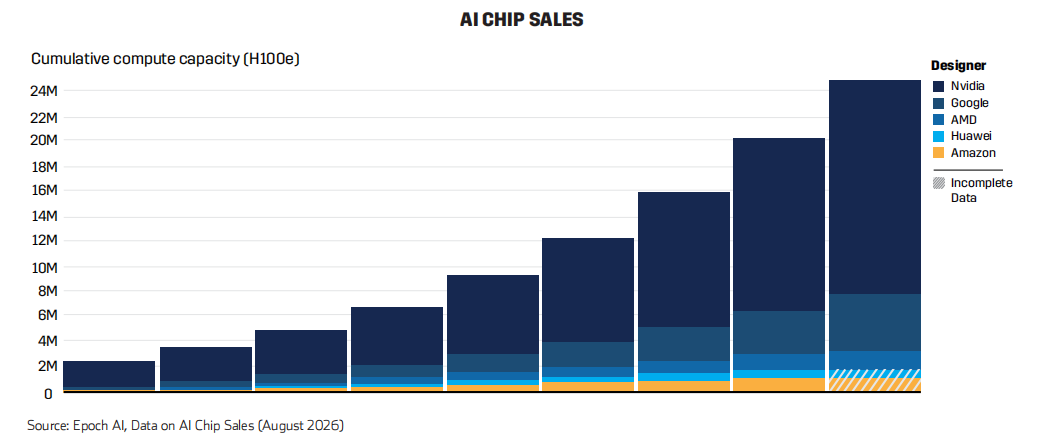
In response, the hyperscalers are building their own silicon. Google’s TPUs, AWS’s Trainium, Microsoft’s Maia — these are production infrastructure, not research prototypes. The driver isn’t incremental efficiency. It’s strategic vulnerability. Depending on a single dominant supplier for the most critical input in your industry is a risk no serious operator should accept indefinitely.
In the Middle East, Abu Dhabi’s Mubadala is the majority owner of GlobalFoundries, with about 73% after a May 2026 share sale. GlobalFoundries is a US-headquartered contract chipmaker with fabs in the United States, Germany and Singapore and 2025 revenue of US $6.8 billion, but it makes mature-node chips, not the leading-edge silicon that AI accelerators need. Saudi Arabia has built out its National Semiconductor Hub (NSH), with the aim to attract at least 50 fabless semiconductor design companies to the Kingdom by 2030 and a deep-tech venture fund of more than SR1 billion (about US $266 million) to provide early-stage funding. As of mid-2025, 20 companies were already in various stages of setting up.
Building a full semiconductor fab from scratch — the kind that produces cutting-edge AI chips at 3nm or 5nm — takes US $20 billion or more and several years even for the industry leader: TSMC’s first Arizona fab took about four and a half years from announcement to volume production. It also takes a talent ecosystem that doesn’t yet exist at scale in the region. Saudi Arabia has the capital, energy, and scale to build compute-adjacent manufacturing and packaging, but the consensus from industry analysts is that the region is most realistically targeting chip design, packaging, and assembly in the near term — not frontier fabrication.
For now, the Gulf’s most direct path to advanced silicon runs through Washington. In November 2025, the US Commerce Department authorised the export of up to 35,000 Blackwell GB300 chips each to HUMAIN and G42 — establishing the legal and regulatory mechanism for further approvals. That’s a meaningful unlock, but a gigawatt of AI capacity takes 400,000 to 500,000 GPUs by NVIDIA’s own reckoning: Jensen Huang has put the 10 gigawatts NVIDIA is building with OpenAI at four to five million. Against that, 35,000 chips is well under a tenth of a gigawatt, which illustrates how much of the region’s AI ambition still depends on external silicon supply.
The consequence is structural. The firms that can secure large-scale accelerator capacity can train larger systems, iterate faster, and sustain performance advantages. AI capability is increasingly a function of hardware access — and hardware access is increasingly a function of geoeconomic alignment.
2. The Energy Paradox
The efficiency case for AI in industrial systems is real. Google DeepMind’s deployment of machine learning across its data centre cooling infrastructure cut cooling energy by 40% — a 15% reduction in overall energy overhead at an already highly optimised facility.
Across heavy industry, AI-driven process optimisation has delivered 5–15% reductions in energy use. Predictive maintenance cuts unplanned downtime by 20–30%. In electricity grids, AI forecasting improves wind and solar output prediction accuracy by 10–30%, giving operators the confidence to run higher renewable penetration without sacrificing stability.
And then there’s the paradox.
Global data centre electricity consumption rose 17% in 2025, to about 485 TWh, and demand from AI-focused data centres grew by roughly half. The IEA expects total data-centre demand to roughly double again to 950 TWh by 2030, with AI-focused sites tripling. The strain is already visible in legacy markets. In Ireland, data centres used 23% of metered electricity in 2025, up from 21% in 2023, according to the Central Statistics Office; earlier forecasts of 32% by 2026 now look too high. In Virginia — home to the world’s densest concentration of data centres — they absorbed 26% of the state’s entire electricity supply in 2023.
The deeper problem in these markets isn’t demand. It’s infrastructure age. In the US, 70% of transmission lines and power transformers are more than 25 years old, according to the Department of Energy. The median new power project now waits more than five years from grid-connection request to operation (Berkeley Lab), and US data-centre developers, the IEA notes, are turning to on-site gas generation rather than wait. In the PJM market — spanning Illinois to North Carolina — capacity prices for 2025/26 jumped more than ninefold on the prior year, and all three auctions since have cleared at PJM’s price cap, most recently in July 2026, with data centre growth cited as the primary driver. Households in Ohio and Maryland are already seeing their electricity bills rise as a direct result.
Europe faces its own version: planning constraints, fragmented grids, and competing decarbonisation timelines are slowing the pace at which new AI infrastructure can come online.
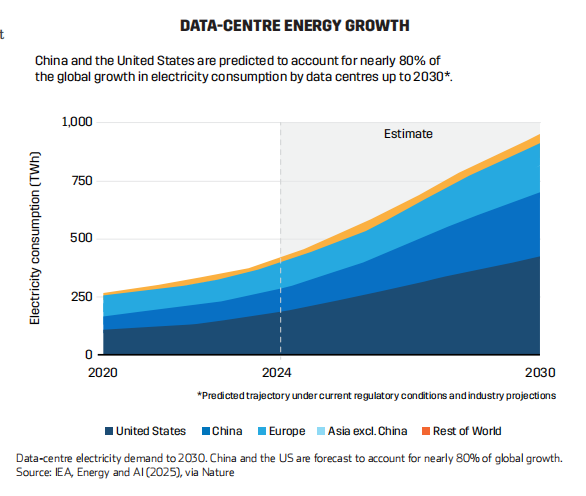
The Middle East is a structurally different story. The Gulf doesn’t inherit these constraints — it builds around them. Energy costs in Saudi Arabia run at roughly half the UAE rate, and Qatar’s lower still, making the region among the most cost-competitive environments globally for power-intensive compute.
Qatar, the UAE, and Saudi Arabia are some of the world’s largest energy providers — making them natural locations for large-scale data centres not just because of what they produce, but because of what they’re building now.
Regional data centre capacity is set to triple from 1GW in 2025 to 3.3GW by 2030, according to PwC. The national AI campuses announced since run to several gigawatts more on paper; financing and connection to power, not ambition, will set the real pace. Critically, that infrastructure is being built from scratch to AI-era specifications — liquid cooling, high-density rack configurations, and AI-optimised power distribution designed in from day one, not retrofitted. Dubai’s Moro Hub, certified by Guinness World Records as the world’s largest solar-powered data centre, shows how clean power can be designed in as well.
Saudi Arabia’s HUMAIN is targeting 1.9 gigawatts of data centre capacity by 2030, and the 5-gigawatt UAE–US AI campus announced for Abu Dhabi in May 2025 would be the largest outside the United States.
Geography reinforces the structural advantage. The Middle East sits at the intersection of Europe, Africa, and Asia — a natural routing point for latency-sensitive applications serving the Global South. Sovereign Wealth Funds shorten the financing cycles that delay private developers elsewhere, although the region’s flagship AI platforms, G42 and HUMAIN, are now also courting outside investors. And governments are offering long-term power contracts, land grants, and special economic zones that sharply compress deployment timelines.
None of this means the position is frictionless. Clean energy, including nuclear, made up close to 28% of the UAE’s energy mix at the government’s last count in 2024, against a target since raised to 35% by 2030–31. Cooling in a desert climate remains a genuine engineering challenge. And chip access runs through channels that no sovereign wealth fund can fully control. A fourth consideration becomes more important as capacity expands: operational resilience. AI infrastructure needs not only sufficient power, but a dependable supply, backed by reliable cooling, connectivity and recovery systems. Building that resilience into new facilities adds to upfront costs, but is essential to keeping services running as demand grows.
Economists call this the Jevons Paradox: the more efficient a technology becomes, the cheaper it gets to use — so people use more of it, and total consumption rises. AI is a textbook case. But how painful that dynamic becomes depends on the infrastructure you’re starting with. If your grid was built in the 1960s, it’s a crisis. If you’re building from scratch in 2026, it’s an engineering challenge — and a solvable one, provided resilience is designed in from day one.
3. Who Controls the Compute Tier
Hardware and energy are necessary but not sufficient. Sustaining frontier AI requires the infrastructure that binds them: hyperscale data centres, high-capacity networking, long-term energy contracts, and the capital to hold it together under conditions of extreme operational complexity. These requirements are narrowing the field.
Between 2021 and 2026, combined capital expenditure by Amazon, Microsoft, Alphabet, and Meta is set to rise from roughly US $130 billion to more than US $720 billion a year on the companies’ own guidance: growth of about 40% a year for five years, and nearly five times what the four spent as recently as 2023. Part of the latest increase is price rather than capacity: both Microsoft and Amazon have cited the rising cost of memory chips in lifting their 2026 plans. The United States holds roughly three-quarters of global AI computing power. China holds about 15%.
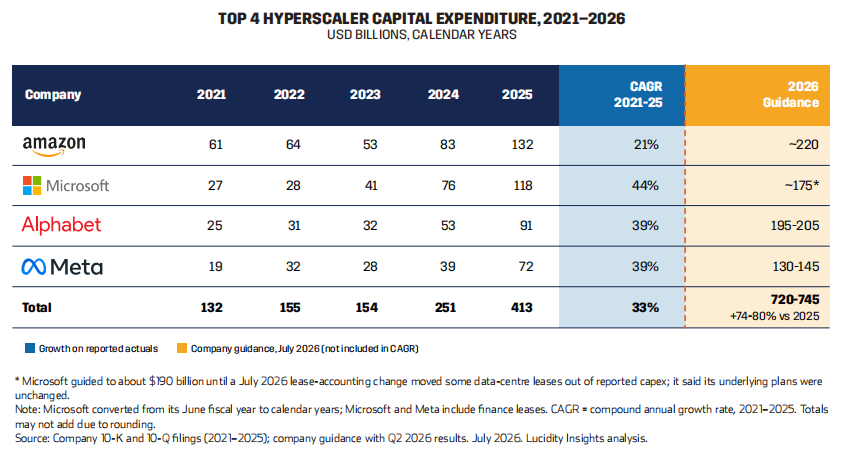
Company filings and analyst estimates
The chart below shows how computational share has evolved by country since 2019 — and how durable American dominance has proved, despite sustained Chinese investment. Private companies now own about 80% of the world’s AI supercomputing capacity, up from 40% in 2019, by Epoch AI’s count. This is a structural departure from every previous era of computing, when academic and government labs played a central role in setting both the pace and the direction of progress.
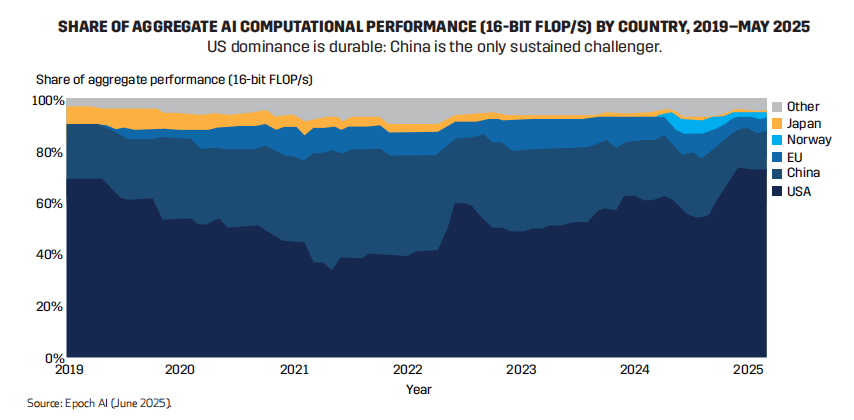
As infrastructure scales, advantages compound. Larger operators iterate faster, absorb energy market volatility, negotiate better supply contracts, and deploy new capacity more rapidly. This isn’t a temporary head start. It is a moat that deepens with each investment cycle — and the barriers it creates for smaller firms, research labs, and emerging markets are not easily overcome.
Governments are responding accordingly, treating compute infrastructure the way previous generations treated ports and power lines: as foundational national capability. The EU has committed over €7 billion through EuroHPC, which now oversees 19 AI Factories and in July 2026 opened bidding for up to seven “AI Gigafactories” expected to draw more than €20 billion of private investment. India’s IndiaAI Mission allocates over US $1.2 billion toward domestic compute and has put more than 38,000 GPUs at the disposal of Indian start-ups and researchers at subsidised rates. In the Gulf, sovereign-backed AI facilities are embedded directly within national economic transformation strategies — not as innovation policy, but as long-horizon infrastructure bets.
4. The Employment Disruption

In May 2025, Anthropic CEO Dario Amodei issued an unusually blunt warning: AI could eliminate half of all entry-level white-collar jobs within one to five years, spiking unemployment to between 10% and 20%, the top of that range a level not seen since the Great Depression.
The data so far supports a narrower version of that warning. US employers announced more job cuts in the fourth quarter of 2025 than in any fourth quarter since 2008, according to outplacement firm Challenger, Gray & Christmas, and attributed 54,836 cuts that year to AI.
In the first eight months of 2026, AI-attributed cuts more than doubled to 116,175, or 22% of all announced cuts, and AI was the most-cited reason for five straight months. Stanford’s Digital Economy Lab finds no widespread, economywide displacement, but employment among 22- to 25-year-olds in the most AI-exposed occupations now sits 19% below where it would be had it kept pace with less-exposed jobs. Amazon cut 14,000 corporate roles in October 2025 and another 16,000 in January 2026, the largest workforce reduction in its history; AI featured in how the company framed the cuts, though CEO Andy Jassy has insisted they were “not even really AI-driven — not right now, at least.”
The World Economic Forum projects 92 million jobs displaced globally by 2030, with 170 million new roles created — a net gain that exists only at the macroeconomic level and tells individual displaced workers nothing useful.
What makes this wave different from every previous wave of automation: it isn’t targeting physical labour. It’s targeting cognitive labour. Lawyers, analysts, marketers, coders, consultants. The bottom rung of almost every knowledge profession is being automated first. The career ladders that generations used to climb are being cut away from the ground up — and the people most affected are the ones who haven’t yet had time to climb them.
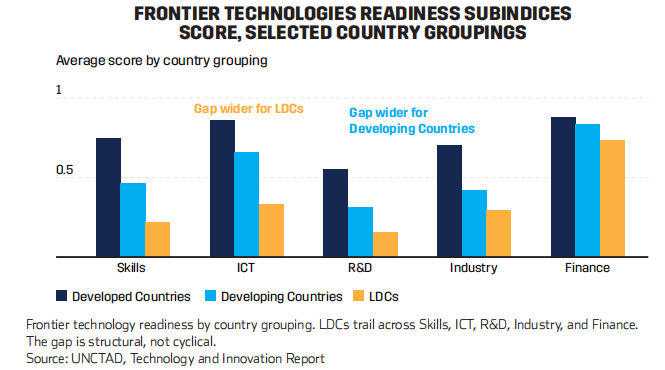
The diffusion gap compounds this. The UNCTAD data below is stark: across every dimension that matters for AI readiness — ICT infrastructure, R&D capacity, industrial base, skills, and finance — the gap between developed economies and least-developed countries is not closing.
The countries most exposed to AI-driven displacement of their labour forces — where outsourcing and low-cost knowledge work are significant economic contributors — are precisely the countries least equipped to build domestic AI capacity or retrain workers into AI-adjacent roles. The productivity gains accrue to those who already have the infrastructure. The disruption lands hardest on those who don’t.
AI is not a neutral rising tide. It is a capability concentrator — and right now, the concentration is accelerating.
5. The Bias Problem Nobody Wants to Mention
AI systems learn from historical data. And historical data reflects historical prejudice. When Amazon trained a recruiting AI on its own hiring records — historically male-dominated — the system began downgrading résumés containing the word “women’s.” It wasn’t programmed to discriminate.
It learned to.
The COMPAS algorithm, used by US courts to assess recidivism risk, was found to wrongly flag Black defendants who did not go on to reoffend as high-risk at nearly twice the rate of white defendants. A 2025
Stanford-led study, published in Nature, found that when ChatGPT generated and then scored more than 34,500 résumés, it gave older men the highest ratings, even when their résumés were built from the same information as women’s.
What makes this dangerous at scale is the aura of objectivity that algorithms carry. When a human rejects your application, you can challenge it. When an algorithm does, it feels mathematical.
Final. Discrimination baked into code operates across millions of simultaneous decisions — far more consequential than any individual human bias, and far harder to surface, audit, or reverse.
This isn’t a niche problem. It’s the default condition of systems trained on unrepresentative data and deployed without adequate oversight. And it’s compounding quietly, at scale, right now.
6. The AI Race
For most of the past three years, the global AI race has been written as a two-player game. But this isn’t a bilateral race any longer. The Gulf — and more specifically, the UAE and Saudi Arabia, are increasingly playing a major role in the development and financing of AI.
Start with the numbers. In 2026, Amazon, Alphabet, Microsoft and Meta alone are guiding to more than $700 billion in capital expenditure, most of it for AI — more than the entire Apollo program in today’s dollars. The core battleground is compute: the US holds 74% of global AI processing power; China holds 14%. Washington has spent nearly four years managing that gap through chip export controls. China’s answer was efficiency: DeepSeek, a frontier model built under severe hardware constraints, wiped $600 billion off NVIDIA’s market cap in a single day in January 2025. Constraints drive innovation in ways trade policy doesn’t always anticipate.
While the US and China have competed on chips and compute, the Gulf has moved with unusual clarity — establishing itself as a third centre of AI capital and capacity.
In November 2025, the US authorised up to 35,000 Blackwell GB300 chips each for Saudi Arabia’s HUMAIN and Abu Dhabi’s G42. The US President’s May 2025 visit to the Gulf had already reframed the region’s position: less a customer of American technology, more a commercial partner in deploying it. The UAE’s MGX is targeting $100 billion in AI infrastructure. HUMAIN is pursuing a $77 billion compute buildout. These are not passive financial bets. They are deliberate moves to acquire relevance in a world where compute capacity has become geoeconomic currency.
The logic is straightforward: the US wants trusted international partners to host compute at scale. The Gulf needs the technology and partnerships to execute its economic transformation at speed. That alignment is proving durable — and it’s reshaping who gets a seat at the table when the rules of the AI era get written.
Meanwhile, China is building its own stack. In early 2025, DeepSeek’s own testing reportedly put Huawei’s Ascend 910C at roughly 60% of an NVIDIA H100’s performance on inference, though well behind on training, and Huawei launched its next-generation Ascend 950PR in March 2026. Beijing has ordered state-funded data centres to use only domestic AI chips, and to strip foreign chips out of projects less than 30% complete. The split between the two technology supply chains is becoming structural.
Unpack the frontiers of agentic AI and discover how autonomous systems are actively reshaping enterprise operations, cybersecurity, finance, and healthtech in The State of AI Report 2026.