
How Getir Invested in Quick Commerce Before the World Was Ready
08 April 2026•
%2Fuploads%2Fturkey-unicorn-2026%2Fspotlights%2Fgetir%2Fgetir-founders.jpg&w=3840&q=75)
%2Fuploads%2Fturkey-unicorn-2026%2Fspotlights%2Fgetir%2Fgetir-logo.jpg&w=3840&q=75)
Getir Co-Founders: Serkan Borançılı, Nazım Salur, and Tuncay Tütek
Before anyone called it quick commerce, before Berlin startups raised nine-figure rounds on the concept, before "dark store" entered the vocabulary of venture capital, a company in Istanbul was already delivering groceries to millions of people in under ten minutes. No retail footprint. No franchise agreements. No third-party warehouses. Just a mobile app, a fleet of riders, and a quietly radical theory about how urban consumers actually behave when you remove the friction of waiting.
Getir launched in July 2015 with 1,500 SKUs, a handful of micro-fulfillment centers in central Istanbul, and a promise that sounded, at the time, more like a marketing line than an operational commitment. It was neither.
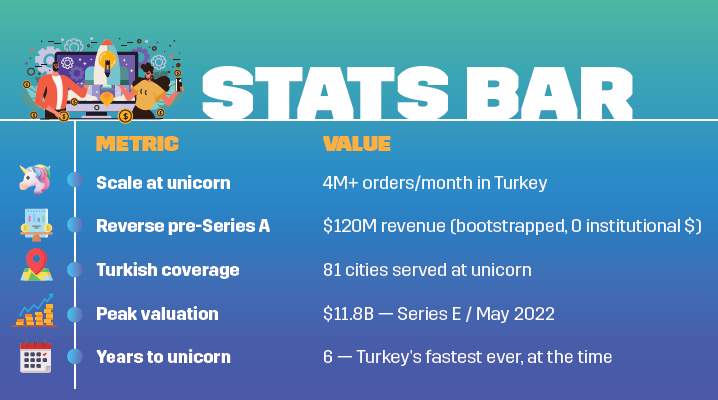
The companies that would eventually imitate that promise — Gorillas, Flink, Weezy, Dija — were all founded in 2020, five full years after Getir had already proved the model works. By the time those startups raised their first institutional rounds and placed their first dark stores, Getir had served hundreds of millions of orders across Turkey, generated $120 million in revenue in 2019 without a single dollar of institutional capital, and delivered nearly 1.5 million orders in December of that year alone. The world didn't invent quick commerce. Istanbul did.
The Insight Was Architectural, Not Accidental

The architectural insight that made Getir possible came from a different business entirely. Nazım Salur founded BiTaksi in 2013 — Turkey's first taxi-hailing app, which introduced credit card payments to Turkish taxis and compressed the consumer waiting experience to three minutes. The lesson wasn't about taxis. It was about tolerance thresholds: when you position supply correctly, you can make waiting feel like it has been eliminated. "BiTaksi offers taxis in three minutes," Salur later explained. "Why not bring people their everyday needs in around ten minutes?" Salur, who hadn't entered the technology sector until approximately the age of fifty after two decades in furniture manufacturing and industrial plant brokering, carried that thesis directly into Getir. Same architecture, larger market.
What Salur brought as the founding insight, his co-founders brought as execution infrastructure. Serkan Borançılı had co-founded GittiGidiyor, Turkey's pioneering e-commerce marketplace, which was acquired by eBay — giving him deep fluency in how Turkish digital consumers discover, decide, and repeat-purchase online. Tuncay Tütek arrived from senior roles at PepsiCo and Procter & Gamble across Europe and the Middle East, translating multinational FMCG experience into the discipline of inventory curation at scale. Before a line of Getir code was written, the founding team had already solved three of the hardest problems in consumer logistics: the timing architecture of on-demand delivery, the behavioral patterns of digital shoppers, and the operational logic of fast-moving consumer goods. What they built wasn't an app. It was a system. And the system's intelligence lived in the dark stores.
A Dataset No Competitor Could Buy
The term "dark store" undersells what Getir actually built. These weren't repurposed retail spaces or improvised storage rooms — they were data-driven hypotheses about urban behavior, expressed in square footage. Each location decision encoded an answer to a specific question: which neighborhood in Istanbul has the right density of digitally active, convenience-oriented consumers, the right mix of morning versus evening demand, the right SKU velocity to justify a 500-square-foot fulfillment center at that exact address? Over time, the answers to those questions became a proprietary dataset that no competitor with eighteen months of operating history could replicate.
The curation logic was equally precise. Getir didn't stock everything — it stocked exactly what moves fast. The roughly 1,500 to 2,000 SKUs per dark store represented a running calculation of local demand patterns: which snack sells fastest on Thursday evenings in Beşiktaş, which baby product spikes on weekends in Kadıköy. By the end of 2018, that calculation had been run across roughly sixty dark stores and six hundred delivery vehicles, processing three million cumulative orders — each one feeding the model with more granular data on what to stock, where to stock it, and how to route riders for a consistent ten-minute outcome. By late 2021, the Turkish network was processing more than four million orders per month.
The competitive implications of that dataset became starkly visible on a single day in March 2021. Gorillas, the Berlin-based quick commerce startup founded in May 2020, raised $290 million at a valuation exceeding $1 billion — a remarkable achievement for a company less than a year old, and one that made it the fastest European startup to reach unicorn status at the time. The announcement came one day before Getir's own Series C closed.
The parallels between the two companies are not coincidental. Gorillas CEO and co-founder Kağan Sümer is Turkish, grew up in Istanbul, and spent time at Bain & Company in Istanbul before moving to Rocket Internet in Berlin and eventually founding Gorillas. Whether or not Getir's model was a direct blueprint — Sümer has never said so publicly — the structural resemblance is hard to dismiss.
Gorillas had built a compelling product and raised exceptional capital, but it had built its dark store network on months of behavioral data. Getir had built its on years. The gap between those two inputs is not something additional funding can close — it can only be narrowed through time and order volume, neither of which Gorillas had in 2021. That asymmetry is why Gorillas was ultimately acquired by Getir in December 2022 — in an all-stock deal valued at approximately $1.25 billion, following severe financial struggles at Gorillas driven by high operational costs and unsustainable cash burn — rather than the other way around. The pandemic didn't create Getir's advantage. It revealed it.
When the World Finally Caught Up
When COVID-19 arrived in early 2020, it validated everything Getir had built rather than building something new. The dark store network was already operational across Istanbul and expanding to Ankara and other Turkish cities. The rider fleet was trained and scaled. The app carried the trust of millions of consumers who had been using it for years. When demand for contactless, immediate grocery delivery surged, Getir's infrastructure absorbed the increase because it had been designed to scale — it wasn't being designed in real time. Revenue grew approximately five times in 2020. The startups racing to enter the category in the same period were building their first dark stores while Getir was optimizing its sixtieth.
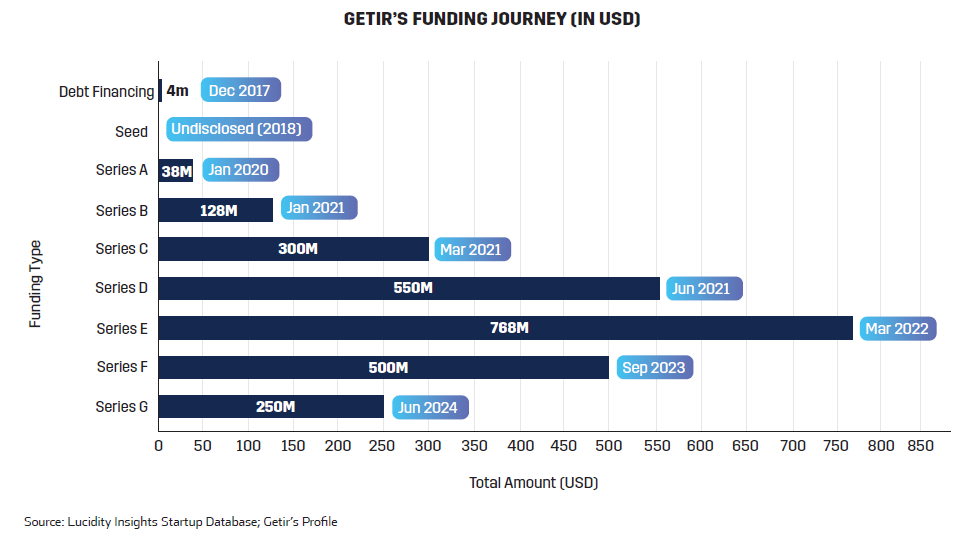
The funding acceleration that followed reflected investor recognition of what the data advantage actually meant. A $38 million Series A in January 2020 — led by Michael Moritz's personal investment vehicle Crankstart, marking the first institutional capital Getir had taken in five years of operation — signaled that the bootstrapped proof of concept had become institutional-grade. Twelve months later, a $128 million Series B co-led by Crankstart and Brazil's Base Partners valued the company at $850 million, coinciding with Getir's entry into London, its first market outside Turkey. Two months after that, the Series C arrived. Sequoia Capital and Tiger Global don't co-lead funding rounds in companies attempting to build new categories. They co-lead funding rounds in companies that have already won them.
Turkey's Fastest Unicorn at the Time
On March 26, 2021, Getir closed its Series C at $300 million and a valuation of $2.6 billion — becoming Turkey's second unicorn and the most valuable startup across the Middle East, North Africa, Turkey, and Pakistan at the time. The round was co-led by Sequoia Capital and Tiger Global, with seven of eight existing investors returning. The valuation had tripled in eight weeks from the Series B, reflecting not a change in what Getir was doing but a change in what the global investment community understood it to be.
The strategic significance of Sequoia's entry extended beyond the capital. Its decision to co-lead the round was, in effect, a statement that the dark store architecture — vertically integrated, data-driven urban fulfillment — was the correct infrastructure answer for quick commerce globally, not just in Turkey. The category Getir had invented in 2015 without a name had acquired one, along with the validation of two of the world's most closely watched venture firms. Salur put it simply: "We have now raised $300 million and will use the investment for our ambitious European expansion. We are glad to announce that we have become the fastest Turkish unicorn."
Getir went on to raise a further $550 million Series D in June 2021 at a $7.5 billion valuation, co-led by Silver Lake and Mubadala, before reaching its peak with a $768 million Series E in March 2022 led by Mubadala at a valuation of $11.8 billion — making it one of the highest-valued private technology companies in Europe at the time. The expansion was swift and global: by late 2021, Getir was operating in nine countries across Europe and the United States, processing close to one million orders per day.
Key Stats Bar
The Questions that Remain
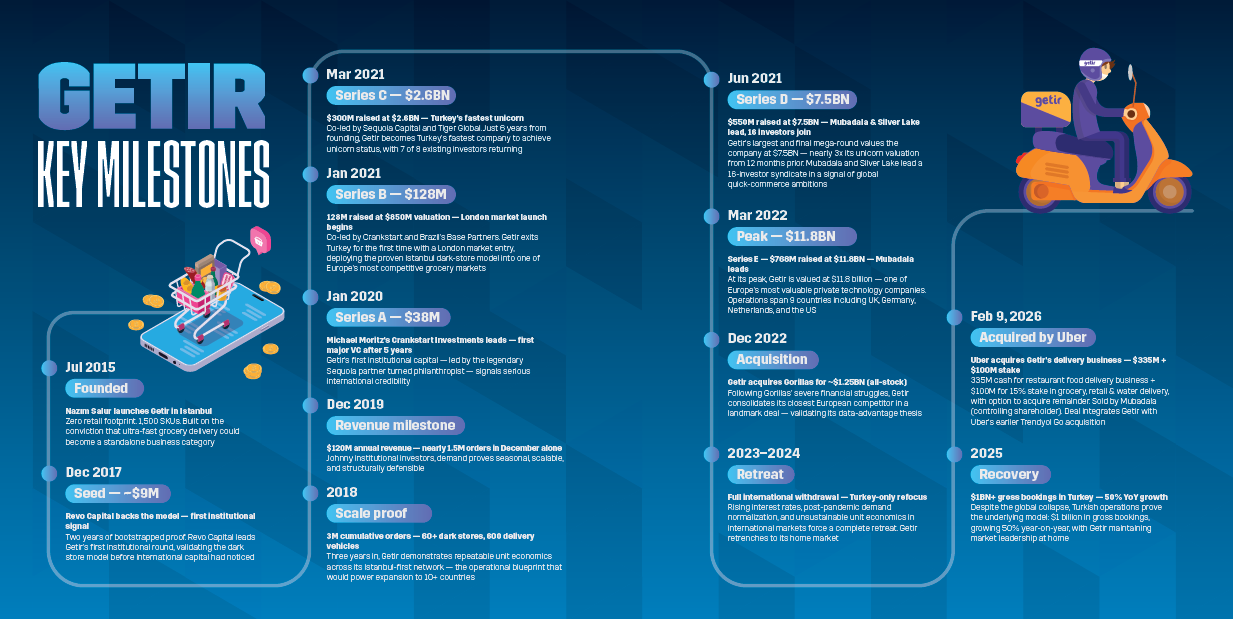
The questions that Getir's trajectory leaves open are more instructive than its peak valuation. But to understand them, you have to follow the full arc — not just the rise.
The cracks appeared quickly after March 2022. Global interest rates rose sharply, venture capital markets seized up, and the pandemic-era behaviors that had supercharged Getir's international expansion began to unwind. The unit economics that had looked manageable in a high-growth environment became brutal in a normalized one. Dark stores are expensive to operate. Riders are expensive to employ. Without the volume surges of 2020 and 2021, the numbers simply didn't work outside Turkey.
The retreat was swift and humbling. Getir pulled out of Southern Europe through 2023, then exited Germany, the Netherlands, the UK, and the US entirely by April 2024 — laying off thousands across each market and winding down the Gorillas network it had acquired for $1.25 billion just eighteen months earlier. Revenue fell from an estimated $1.15 billion in 2022 to around $800 million in 2023 as active users and downloads collapsed. The valuation followed. In September 2023, Getir raised $500 million in fresh financing at just $2.5 billion — less than a quarter of its $11.8 billion peak eighteen months prior. A fallen unicorn in everything but name.
What followed was arguably more turbulent than the financial decline itself. As cash reserves drained, Mubadala — which had led the 2022 Series E and provided emergency loans in 2024 — moved to take majority control of Getir's Turkish grocery operations through a $250 million restructuring. Co-founders Nazım Salur and Serkan Borançılı resisted, with Salur calling it an "illegal coup." A Dutch court rejected the founders' appeals, ruling that Mubadala had acted in the interests of a company otherwise facing imminent bankruptcy. Court documents filed at the time valued Getir's entire group assets at just $374 million — a figure that captures the full distance traveled from the $11.8 billion summit. Days after the Uber deal was announced, the founders filed a $700 million lawsuit against Mubadala in London's High Court, alleging the fund had reneged on promises to transfer key assets — including Getir Finance, valued at approximately $510 million — as part of the restructuring. That legal battle remains ongoing.
Then came Uber. The deal announced on February 9, 2026 sees Uber pay $335 million in cash for Getir's restaurant food delivery business, and a further $100 million for a 15% stake in the grocery, retail, and water delivery operations — with an option to acquire the remainder over the next few years, subject to performance milestones. The total upfront consideration of $435 million is anchored by real operating momentum: Getir's food delivery unit alone recorded more than $1 billion in gross bookings in 2025, up 50% year-on-year. The core Turkish business, stripped of its international overextension, remained genuinely strong.
So is Getir still a unicorn? The Uber deal doesn't ascribe an explicit valuation to the overall group, but the implied maths are suggestive. The $100 million paid for a 15% stake in the grocery operations alone implies a valuation of roughly $667 million for that business. Add the $335 million food delivery transaction, and the total implied value sits in the region of $1 billion — though the performance-based earnout structure makes any precise figure conditional. This is something global Q-commerce players will watch closely as the deal closes in the second half of 2026.
What is not in question is the shape of the story. Getir raised $2.4 billion, reached $11.8 billion on paper, expanded to nine countries, lost control of the company to its largest investor in boardroom battles played out across Dutch and British courts, and was subsequently sold in pieces. Uber — which now owns both Getir and Trendyol Go — quietly became the dominant force in Turkish delivery without ever having built a dark store.
The model was not broken. It was applied somewhere it couldn't work at the pace and scale investors demanded. Getir's 50% gross booking growth at home in 2025, sustained after abandoning every other market, is the clearest answer it has given to the question of where the data-driven dark store model actually works. The answer turns out to be: exactly where it started.
The ten-minute promise was never really about speed. It was about knowing, before the customer opened the app, exactly what they needed — and having built the infrastructure, years in advance, to already be there. In Turkey, that infrastructure endures. Everything else was a lesson in the limits of exporting a dataset.

%2Fuploads%2Fturkey-unicorn-2026%2Ftur26-new-cover2.jpg&w=3840&q=75)