
More Than Half of Turkey’s Unicorns Have Female Founders. Here’s Why
15 April 2026•
%2Fuploads%2Fturkey-unicorn-2026%2Farticles%2Ffemale-founders%2Ffemale-founders-cover.jpg&w=3840&q=75)
There are startup ecosystems that debate gender parity. And then there are those that quietly produce outcomes. Turkey is the latter, and by a long-shot.
Since 2010, Turkey has produced eight unicorn companies — startups that crossed the $1 billion valuation mark. Five of those eight were founded or co-founded by women. What makes this number remarkable isn’t just the ratio. It’s what happened next. The female-founded companies largely held. The male-led ones, with one notable exception, did not.
In a global venture ecosystem where female founders have historically received somewhere between 2% and 5% of total venture capital depending on year and geography, this is not a diversity anecdote. It may very well be a structural signal; and the signal is sharpest not at the level of entry, but at the level of outcome.
The Women Behind Turkey’s Unicorns
Start with Ms. Demet Mutlu, co-founder and CEO of Trendyol. After graduating top of her class at NYU in economics, Mutlu began an MBA at Harvard Business School in 2008 — and dropped out the following year to build the company herself, bootstrapping $300,000 of her own funds to launch what would become Turkey’s most valuable private technology company.
That decision reflects a defining trait seen across many of Turkey’s female founders: global exposure, but execution anchored locally. Trendyol reached a valuation of $16.5 billion, and as Turkey’s first decacorn, it remains the country’s largest private technology company. Mutlu is also a co-founder and early investor in Peak Games, Turkey’s first unicorn — a connection that underscores how concentrated this particular network of founders truly is.
At Hepsiburada, Ms. Hanzade Doğan Boyner built one of Turkey’s earliest internet businesses, launching the platform in 2000 when e-commerce infrastructure in the region was still nascent. Under her founding leadership, Hepsiburada became the first Turkish technology company to list on Nasdaq in 2021, reaching a valuation of $3.9 billion at IPO. That milestone remains unmatched.
What followed that IPO illustrates a second layer of maturity in Turkey’s ecosystem. Hepsiburada’s continued post-IPO leadership reflects the pattern of female founders building organizations that sustain and advance women from within. In 2023, Ms. Nilhan Onal Gökçetekin became CEO, bringing over a decade of senior leadership at Amazon across retail and operations. This is not simply succession — it is continuity of culture. According to Hepsiburada’s 2023 annual report, the company increased its female manager ratio to 36%, above the global average for comparable technology and e-commerce companies. For context, McKinsey’s 2025 Women in the Workplace report found women hold just 29% of C-suite roles globally. Amazon’s own senior leadership team, despite being one of the world’s largest e-commerce operators, had only three women out of twenty-two members as recently as 2020.
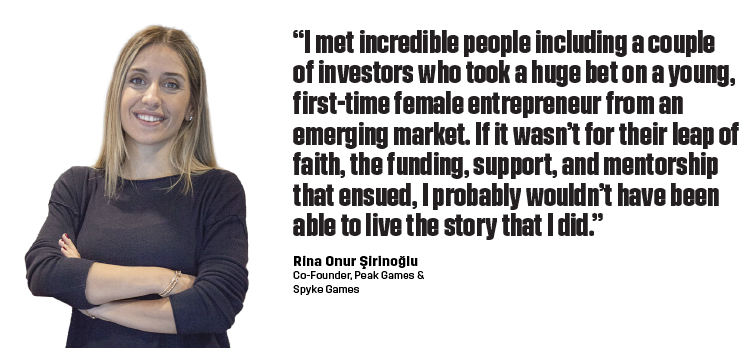
The internal numbers at Insider are even more striking. Ms. Hande Çilingir co-founded the company in Istanbul in 2012 and built it from the ground up as a global SaaS enterprise — not a regional company that expanded outward, but a business designed from day one to compete on international markets. Insider was not built to serve Turkey. It was built to serve Samsung, Unilever, Toyota, and L’Oréal. Today the company, which rebranded as Insider One in December 2025, operates across 28 countries and six continents. By 2022, 50% of Insider’s top executives were women, including both the CEO and CFO — a statistic that does not happen by accident in enterprise software.
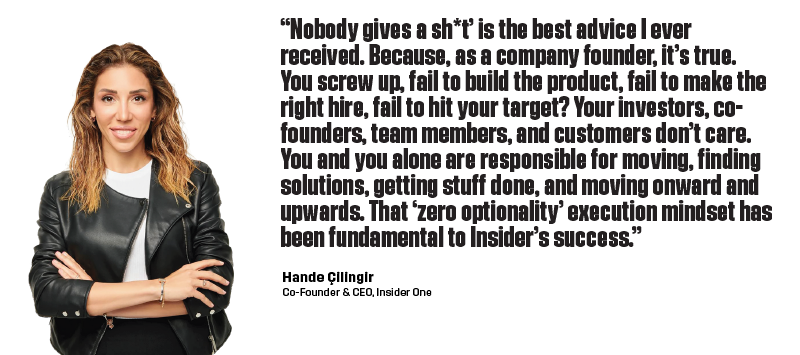
In gaming, the pattern is particularly pronounced — and particularly well-documented. Ms. Rina Onur Şirinoğlu co-founded Peak Games in 2010, one of the most capital-efficient exits in global gaming history: the company raised just $18 million in venture capital before being acquired by Zynga for $1.8 billion in 2020. After transitioning into venture capital as General Partner of 500 Istanbul for a brief stint — investing early in companies including Insider — she returned to operating and co-founded Spyke Games in 2020, now one of Turkey’s most watched gaming startups. Her story reinforces a key dynamic within Turkey’s ecosystem: success is not a one-time event. It compounds, and it recycles.
Then comes Ms. Kübra Gündoğan of Loom Games — and her story requires the right context to be understood properly. In 2019, Gündoğan and co-founder Emre Çelik founded Crescive Games, a bootstrapped Istanbul-based mobile puzzle studio that spent six years iterating with no external funding, building craft, user intuition, and operational discipline in the hyper-casual gaming market. In August 2025, the same two founders launched Loom Games. Within months, Scopely acquired a majority stake at a valuation exceeding $1 billion. What read as overnight success was the concentrated output of six years’ worth of discipline — compressed into a single, perfectly timed release. Gündoğan represents the next generation of this pattern, not a departure from it.
These are not symbolic roles. These are founders and operators responsible for building, scaling, and sustaining billion-dollar enterprises.
The Complete Picture: Where the Story Gets Sharper
Turkey’s eight unicorns tell two very different stories depending on who built them — and it is important to tell both honestly.
Dream Games — founded in 2019 by Soner Aydemir, Ikbal Namlı, Hakan Sağlam, Eren Şengül, and Serdar Yılmaz, all male, and all veterans of Peak Games — is the exception among male-founded Turkish unicorns. Its Royal Match puzzle game became one of the world’s top-grossing mobile titles, and the company is currently valued at $5 billion following a Series C in May 2025. Dream Games has executed with the same discipline and capital efficiency that characterizes the female-led cohort in this story. It stands as proof that the approach transcends gender when it is genuinely embedded in company culture.
But the other two male-founded unicorns tell a different story — and not one explained by macro conditions alone.
Getir, which peaked at a $12 billion valuation in 2022, sold its delivery operations to Uber in early 2026 for $335 million — a collapse in valuation of more than 97%. The model had expanded aggressively into the US and across Europe during pandemic-era funding euphoria, deploying capital into dark store networks with unit economics that were never sustainable at scale. When interest rates rose and the liquidity environment shifted, the structural weakness became fatal. It was not bad luck. It was overreach built into the architecture of the company from the start.
Papara’s collapse was more acute. The company achieved unicorn status in July 2023. By May 2025, its founder Ahmed Faruk Karslı had been arrested as part of a criminal investigation into illegal betting and money laundering. Turkey’s central bank revoked Papara’s operating license in October 2025 — effectively dismantling a $2 billion company in under two years. This was not a valuation correction, but a governance failure – if allegations are proven in court.
The contrast becomes difficult to ignore. Two of Turkey’s three male-founded unicorns were undone not by market forces but by decisions made at the top. The female-founded companies — built through currency crises, inflation, capital scarcity, and competitive pressure — continued to operate, scale, and sustain.
Not More Women, But More Selective Entry
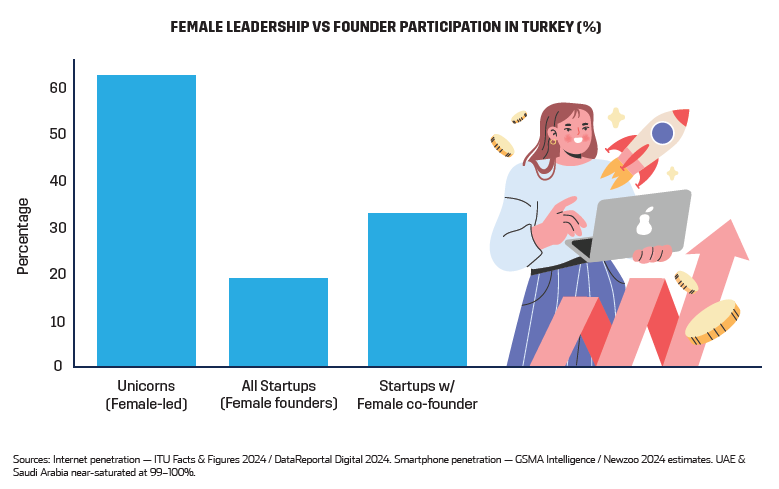
And here’s the thing. Turkey does not lead globally in female entrepreneurship participation. Women account for only 19% of startup founders in the country, and 32.2% of startups have at least one female co-founder. The base is still male-dominated.
But this constraint creates selection pressure.
The women who do enter the ecosystem tend to be disproportionately highly educated, globally exposed, operationally rigorous, and motivated by long-term value creation rather than short-term gain. This is not a broad funnel. It is a narrow, high-intensity pipeline.
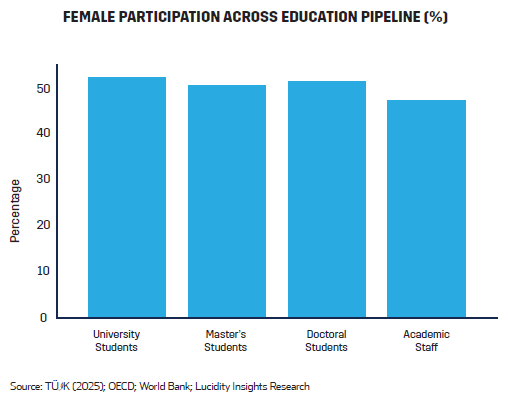
And the data supports this upstream. Women now represent 51.7% of university students in Turkey, 50.6% of master’s students, and 51.3% of doctoral candidates. Even among academic staff, women account for 47%, and female literacy stands at 95.3%. Higher education in Turkey has a strong correlation with entrepreneurial entry — particularly for women. The result is a quiet filter. Women entering the startup ecosystem are often among the most qualified operators in the market.
Constraint as a Catalyst
If education is the input, constraint is the catalyst.
Turkey’s macro environment has been defined by inflation, currency depreciation, and capital volatility. Access to capital is uneven. Networks are narrower. The path to scale is less forgiving.
But those constraints shape behavior. Female founders in Turkey tend to build differently. They scale more deliberately. They optimize capital efficiency earlier. They prioritize sustainable growth over aggressive expansion. They build through volatility, not around it. In a market defined by instability, those traits are not advantages. They are requirements.
The $18 million Peak Games raised before its $1.8 billion exit is perhaps the purest expression of this. Or the six years Gündoğan spent building Crescive with her co-founder before launching Loom. Or the fact that Çilingir built Insider into a global SaaS platform serving one-third of the Global Fortune 500 while headquartered first in Istanbul, then Singapore — not in the markets her clients came from, but from the outside looking in, on the strength of product and execution alone.
The Flywheel Effect
Success compounds, but in Turkey, it compounds visibly.
Demet Mutlu proved that a Turkish woman could build a decacorn — and co-found the country’s first gaming unicorn along the way.
Ms. Hanzade Doğan Boyner proved that longevity and institutional strength matter — and that a female-founded company could be the first from its country to list on Nasdaq.
Ms. Hande Çilingir proved that global SaaS could be built from Istanbul, with a leadership team that is 50% women, for the world’s largest companies.
Ms. Rina Onur Şirinoğlu proved that operators can recycle into builders and back again — and that exits create ecosystems, not just liquidity.
Ms. Kübra Gündoğan is now extending that trajectory into the next generation, carrying six years of quiet work into a record-setting gaming exit.
This creates a reinforcing loop. Visibility drives ambition. Ambition increases participation. Participation produces outcomes. Outcomes reset expectations. Even if the base remains smaller, the ceiling continues to rise.
Turkey’s female unicorn story is not about equality at scale. It is not even, ultimately, about gender. It is about what happens when a narrow pipeline — shaped by structural constraint, high educational attainment, and global exposure — selects for founders who build with discipline rather than velocity, with governance rather than growth-at-any-cost.
The Getir and Papara collapses are not footnotes to this story. They are the story. They are what Turkey’s ecosystem looks like when those traits are absent.
Dream Games is the story too — proof that the discipline is replicable, and that the female-led cohort does not have a monopoly on it. Only a demonstrably stronger track record of it.

In a system where fewer women enter: Turkey’s startup ecosystem shows us that those that do enter are notably sharper, more globally minded, and more resilient, producing an altogether different kind of founder. Not average. Not incremental. But exceptional. Outliers, again and again.
And increasingly, in Turkey, that founder is female.
Curious what’s next? Our The State of Unicorns: Turkey 2026 report reveals where Turkey’s unicorn landscape is really heading. Download now!


%2Fuploads%2Fturkey-unicorn-2026%2Ftur26-new-cover2.jpg&w=3840&q=75)