
Turkey Has Built 8 Unicorns Worth $31 Billion and counting. The World Is Only Just Starting to Pay Attention.
06 April 2026•
%2Fuploads%2Fturkey-unicorn-2026%2Farticles%2Flaunch-cover.jpg&w=3840&q=75)
Lucidity Insights, in partnership with Entrepreneur Magazine, published The State of Unicorns: Turkey 2026 Special Report — the most comprehensive analysis of Turkey's billion-dollar startup economy ever produced.
There was a time when building a billion-dollar startup almost guaranteed one thing: you had to be in Silicon Valley to do it. That assumption is now outdated. And few places make the case more forcefully than Turkey.
In a country of 85 million people, with a median age of just 33, a deeply mobile-first economy, and an engineering talent pool that has quietly been compounding for decades, Turkey has produced eight unicorn companies across gaming, e-commerce, fintech, and enterprise software — collectively valued at more than $31 billion, having raised approximately $8.3 billion in disclosed funding.
Lucidity Insight’s newest special report, The State of Unicorns: Turkey 2026, published in partnership with Entrepreneur Middle East, maps this story in full — the companies, the founders, the data, and the ecosystem dynamics that made it possible. Here are some of the findings that surprised even us.
The Global Context First: Unicorns Are No Longer Rare
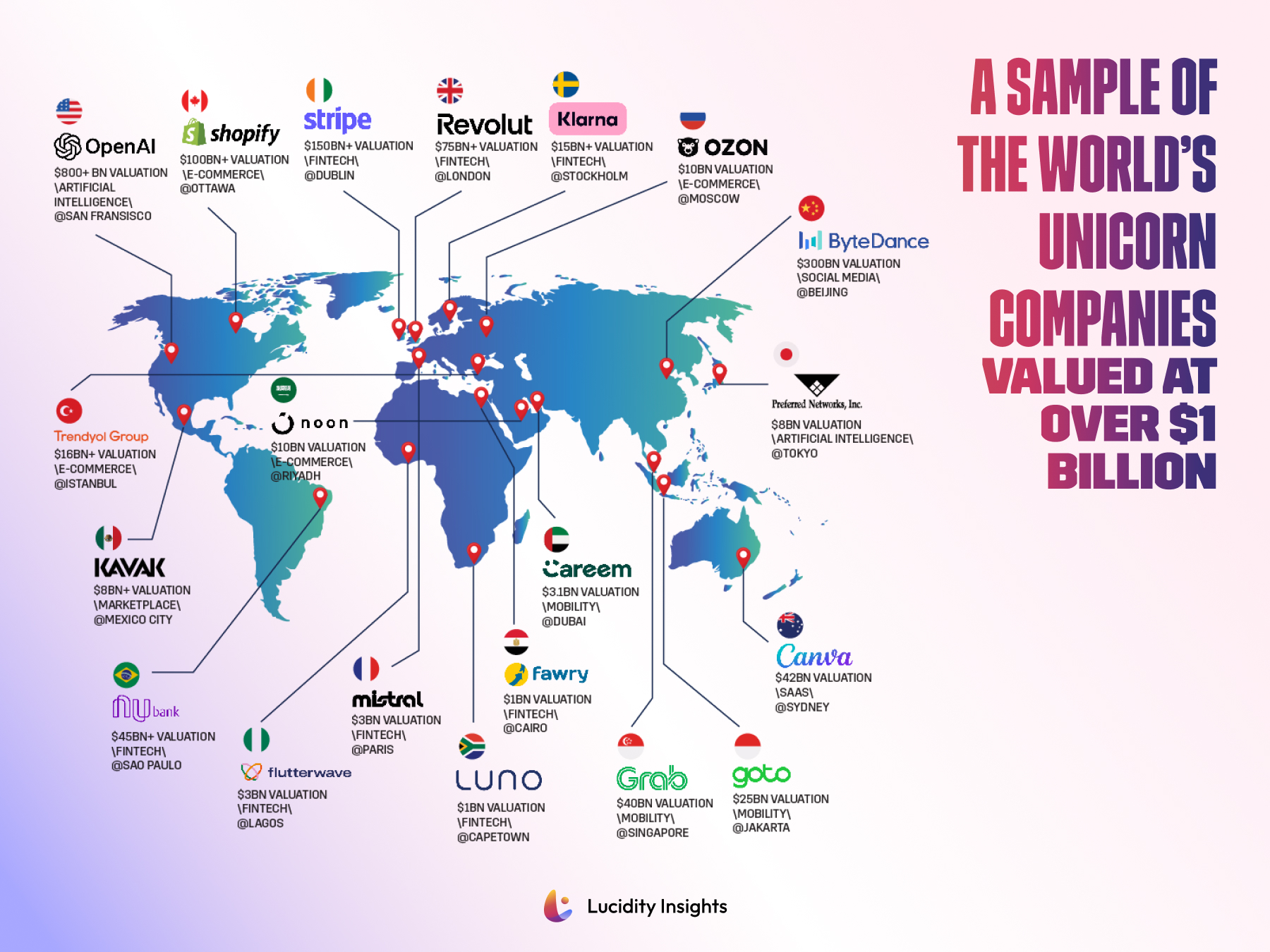
Before diving into Turkey, it's worth understanding the world it sits in.
According to data from WIPO and CBInsights, the global unicorn count stood at approximately 1,290 companies in 2025, collectively valued at over $5.2 trillion — a figure that rivals the GDP of major economies. When venture capitalist Aileen Lee coined the term "unicorn" in 2013, there were just 39 in existence, all in the United States. Today there are more than 1,330 globally, and the number is still climbing.
More striking than the count is the value concentration: unicorns are not just multiplying — they're getting dramatically bigger. The rise of decacorns (companies valued over $10 billion), particularly in AI and cloud infrastructure, has supercharged the aggregate value of the global unicorn herd even as new entrants have slowed.
Geographically, the US (52%), China (23%), and India (9%) dominate. But the next chapter of this story is increasingly being written in fast-growth emerging markets, across the Middle East, Africa, Central and South East Asia, Eastern Europe, and South America — and Turkey is one of its most compelling protagonists.
Why Turkey?
Turkey's unicorn story isn't luck. It's the product of a specific set of structural conditions that the report maps in detail.
Population and age. With 85 million people and nearly half the population under 30, Turkey has the kind of domestic demand density that allows startups to achieve product-market fit quickly before expanding internationally.
Digital infrastructure. Internet penetration exceeds 87%, and smartphone usage is approaching saturation — creating a mobile-first consumer base that digital products can reach cheaply and at scale.
Financial infrastructure. Perhaps Turkey's most underappreciated structural advantage: banking penetration sits at around 74%, and credit card usage is both widespread and deeply embedded in everyday life; this wasn’t the case a decade or two ago - but the rise has been dramatic. This fast pace of digital finance adoption reduces the friction that fintech startups face in other emerging markets, and helps consumer platforms monetize earlier.
Currency risk as a forcing function. The Turkish lira's volatility made building a lira-denominated business a slow route to irrelevance — so Turkish founders used it to their advantage. They priced in dollars, fundraised in dollars, and chased international users from day one, not as an aspiration but as a hedge against their own currency. Meanwhile, their cost base stayed lira-denominated: engineering salaries, office space, local operations — world-class talent at a fraction of the price in London or San Francisco. Dollar revenue, lira costs. It's a structural arbitrage no accelerator program can manufacture, and it goes a long way toward explaining why Peak Games, Dream Games, and Insider all scaled globally before most of their international competition had even considered it.
Engineering talent. High literacy rates, strong university enrollment in technical disciplines, government-backed R&D incentives, and a network of techno-parks have produced a deep bench of software and game development talent that global acquirers keep coming back to buy.
GDP and scale. With a GDP exceeding $1.3 trillion and GDP per capita of approximately $15,473, Turkey is a large, urbanized, and commercially sophisticated economy — not an emerging market in the traditional sense.
The Unicorns Themselves: Eight Companies, Eight Different Lessons
The special report dives deep into each of Turkey's eight unicorns individually, so read the full case-studies there. But here’s a teaser to wet your appetite on what makes the collective picture so interesting.
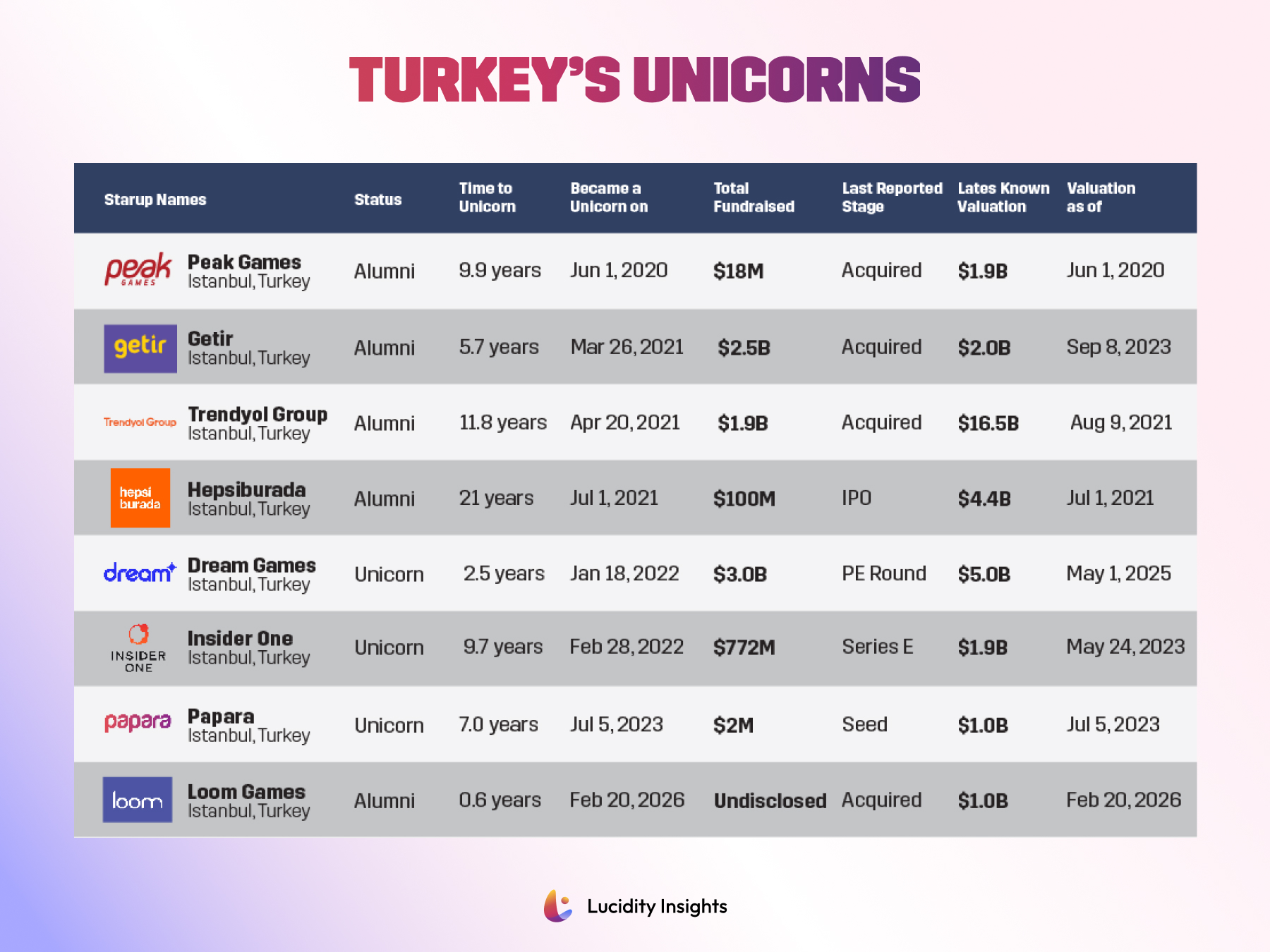
Trendyol Group is the fashion e-commerce decacorn. Founded in 2010 by Demet Mutlu — a Harvard dropout who bet on Turkish e-commerce before broadband penetration was even widespread — Trendyol was majority-acquired by Alibaba in 2018 and became Turkey's first decacorn in 2021 at a valuation of $16.5 billion. It remains one of the highest-valued private technology companies ever produced in the broader European and Middle Eastern region. International revenue now accounts for nearly 20% of its business, with Gulf market GMV already exceeding $1 billion, and an IPO is on the horizon before 2030.
Peak Games was Turkey's first unicorn — and one of the most capital-efficient gaming exits in history. Founded in 2010, Peak raised just $18 million in total before being acquired by Zynga for $1.8 billion in 2020. That's a return multiple that most VC-backed companies never come close to.
Dream Games is what Peak Games made possible. Founded by Peak alumni, Dream reached unicorn status in January 2022 and has grown to a latest known valuation of $3.8 billion following a private equity round led by CVC Capital Partners in 2025. Its flagship title Royal Match has become a global casual gaming phenomenon. The founder-to-founder lineage is exactly the kind of ecosystem flywheel — comparable to Silicon Valley's "PayPal Mafia" — that compounds over time.
Loom Games may be the most astonishing story in the entire report. Officially founded in 2025, Loom reached unicorn status in February 2026 after just 4-5 months of operations — the fastest in Turkey's history and one of the fastest anywhere in the world. Of course, that’s not the full story; as the founding team have been working together for 6 years prior to that bootstrapping their own gaming boot-camp to get to this point. Its’ casual game Pixel Flow attracted more than 10 million players and broke into the monthly top-20 grossing charts in the United States, prompting Saudi-owned Scopely to acquire a majority stake at a valuation exceeding $1 billion. Turkey now has three gaming unicorns. Industry observers expect it will not stop there — the country is home to more than 30 gaming studios valued above $100 million each.
Papara tells a different kind of story: it’s Turkey’s first fintech unicorn, built on pure capital discipline, followed by an unbelievable crash, as the founder(s) get arrested. In 2015, the fintech neobank raised just $2 million in seed funding before reaching profitability in 2016, and subsequently achieving a $1 billion valuation in July 2023 after seven years of scaling. In an era when many fintech startups burned hundreds of millions to acquire customers, Papara earned its unicorn status and was ‘profitable’ from year one. It is perhaps the clearest illustration of what disciplined Turkish startup building looks like. But then, came significant growth and a downfall, which resulted in an arrest of founders and executives in 2025, with allegations of money-laundering.
Getir provides another Cinderella story that takes a wild turn. Getir became a decacorn at a peak valuation of $11.8 billion in 2022 before suffering one of the most dramatic collapses in recent startup history. Its ultra-fast grocery delivery model scaled brilliantly during the pandemic, but couldn't survive the combination of rising interest rates, international overexpansion, and post-COVID demand normalization. Getir retrenched entirely to Turkey, and its delivery operations were subsequently acquired by Uber in February 2026, while the founders continue to fight what they termed an “illegal coup” resurrected by their own investors. The lessons are many — and the report explores it in full.
The fact that Turkey's ecosystem produced both a Trendyol and a Getir — capital discipline and long-term strategic innovation bets versus over-expansion, capital excess, and poor governance which led to quiet compounding and dramatic implosion — is precisely what distinguishes a real, mature startup ecosystem from a curated one.
A Regional Comparison
Turkey takes longer to build unicorns than its Gulf counterparts — an average of 8.5 years versus the GCC's median of 4.6 years. But five of Turkey's eight unicorns have already exited via acquisition or IPO — a real-world validation rate that many faster-moving ecosystems can't match.
One more number worth highlighting: the majority of Turkey's unicorns are led by women (5 of 8 unicorns) — a figure that stands out sharply against global benchmarks and suggests something structural in the ecosystem rather than coincidental. Turkey's most valuable unicorn and Turkey’s only unicorn to list on the NASDAQ were both female-led.
For more deeper insights, go and check-out the full report and analysis. As the report notes: "Turkey's experience suggests that long-term startup success may depend less on the speed of creating unicorns — and more on the strength of the ecosystem that sustains, corrects, and keeps producing them."
The State of Unicorns: Turkey 2026 is available now. The full report includes individual company profiles of all eight Turkish unicorns, deep-dive analyses of the gaming ecosystem, the Lucidity Insights Regional Unicorn Tracker data, and comparative benchmarking across the MEAIPT region.
Lucidity Insights is a data-driven intelligence platform covering the innovation economies of the Middle East, Africa, India, Pakistan, and Turkey. The State of Unicorns: Turkey 2026 was produced in partnership with Entrepreneur Magazine.

%2Fuploads%2Fturkey-unicorn-2026%2Ftur26-new-cover2.jpg&w=3840&q=75)