Six things you need to know about Anthropic's IPO filing
30 October 2026•

Anthropic filed its S-1 on 26 October 2026 for a Nasdaq listing under the ticker ANT. Beneath the headline numbers sit an unusual control structure, a misleading loss figure and one of the largest compute bills in corporate history. Here’s six things you need to know about Anthopic’s IPO filing.
1. Seven founders keep control with a single share
The co-founders will pool their power in a Founder LLC that holds one Class F share. It carries no economic rights, but it gives them 50.1% of the vote on general shareholder matters. Anthropic says this gives them "the ability to determine the outcome of all matters submitted to a vote of our stockholders generally for the foreseeable future."
Is it a first? Not quite. Founder control through super-voting shares is well established: Mark Zuckerberg alone holds about 60.8% of Meta's vote, and Google and The New York Times use similar dual-class structures. Anthropic seems to borrows ideas from all of them.
What is new is the form it takes. Control sits in one share with no economic value, shared by seven co-founders: Dario Amodei, Daniela Amodei, Tom Brown, Jack Clark, Jared Kaplan, Sam McCandlish and Chris Olah. Notably, Benjamin Mann, often described as a co-founder, is not part of the Founder LLC. Each co-founder has pledged to dedicate 80% of their personal equity to philanthropic causes, and a founder keeps a seat in the controlling vehicle while holding as little as 2% of their IPO-day stake.
A founder who dies or is incapacitated can be replaced by a successor, but only within the first ten years after the IPO, so control cannot be handed down indefinitely. Once fewer than three founders remain for 90 days, a 450-day wind-down begins, roughly 16 months in all, after which the Class F share is cancelled for nothing. At that point the founders' 50.1% disappears, but the trust, not public investors, keeps control of the board.
2. A Safety Trust picks the Board
The Long-Term Benefit Trust holds a single Class T share and elects four of the seven directors. One of those seats is currently vacant. The trust has five trustee seats, one of them also vacant. It is chaired by Dr. Neil "Buddy" Shah, CEO of the Clinton Health Access Initiative, and since June 2026 its trustees have included former Federal Reserve chair Ben Bernanke. The other three directors are elected by the founders' share and public Class A shareholders voting together, and with 50.1% of that vote, the founders decide those seats.
The result is a Nasdaq "controlled company" and a Delaware public benefit corporation. Anthropic says it will use the controlled-company exemption only for its nominating and governance committee. For public investors, that means little say. Buyers of Class A shares get an economic stake and one vote per share, but on most matters the founders' 50.1% decides the outcome, and the trust picks the board majority. Control sits with two holders that own one share each.
3. $16.3 billion in revenue, not $65 billion
Anthropic's revenue is real, and it is exploding. The company booked $16.3 billion in the first half of 2026, more than three times its $4.6 billion for all of 2025. The second quarter alone brought in $11.6 billion, up 1,368% year on year.
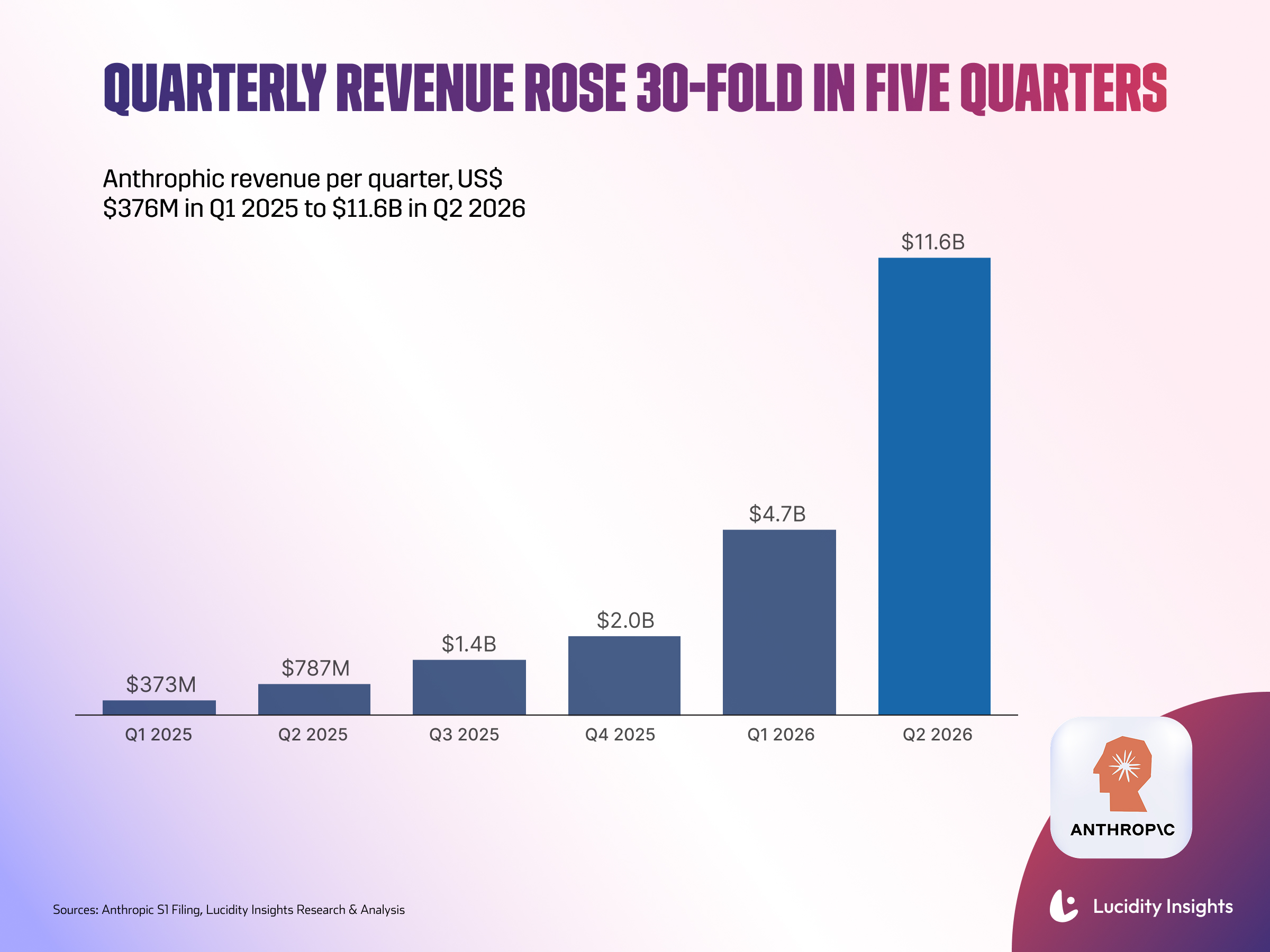
So where does the widely quoted $65 billion come from? It is a run rate, not revenue. Anthropic takes its last 28 days of usage fees and multiplies them by 13, then adds a month of subscriptions multiplied by 12. In other words, it is one month's sales stretched across a full year. The $65 billion figure, shared with investors in August, describes July's pace, not money the company has actually banked.
The gap between the two numbers is itself a measure of how fast Anthropic is growing: when sales climb this steeply, the latest month always looks far bigger than the months before it. The S-1 is careful here. It leaves its own latest run-rate figure, as of 31 October, blank, and warns that run rate "is not a substitute for revenue" and that its growth rate is expected to decline over time.
4. An $80.7 billion loss that is mostly on paper
The headline first-half net loss of $80.7 billion is one of the largest any company has ever reported. But $72.4 billion of it is a non-cash accounting charge: as Anthropic's valuation rose, so did the value of the convertible notes it had sold to investors.
Below that line, the picture is far healthier. The operating loss for the half was $693 million, and the second quarter brought an operating profit of $974 million, the first shown in the filing. Compute and infrastructure remained the biggest cost, at $8.9 billion for the half.
5. More than half a trillion dollars in compute commitments
Since the start of 2026, Anthropic has signed new and expanded compute and data-centre deals carrying about $417 billion in minimum payments, and expects to pay a further $125 to $150 billion for capacity delivered between 2028 and 2031. Together, that is roughly $542 to $567 billion. The largest deals are $161.2 billion in Broadcom equipment leases, up to $120.5 billion with SpaceX's AI unit, $114.5 billion with Google and $110 billion with Amazon.
Most of that is owed regardless of actual usage, while many top customers are not on long-term contracts and can cut spending at any time. No single customer accounts for more than 10% of revenue, but the top five made up about 25% over the first nine months of 2026, and 48% of first-half revenue came through cloud providers' marketplaces.
6. A target valuation of up to $2 trillion
The S-1 does not yet include a price range, but reports put Anthorpic’s target valuation at $1.5 to $2 trillion, raising $100 billion or more. At the top of that range, Anthropic would be worth roughly double the reported $965 billion post-money valuation of its $65.2 billion Series H in May 2026. The price range and share count will come in an updated filing.
Strip away the headlines and the S-1 describes a company growing at a pace few have ever matched, losing far less than its income statement suggests, and betting more than half a trillion dollars that the growth will continue. Public investors are being asked to back that bet at up to $2 trillion, while handing control to seven founders and a safety trust.