Money Flows: What AI Investments in 2026 Tell Us
25 October 2026•

At first glance, AI investment patterns in 2025–2026 appear counterintuitive . Enterprise deployment remains uneven. Productivity gains are still emerging. Monetization at scale is concentrated in a narrow band of use cases. Yet capital flows into artificial intelligence have not slowed. In key segments, they have intensified.
This is not a disconnect between hype and reality. It reflects a structural shift in how investors, governments, and institutions interpret where long-term AI value will reside. Funding is no longer about validating AI’s promise. It is about securing position within its foundations.
Funding Remains Elevated, But Concentrated
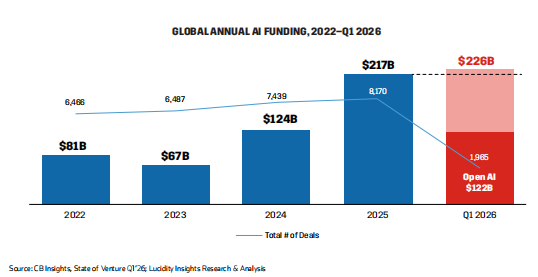
Global private AI funding reached US $217B in 2025. Q1 2026 alone added US $226B, more than the entire previous year. What has changed is how that capital is distributed. OpenAI’s single US $122B round took 54% of the quarter, and the ten largest deals took 82%. Even excluding OpenAI, the quarter reached roughly $104B, up about 45% on Q4 2025.
Late-stage funding now dominates, while early-stage capital faces significantly higher thresholds for proof and differentiation. Investors are increasingly reluctant to back undifferentiated AI applications or incremental productivity tools. Capital is reserved for companies that demonstrate scalereadiness, defensibility, and deep integration into core enterprise or institutional workflows. The deal count shows it: it barely moved, at 8,170 in 2025 and 1,965 in Q1 2026 (down 5% on Q4), while the average deal in Q1 2026 was roughly four times the 2025 average. Scale matters more than novelty.
Unicorns Reveal where Confidence Lies
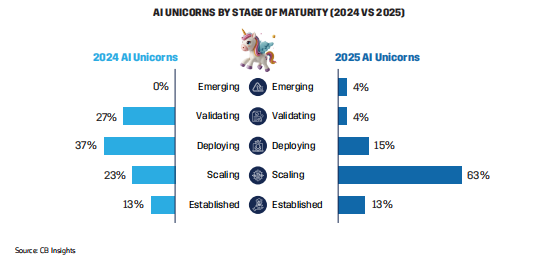
The changing profile of AI unicorns offers one of the clearest signals of this shift. In 2024, AI unicorns were spread across multiple stages of maturity, with a meaningful share still validating or deploying their solutions. By 2025, the picture has changed sharply. A dominant proportion of AI unicorns are now in the scaling phase which means that these companies have moved beyond experimentation and initial deployment into expansion, across customers, geographies, or infrastructure. The rapid increase in scaling-stage unicorns reflects growing investor confidence in execution and endurance rather than technological novelty alone. Early-stage and validating-stage unicorns now represent only a small fraction of the total, underscoring a decisive shift toward proven operating models.
Capital is Flowing up the Stack
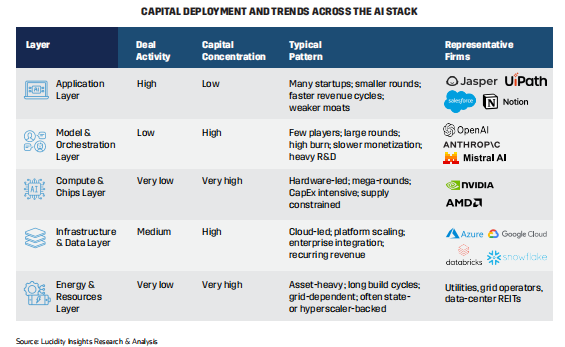
If we imagine the AI stack, it spans several distinct layers: applications, models, data and enablement, infrastructure and compute, and energy. Capital flows in 2025 point to a clear structural realignment across these layers. A disproportionate share of investment is now directed toward large-scale model development, compute infrastructure, data centers, specialized hardware, and the energy systems that support them.
These upper layers share common characteristics: they are highly capital-intensive, slow to monetize, and difficult to replicate. Yet they increasingly define who can build, deploy, and scale AI systems in practice. As awareness grows around compute intensity, energy constraints, and infrastructure bottlenecks, investors have moved upstream, toward the inputs that govern innovation velocity rather than the applications that sit closest to end users.
The implication is straightforward. Ownership, access, or control over infrastructure is becoming a primary determinant of who participates meaningfully in the AI economy. This shift has broadened the investor base beyond traditional venture capital, drawing in governments, sovereign entities, hyperscalers, and large corporates with the balance sheets and time horizons required to operate at this layer.
Where the Middle East Fits
Within this global pattern, the Middle East plays a distinct role. Capital from the region follows the global shift toward the upper layers of the AI stack, with a clear focus on infrastructure, scale, and long-term control rather than a broad spread of early-stage applications. This reflects how AI is positioned in regional economic plans. In leading Gulf economies, AI is expected to contribute more than 10% of GDP by 2030, an outcome that depends on national-scale platforms, shared compute, and durable infrastructure rather than fragmented innovation.
Unlike ecosystems where funding is spread across large numbers of startups, AI investment in the Middle East has focused on foundational assets such as compute capacity, data centers, and long-term platform partnerships. This pattern is visible at the country level. Saudi Arabia and the UAE have prioritized national AI platforms, sovereign-backed compute, and deep partnerships with global technology providers, while Qatar and Abu Dhabi have focused on cloud regions, data centers, and governmentled AI use in sectors such as energy, healthcare, and public services.
In this context, the region acts as a capital amplifier. Innovation in AI may originate globally, but capacity, access, and control are increasingly shaped locally. By funding the infrastructure and operating environments that AI systems depend on, Middle Eastern capital amplifies the reach and scale of AI developed elsewhere. As organizations move from pilots to enterprise-wide deployment, demand is shifting toward reliable capacity, energy, and governance (areas where the region has chosen to concentrate its resources).
By 2025, AI investment no longer resembles a typical technology adoption cycle. The rise of scalingstage unicorns, the persistence of high funding volumes, and the prioritization of infrastructure all point to the same conclusion: AI is being financed as an economic foundation, not a short-cycle product market. Money flows are not simply expressions of optimism; they encode beliefs about where power in the AI economy will reside, and who intends to secure it.