
The Global State of Gaming & eSports in 10 Graphs
03 October 2025•
%2Fuploads%2Fgaming-review-2025%2Farticles%2F10graphs-cover.jpg&w=3840&q=75)
1. Top 10 Arcade Games of All Time
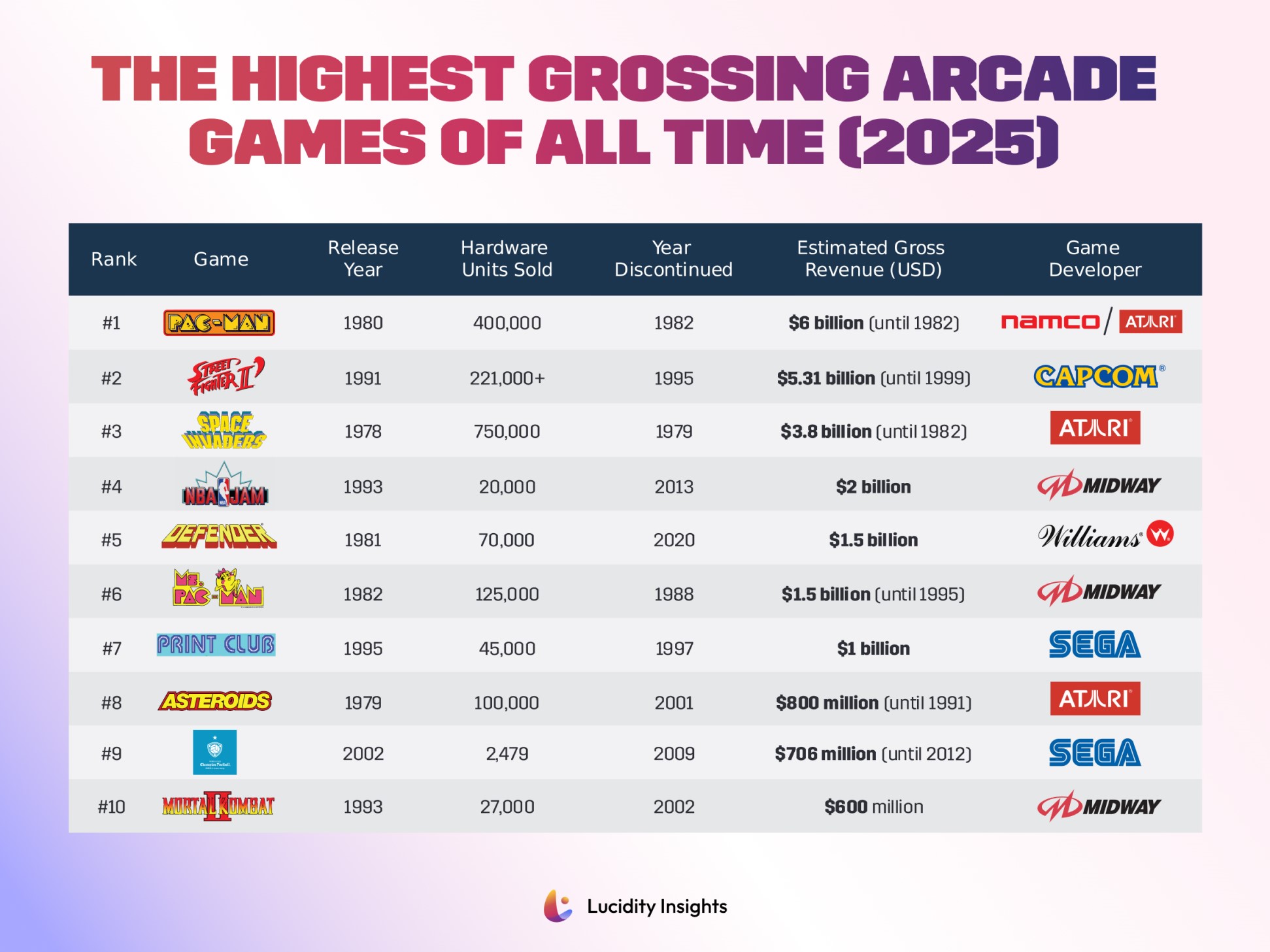
The rise of arcade gaming between the late 1970s and early 1990s laid the cornerstone for today’s US $180 billion global gaming industry. Long before the era of eSports arenas and cloud gaming, arcades were where innovation met community — turning local cafés, bowling alleys, and shopping malls into digital battlegrounds and social hubs. Titles like Pac-Man (1980), which generated an estimated US $6 billion by 1982, and Space Invaders (1978), selling more than 750,000 arcade cabinets, didn’t just rack up quarters — they became cultural icons. These games helped cement gaming as a mainstream form of entertainment, sparking the imaginations of millions and influencing the design of future games across platforms.
By the early ‘90s, arcades had evolved into competitive spaces that prefigured modern eSports arenas. Games like Street Fighter II (1991) pushed the concept of one-on-one player battles into the spotlight, grossing over US $5.3 billion by 1999 and fueling the rise of competitive fighting game communities still active today.
Beyond the leaderboard bragging rights, these arcade titles shaped entire generations of game developers, artists, and engineers — many of whom went on to build the blockbuster franchises and game engines that power the industry today. From NBA Jam’s over-the-top dunks to the combo-driven violence of Mortal Kombat II, these games weren’t just technical feats — they were shared experiences that defined an era.
The financial success of these top 10 titles underscores just how massive arcade gaming was at its peak. It also serves as a reminder that before global gaming became digital, downloadable, and mobile — it was tangible, social, and stood proudly in cabinets across the world.
2. Top 10 Gaming Consoles of All Time
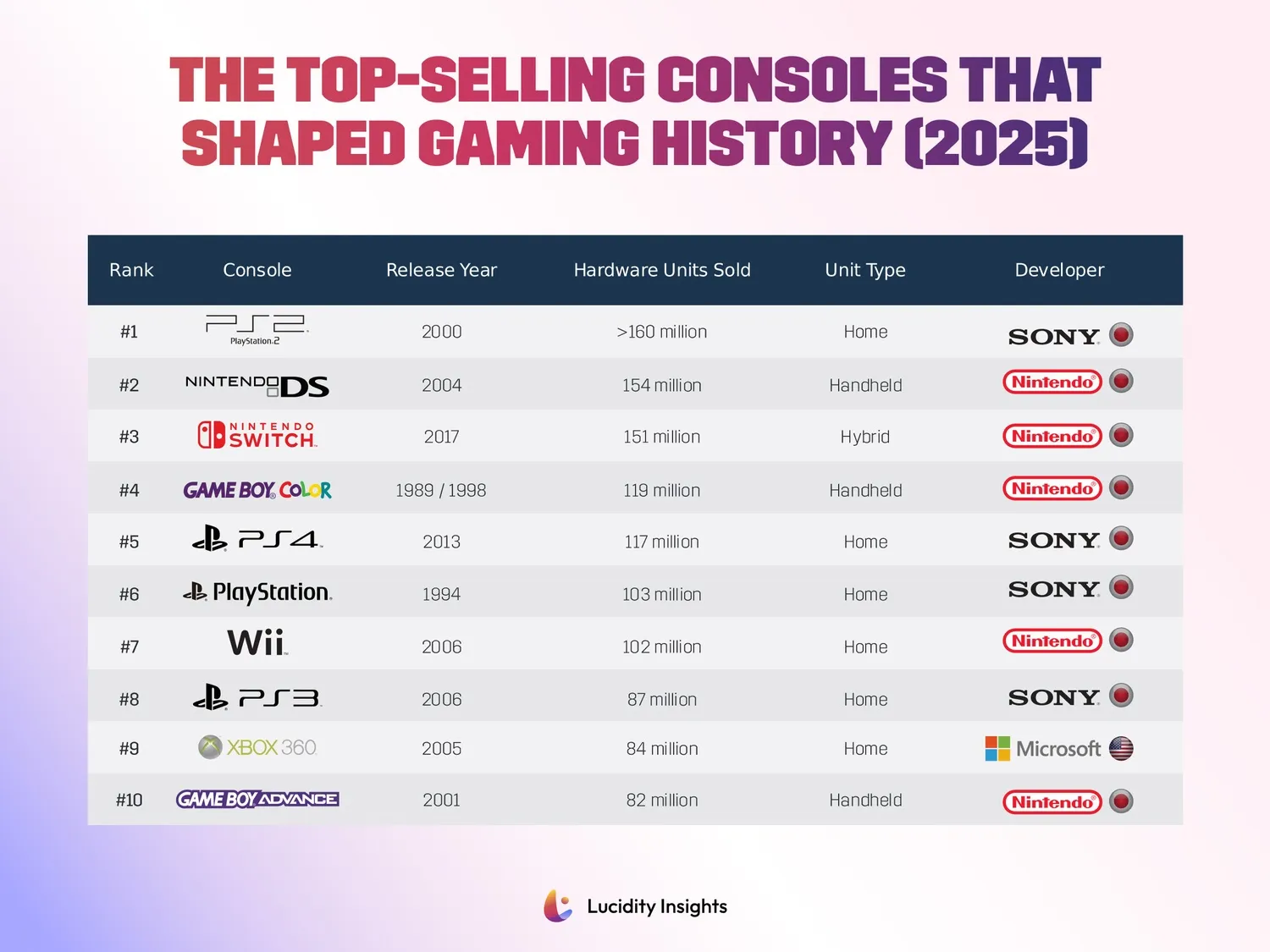
The world’s best-selling gaming consoles aren’t just devices — they’re masterclasses in platform strategy, product innovation, and ecosystem design.
Sitting at the top of the leaderboard is Sony’s PlayStation 2, with over 160 million units sold. Its success wasn’t just about processing power; it was about strategy. Sony paired backward compatibility with a massive developer ecosystem and positioned the PS2 asan entertainment hub with integrated
DVD playback — expanding its appeal far beyond core gamers. Nintendo’s dominance is equally hard to ignore. With five consoles in the top ten and a combined 608 million units sold, Nintendo’s success has never been about hardware specs alone. Instead, it perfected the art of vertical integration — building beloved franchises like Pokémon, Super Mario, and The Legend of Zelda directly into its console DNA. Games weren’t just content; they were the reason people bought the hardware and kept coming back for more.
The Nintendo Switch, currently the third best-selling console, showcases this approach beautifully. By blending handheld flexibility with home console performance, the Switch didn’t just sell units — it expanded the total addressable market and redefined when and where people could play.
Meanwhile, the Xbox 360 and PlayStation 3 introduced a generational shift toward persistent online ecosystems. These consoles helped mainstream digital storefronts, multiplayer networks, and downloadable content — laying the groundwork for today’s live-service models, battle passes, and subscription platforms like Xbox Game Pass and PlayStation Plus.
More than just hardware sales, these top 10 consoles tell a bigger story: the platforms that win are the ones that build sticky ecosystems, cultivate fan loyalty, and adapt with the times. They didn’t just sell millions of devices — they shaped how gaming culture evolved, paving the way for the US $250 billion+ global gaming industry we know today.
3. Top 10 Computer Games of All Time
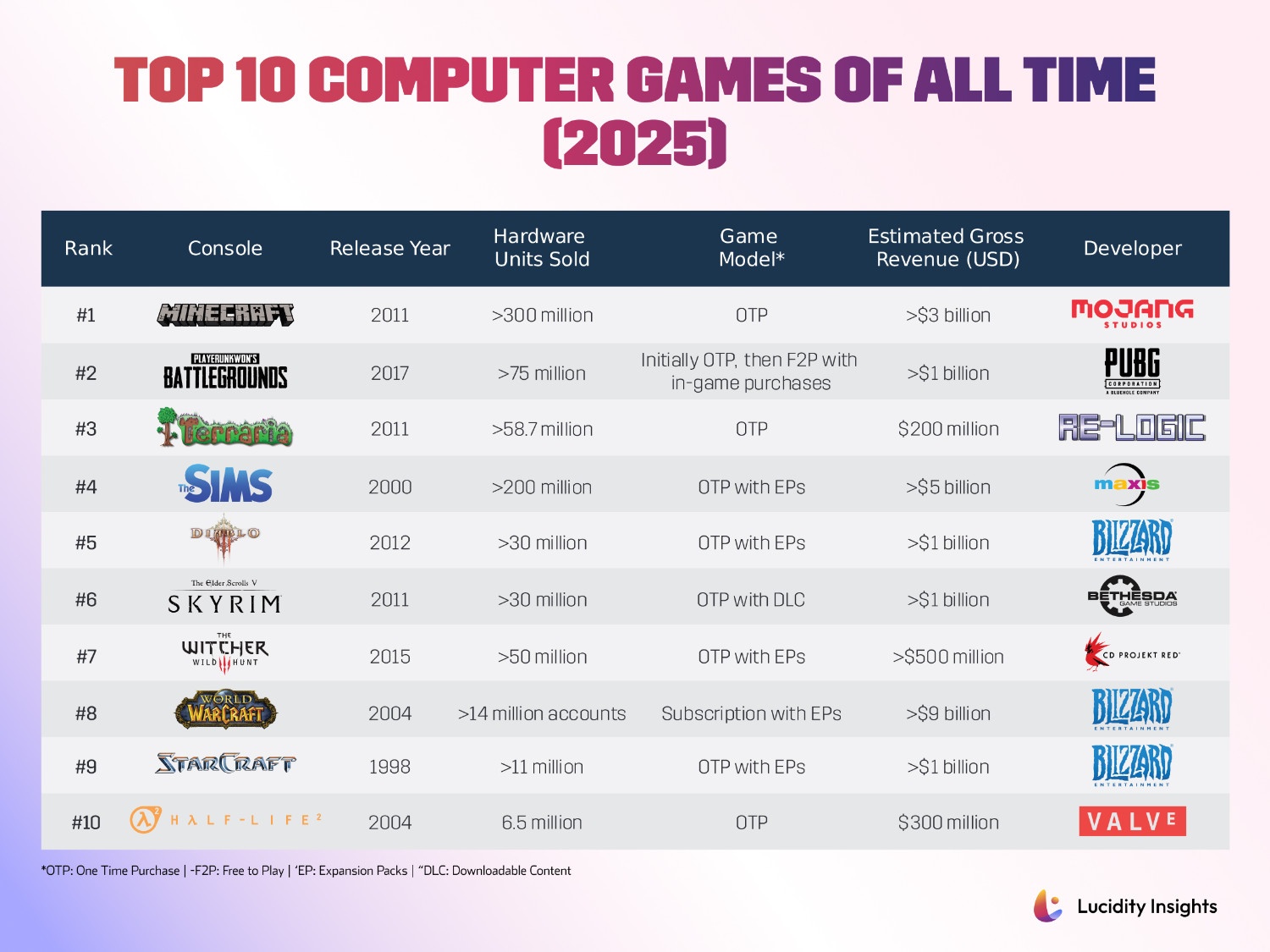
The best-selling computer games of all time aren’t just commercial hits — they are blueprints for how game design, monetization models, and long-tail engagement have shaped the PC gaming world for over two decades.
Leading the charge is Minecraft (2011), with more than 300 million copies sold and an estimated US $3 billion in revenue. Its sandbox, open-world approach and emphasis on usergenerated content didn’t just make it a game — it became a global creative platform, embraced across demographics and even integrated into school curricula.
The Sims (2000), with over 200 million copies sold and more than US $5 billion in revenue, turned the concept of expansion packs into a powerful growth engine. Maxis and EA created a simulation-lifestyle hybrid where constant content refreshes kept players engaged for decades.
Meanwhile, World of Warcraft (2004) flipped the monetization script entirely. With just over 14 million accounts, WoW generated an industry-leading US $9 billion through its subscription model — proving that engagement, not just player count, is the ultimate revenue driver.
Games like PUBG: Battlegrounds (2017) illustrate the power of hybrid monetization strategies. Initially a onetime purchase, PUBG shifted to a free-to-play model with in-game purchases, demonstrating how flexible pricing can unlock both upfront sales and long-term retention in multiplayer ecosystems.
Titles like The Witcher 3: Wild Hunt, Skyrim, and Diablo III reflect the enduring success of story-rich, single-player games supplemented by DLCs and expansion packs, while StarCraft and Half-Life 2 stand as genre-defining classics that shaped competitive strategy and narrative design, respectively.
This list doesn’t just showcase best-sellers — it reveals how the right mix of gameplay innovation, monetization strategy, and community building can drive lasting success. Whether through subscriptions, one-time purchases, or microtransactions, these games helped write the playbook for how to win in the PC gaming arena.
4. Top 10 eSports Players of All Time
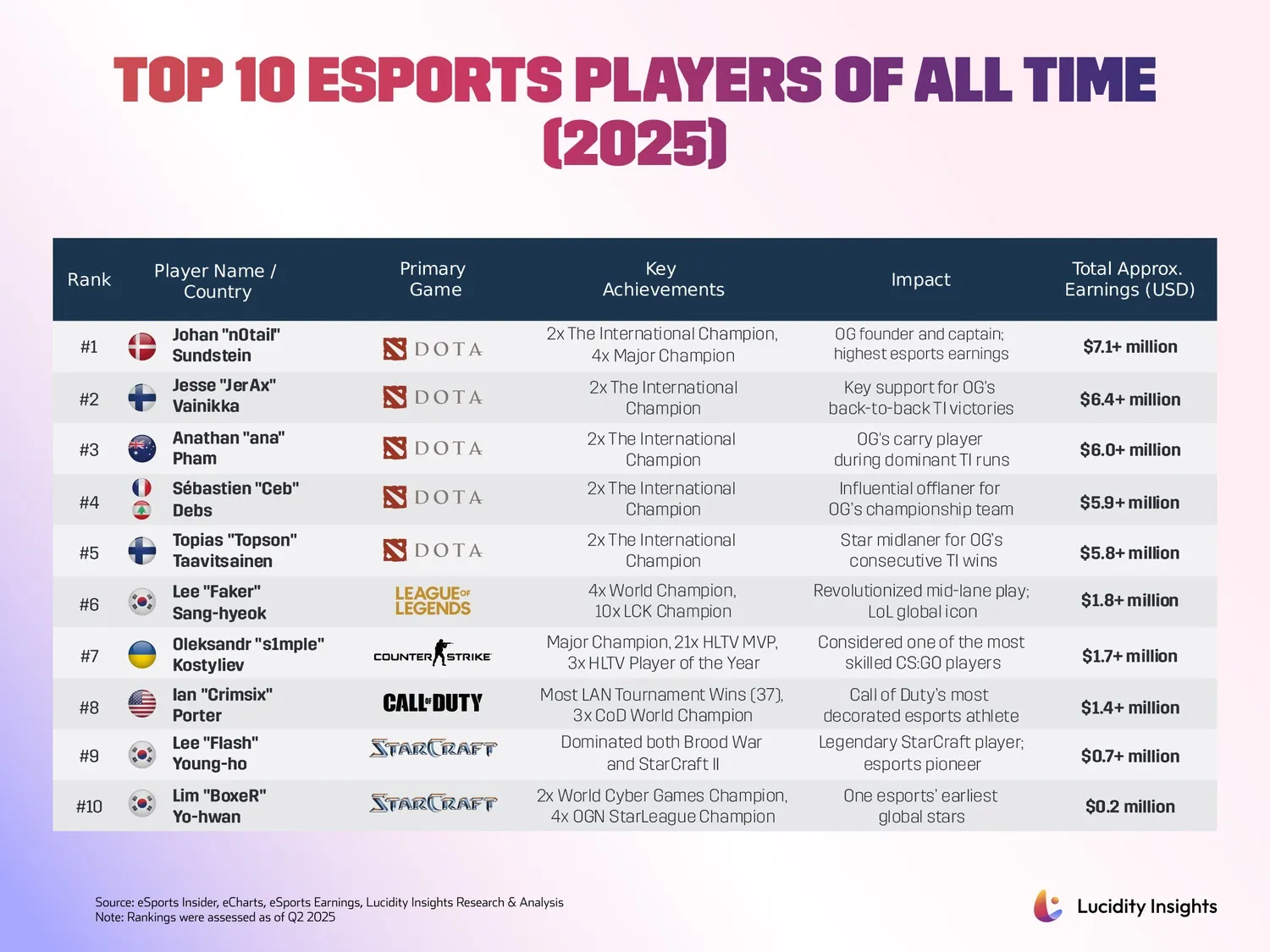
Ranking Criteria Summary
This ranking considered a mix of individual skill and career impact, including: Major championship wins, sustained excellence and tournament success, prize money earned, individual awards, influence on game/meta, leadership and team success. Comparing players across different games is challenging due to unique structures and histories. This ranking aims to balance quantitative achievements with qualitative influence to reflect an all-time eSports ranking.
eSports has birthed icons whose dominance transcends the digital arena, turning gameplay into global influence and multimillion-dollar careers.
At the pinnacle is Johan “n0tail” Sundstein, the Danish Dota 2 maestro. With over US $7.1 million in tournament winnings, he’s the highest-earning eSports player to date. Beyond the prize pools, his leadership in OG’s back-to-back The International victories and savvy brand partnerships have solidified his legacy.
OG’s dynasty was a collective effort. Teammates Jesse “JerAx” Vainikka, Anathan “ana” Pham, Sébastien “Ceb” Debs, and Topias “Topson” Taavitsainen each contributed to OG’s unparalleled success, amassing millions in earnings and redefining team synergy in competitive gaming.
In the League of Legends realm, Lee “Faker” Sang-hyeok stands unparalleled. With four World Championships and ten LCK titles, his in-game prowess is legendary. Financially, Faker’s impact is profound; his estimated net worth ranges between US $30–50 million, bolstered by a substantial salary, endorsements, and even real estate ventures like the “Faker Tower” in Seoul.
Oleksandr “s1mple” Kostyliev is Counter-Strike’s prodigy. His tournament earnings exceed US $1.7 million, but his total net worth is estimated between US $6-8 million, thanks to lucrative sponsorships with brands like Logitech G and Monster Energy, streaming revenue, and a significant salary from Natus Vincere.
Ian “Crimsix” Porter dominates the Call of Duty scene with 37 LAN tournament wins and three World Championships, earning over US $1.4 million in prize money. His consistency and longevity make him a cornerstone of CoD eSports.
Pioneers Lee “Flash” Young-ho and Lim “BoxeR” Yo-hwan laid the foundation in StarCraft, turning South Korea into an eSports powerhouse. Their strategic brilliance and early dominance paved the way for the global eSports phenomenon we witness today.’
It’s essential to note that these figures in the table primarily reflect tournament winnings. The actual financial success of these players often extends far beyond, encompassing sponsorships, streaming, merchandise, and more, underscoring the immense commercial potential within eSports.
As the industry continues to evolve, these ten players remain benchmarks of excellence, inspiring future generations to push the boundaries of competitive gaming.
5. Top 10 eSports Competitions of All Time
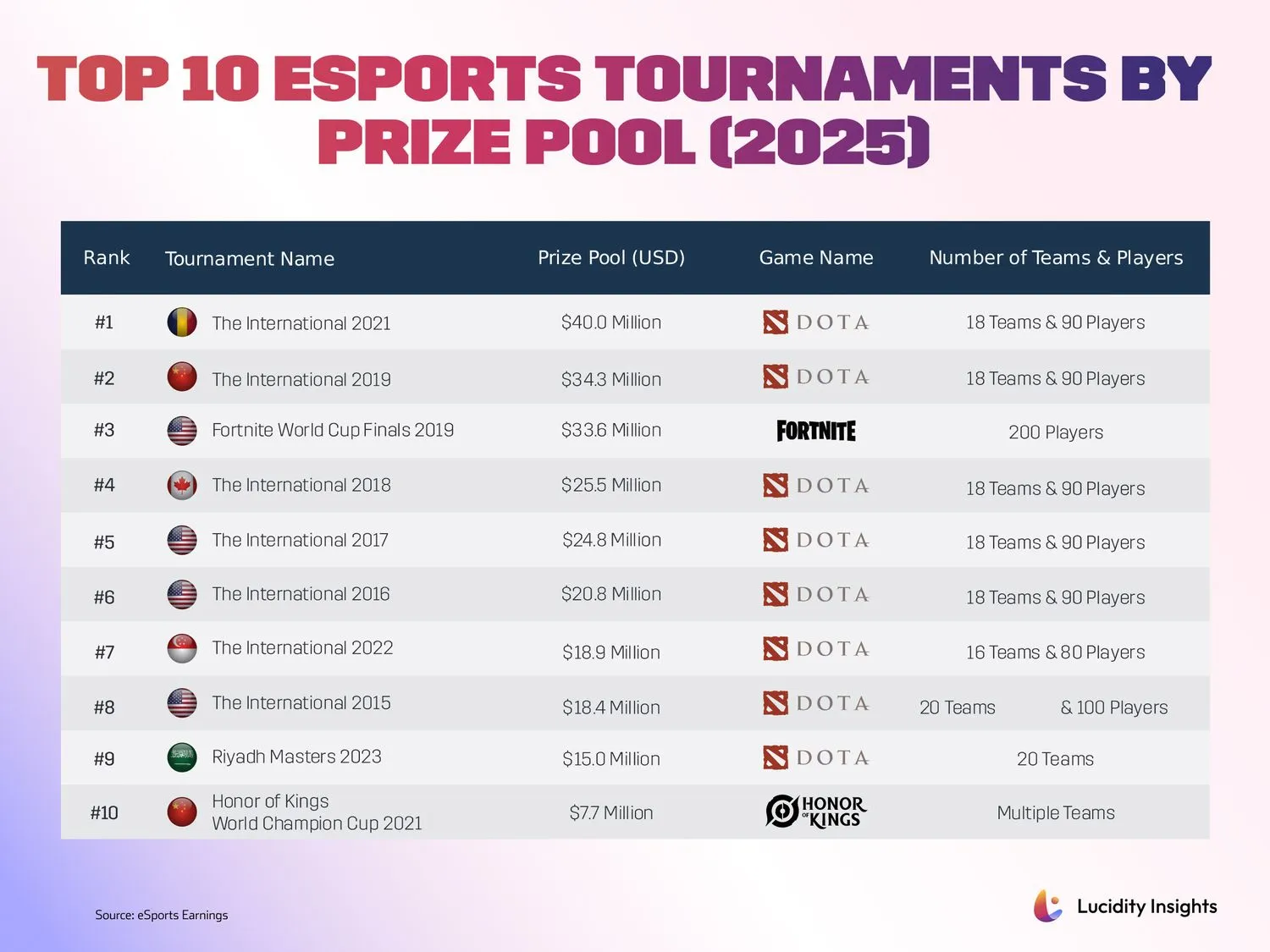
The eSports industry has officially outgrown its “niche subculture” label. Today, it’s a high-stakes, professionalized global arena — worth US $2.53 billion in 2025 and projected to more than double to US $6.32 billion by 2030, growing at a CAGR of 20.05% according to Mordor Intelligence.
Leading this charge are the biggest prize pools in eSports history, turning tournaments into multi-million-dollar showcases of digital competition. At the top sits The International (TI) — Valve’s flagship Dota 2 tournament — which claims seven of the top ten slots. TI 2021 alone reached a staggering US $40 million prize pool, funded largely through its Battle Pass system that lets fans directly contribute via in-game purchases. This model didn’t just boost the pot — it turned the community into active stakeholders and amplified fan engagement across the globe.
The Fortnite World Cup Finals 2019 also made history, offering US $33.6 million across its solo and duo formats. Unlike Dota 2’s community-funded approach, Epic Games injected this prize money directly, using competitive play as a bold marketing engine to fuel Fortnite’s cultural dominance and player acquisition.
Another rising force on the eSports stage is Saudi Arabia. The Riyadh Masters 2023, part of the Kingdom’s broader gaming ambitions, entered the charts with a US $15 million prize pool — the largest Dota 2 tournament outside of The International. Backed by sovereign wealth and tied to the Gamers8 festival, this event signals the increasing role of government-supported eSports infrastructure, especially across emerging markets.
Looking ahead, Saudi Arabia is set to up the ante even further with the ESports World Cup 2025, scheduled from July 7 to August 24 in Riyadh. With a confirmed US $70 million prize pool — the biggest ever announced — the event aims to reshape the global eSports landscape and solidify the region’s ambition to become a dominant gaming hub.
Whether community-backed, publisher-funded, or state-sponsored, these tournaments show that eSports is no longer just play — it’s business, brand-building, and a cultural force to be reckoned with.
6. Global Gaming Industry Market Forecast
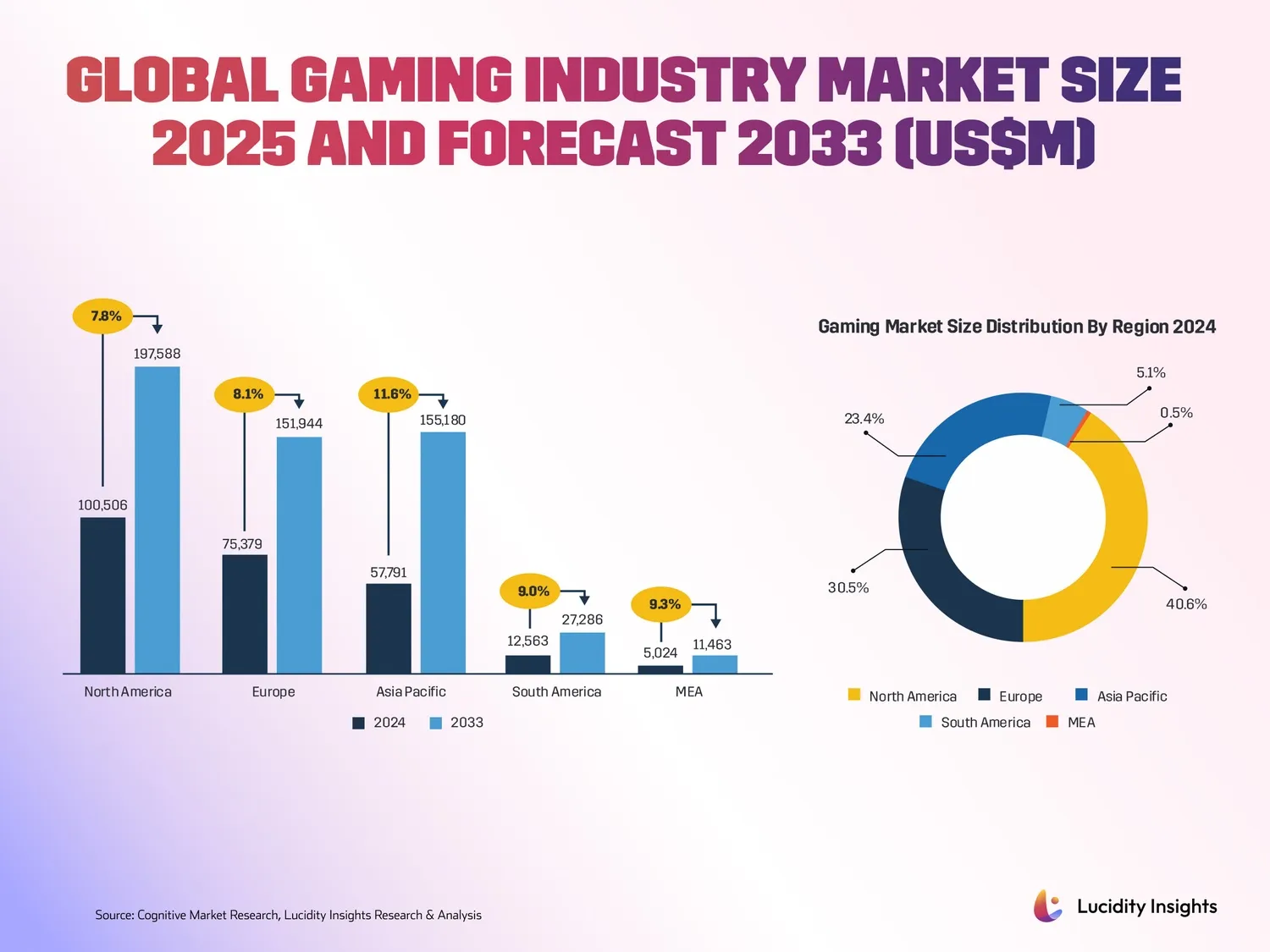
The global gaming industry is on track to more than double in size — from US $247.4 billion in 2024 to US $564.5 billion by 2033, growing at a healthy CAGR of 9.6%. But while the market surges overall, a closer look at regional dynamics reveals a more nuanced story: the global power balance is quietly shifting.
North America, long the epicenter of console and AAA gaming, will maintain its lead, growing from US $100.5 billion in 2024 to nearly US $197.6 billion by 2033. Yet its global share will shrink from 41% to 35% as emerging regions accelerate. With its platform maturity, high ARPU, and entrenched eSports infrastructure, North America remains dominant — but faces increasing competition from faster-growing markets.
Europe, the second-largest region at 30.5% of global revenue, will expand steadily to US $151.9 billion by 2033, fueled by mobile adoption, a thriving indie game scene, and AR/VR innovation. Still, like North America, Europe’s share of the global pie will contract as Asia Pacific, Latin America, and the Middle East & Africa (MEA) rise.
The real growth engine is Asia Pacific (APAC) — set to scale from US $57.8 billion to US $155.2 billion by 2033 at a market-leading 11.6% CAGR. Mobile-first development strategies, rapid smartphone adoption, and booming eSports ecosystems in China, India, and Southeast Asia are driving this surge, positioning APAC as gaming’s fastest-growing frontier.
While South America and MEA remain smaller markets today, they’re punching above their weight in growth. With CAGRs of 9.0% and 9.3% respectively, these regions are fueled by young, mobile-savvy populations, improving digital infrastructure, and rising demand for affordable entertainment options.
This data makes one thing clear: the next decade of gaming won’t just be about bigger revenues — it will be about a changing global map. The growth stories unfolding outside traditional power centers will shape the future of games, eSports, and interactive entertainment.
7. Distribution of Gamers around the World
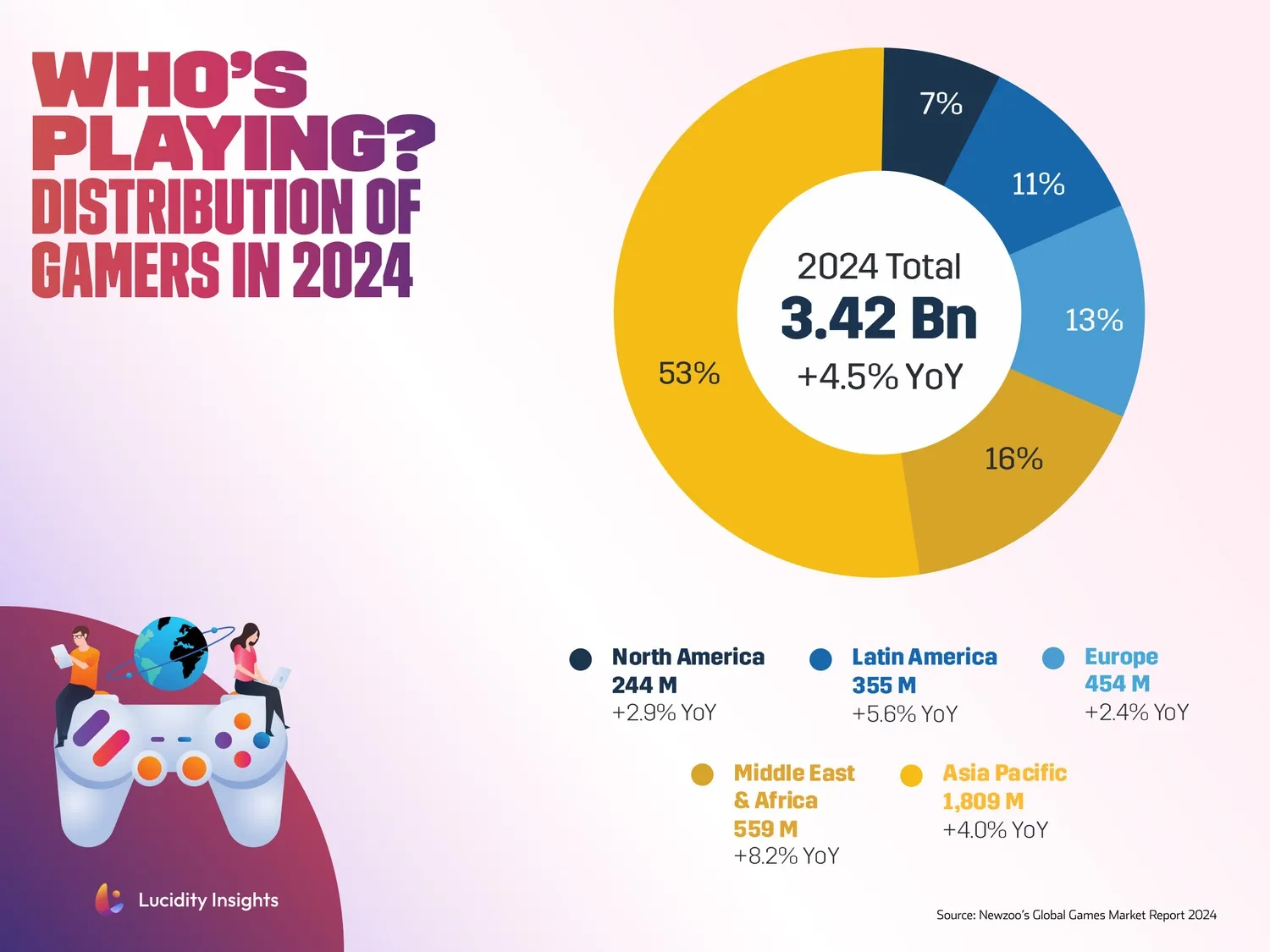
In 2024, the global gaming community hit a staggering 3.42 billion players — growing 4.5% year-over-year — solidifying gaming as one of the most ubiquitous entertainment activities on the planet.
No region commands the gaming landscape quite like Asia Pacific (APAC), which accounts for 53% of all global gamers, or 1.81 billion people. This dominance is powered by mobile-first access, affordable smartphones, and rising connectivity across China, India, and Southeast Asia. Even with only +4.0% YoY growth, APAC remains the undisputed volume engine of the gaming world.
The breakout growth story, however, is the Middle East & Africa (MEA), now home to 559 million gamers, representing 16% of the global player base. With +8.2% year-over-year growth, MEA stands as the fastest-growing region globally — fueled by youthful demographics, mobile-first consumption, and rapidly improving digital infrastructure. As publishers seek the next frontier, MEA is fast becoming a strategic priority.
Europe, with 454 million gamers (13% share), shows the profile of a mature, saturated market. Growth is slower at +2.4% YoY, but innovation through AR/VR adoption and cross-platform experiences continues to keep audiences engaged.
Meanwhile, Latin America hosts 335 million gamers (11% share) and posted an impressive +5.6% YoY growth, driven largely by mobile games and multiplayer titles that work well on low-cost devices. Brazil and Mexico lead the region, both in player numbers and engagement levels.
Interestingly, North America — often seen as gaming’s revenue leader — makes up just 7% of global gamers, or 244 million players, growing a modest +2.9% YoY. While it may not win on volume, North America continues to boast the world’s highest ARPU (average revenue per user), with a content-heavy, console-first player culture.
This snapshot of gamer distribution tells a broader story: the future of gaming isn’t just about more players — it’s about where those players are coming from. As infrastructure improves and mobile access expands, emerging markets like MEA and Latin America are poised to reshape the global gaming map.
8. Middle East & Africa Gaming 2024 Market Size and 2033 Forecast by Region
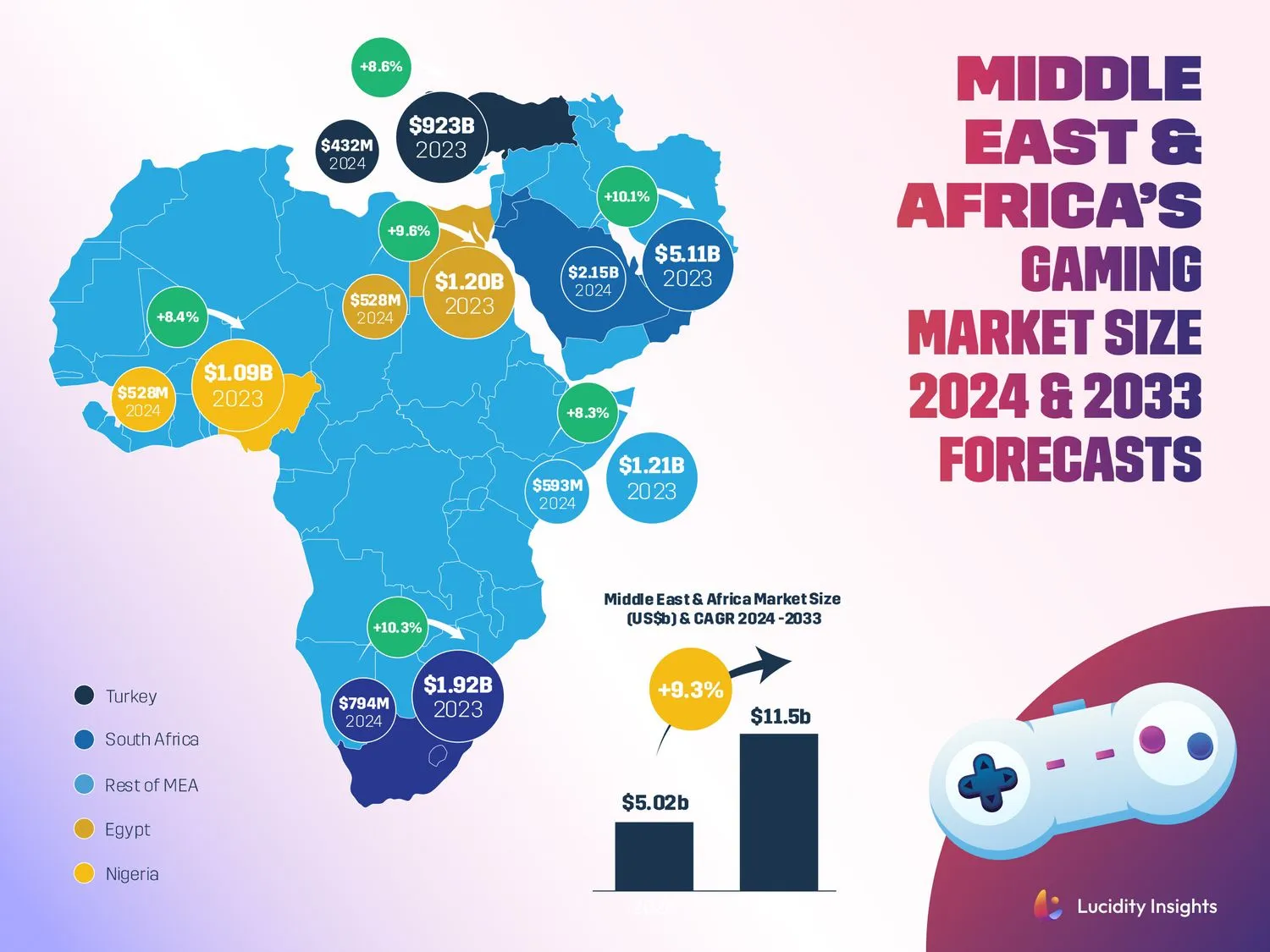
The Middle East & Africa (MEA) gaming market is projected to more than double over the next decade — from US $5.0 billion in 2024 to US $11.5 billion by 2033, expanding at a robust 9.3% CAGR. But this isn’t just about scale — it’s about a regional power shuffle fueled by mobile-first strategies, infrastructure upgrades, and rising eSports ambitions.
At the top of the leaderboard are the GCC nations, with US $2.15 billion in gaming revenue in 2024. Backed by state-sponsored eSports investments like Dubai’s X-Stadium and Saudi Arabia’s Qiddiya Gaming City, the Gulf is positioning itself as the premium destination for immersive gaming experiences. With smartphone penetration expected to hit 91% across the GCC by 2025, this region continues to set the pace for high ARPU and digital engagement.
South Africa is emerging as the fastest-growing market by volume, expanding at a 10.3% CAGR to reach US $1.92 billion by 2033. Powered by 5G rollout, a tech-savvy urban youth, and growing eSports activity, South Africa is quietly shaping up to be a gaming hub to watch.
In North Africa, Egypt presents steady growth, with its youth-heavy demographics and rising demand for localized gaming content. The market is forecasted to grow from US $528 million in 2024 to US $1.20 billion by 2033, expanding at a healthy clip of 9.6% CAGR. Meanwhile, Nigeria, Africa’s most populous nation, represents significant potential but remains tempered by infrastructure and affordability challenges. Its market is expected to grow from US $528 million to US $1.09 billion by 2033, at an 8.4% CAGR, largely driven by mobile gaming and improving digital payment adoption.
The Rest of MEA, including key emerging markets like Kenya and Morocco, is forecasted to reach US $1.22 billion by 2033. Investment in broadband, mobile connectivity, and the rise of grassroots eSports leagues are setting the stage for longer-term growth across the region.
As the global gaming map continues to evolve, MEA stands out not just for its double-digit growth but for its untapped potential to rewrite the rules of the game — powered by mobile, backed by investment, and driven by one of the youngest populations in the world.
9. The MEA Gaming & ESports Funding Leaders: Where the Money is Flowing
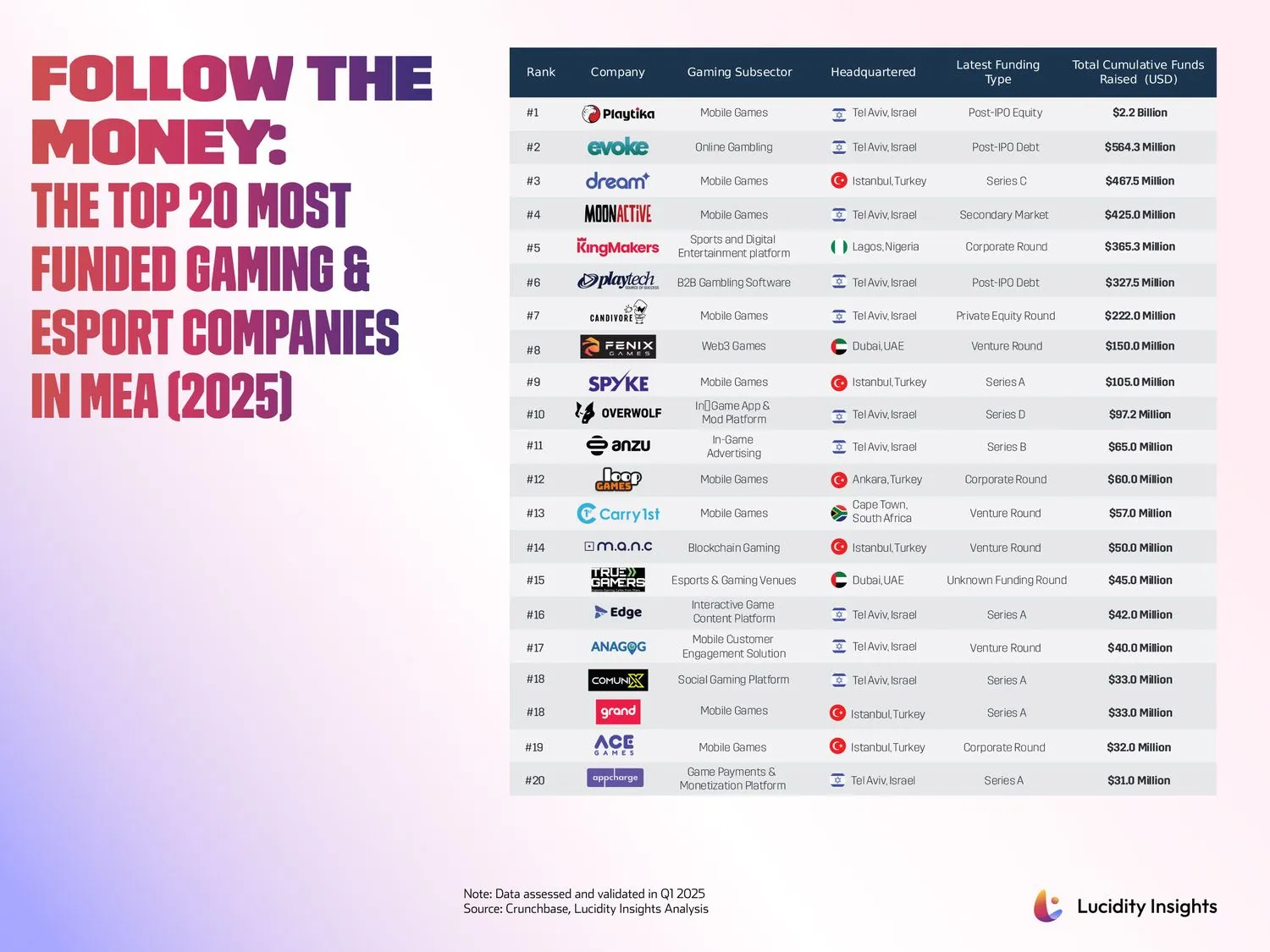
When it comes to venture backing and funding firepower, the Middle East & Africa gaming landscape is far from even — and the top 20 most funded companies tell that story loud and clear. Dominated by Israel and Turkey, the funding landscape highlights two clear epicenters of capital, creativity, and commercial success.
Israel tops the chart, home to eight of the ten most funded gaming companies in the region. Tel Aviv alone accounts for industry giants like Playtika, which has raised over US $2.2 billion, alongside Evoke PLC (US $564.3 million) and Moon Active (US $425 million). Benefiting from Israel’s mature tech ecosystem, IPO-ready capital markets, and deep VC networks, these players exemplify what’s possible when innovation meets institutional backing.
Turkey emerges as the region’s second funding heavyweight, driven by Istanbul’s thriving mobile-first gaming scene. Standouts like Dream Games (US $467.5 million) and Spyke Games (US $105 million) reflect a wave of mobile gaming studios increasingly favored by global investors for their scalable models and hit-driven revenue potential.
Beyond these two powerhouses, the broader MEA region is beginning to carve out its own funding narrative. Nigeria’s KingMakers, with US $365.3 million raised, signals the rising significance of Africa’s digital sports entertainment and betting platforms. Similarly, Fenix Games in Dubai (US $150 million) and True Gamers (US $45 million) showcase the UAE’s growing commitment to eSports infrastructure and immersive gaming ventures — much of it aligned with government-backed digital transformation agendas.
South Africa’s Carry1st (US $57 million) also makes the list, standing out as one of the few African gaming startups to consistently attract global investor attention, thanks to its focus on mobile-first games tailored to African markets.
What’s clear from this snapshot is that while funding remains highly concentrated in Israel and Turkey, the seeds of the next wave of gaming and eSports innovation are being planted across the region — from Lagos to Dubai to Cape Town. As MEA’s young, mobile-native population continues to drive demand, expect capital to increasingly follow.
10. Funds Raised by Gaming Startups in the Middle East and Africa and Number of Startups (2024)
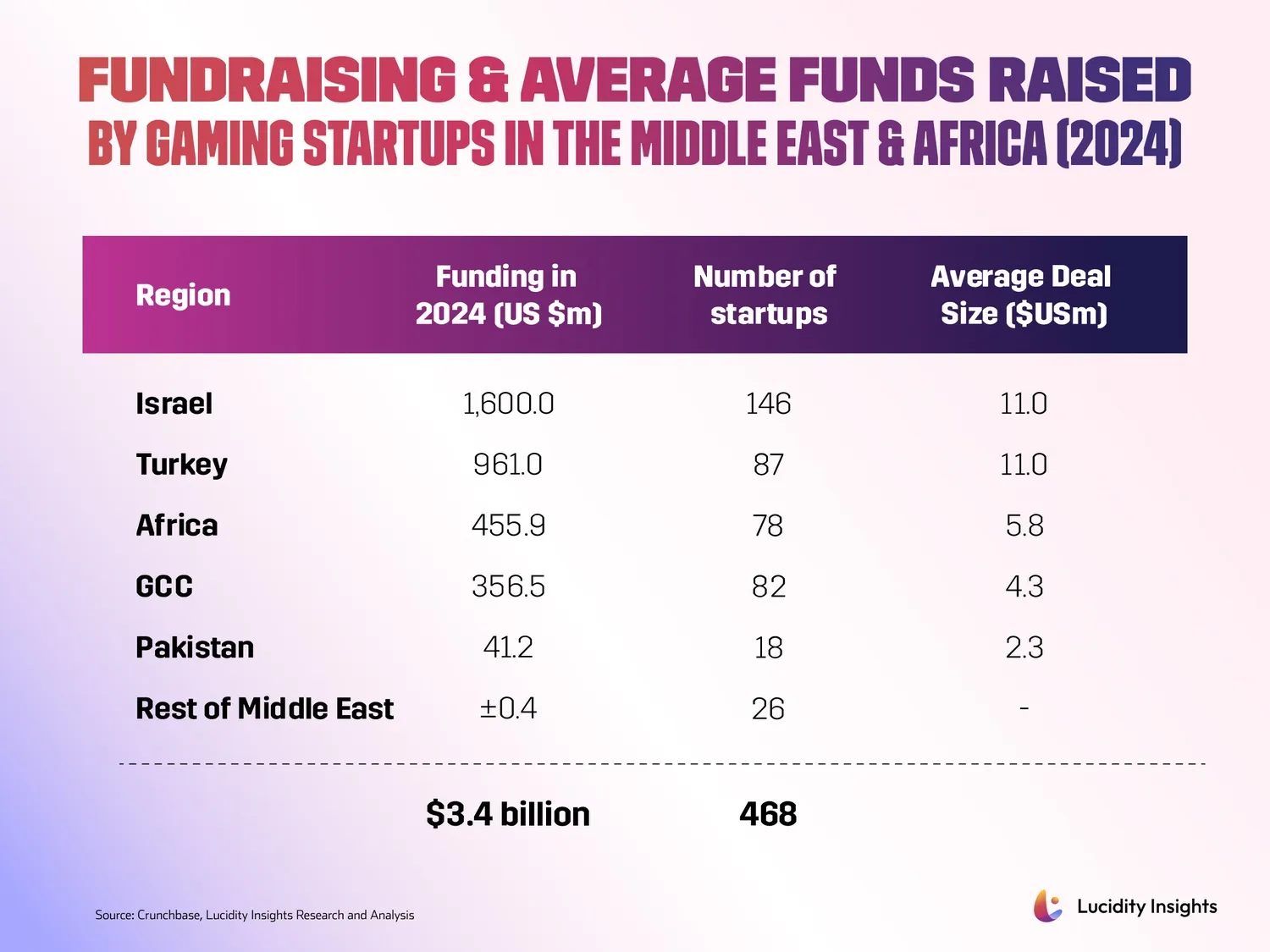
Gaming startups across the Middle East, Africa, Pakistan, and Turkey (MEAPT) raised over US $3.4 billion across 468 startups in 2024 — but the capital flow remains highly concentrated, with just two markets accounting for over 75% of total funding.
Israel leads by a wide margin, raising US $1.6 billion across 146 startups — averaging US $11 million per deal. Powered by one of the world’s most sophisticated venture ecosystems, Israel’s gaming sector benefits from deep-tech expertise, institutional capital availability, and mature secondary and IPO markets. Many of Israel’s gaming startups operate at the intersection of adtech, monetization, and scalable mobile-first models.
Turkey ranks second, pulling in US $961 million across 87 startups, also with an average deal size of US $11 million. Turkey’s success story is rooted in its thriving mobile gaming studios, with Istanbul emerging as a key regional hub for hit-driven consumer game development that continues to attract global venture interest.
Africa secured US $455.9 million across 78 startups, with an average deal size of US $5.8 million. Nigeria dominates this landscape, accounting for the bulk of the continent’s funding, driven by a mix of gaming, fintech integration, and blockchain-based monetization models. South Africa, while mature in ecosystem development, lags behind in funding volume — suggesting untapped potential or gaps in investor engagement.
The GCC region, led almost entirely by the UAE (US $347 million of the GCC’s US $356.5 million total), raised capital across 82 startups. While average deal size here is lower at US $4.3 million, funding aligns closely with government-backed initiatives like Dubai’s X-Stadium, NEOM, and Qiddiya — signaling strategic national bets on eSports infrastructure and immersive technologies.
The Rest of the Middle East (including Pakistan) contributed a mere US $41.6 million across 26 startups, highlighting both the concentration of capital in a few key markets and the potential whitespace that remains across other parts of the region.

%2Fuploads%2Fgaming-review-2025%2Fcover26.jpg&w=3840&q=75)