G42 vs HUMAIN: Inside the UAE and Saudi Arabia's Race for Sovereign AI
09 November 2026•

Key takeaways
- G42 is the first mover. Founded in 2018 and chaired by Sheikh Tahnoun bin Zayed, it runs about ten operating companies, including two listed ones that together earned about $1.4 billion in 2025.
- The UAE sells access. G42 reportedly tore out $150 million of Huawei equipment to win privileged US chip access, and now offers American AI companies a springboard into the Middle East, Africa, South Asia and much of the Global South.
- Saudi Arabia bets on scale. HUMAIN, launched by PIF in May 2025 and chaired by Crown Prince Mohammed bin Salman, is building a national AI stack for the Kingdom, targeting 1.9 GW of compute by 2030 and 6.6 GW by 2034.
Every country with serious economic ambitions now asks the same question: who will own the AI that runs our government, our banks, our hospitals and our industries? For most, the honest answer is a handful of American and Chinese companies. Two Gulf states, through their national champions G42 and HUMAIN, have decided that answer is not good enough.
The United Arab Emirates and Saudi Arabia are each building a sovereign AI champion: a single national company that controls every layer of the stack, from power and data centres to chips, cloud, models, agents and the applications on top. In Abu Dhabi, that champion is G42. In Riyadh, it is HUMAIN.
The two are often described as rivals in a single race. They are not. They were born seven years apart, built in opposite ways, and are heading to very different destinations. This piece compares how each country approaches AI, how its champion was formed, what each has actually delivered as of November 2026, and where each is going.
UAE vs Saudi Arabia: two philosophies, two end games
The UAE bet early and bet on access. The Emirates treated AI as a national priority long before the generative AI boom, appointing Omar Al Olama as the world's first Minister for Artificial Intelligence in October 2017. With a population of around 11 million, it cannot win on market size, so it competes on openness, regulation and partnerships. Its pitch is simple: we are the trusted, well-governed place where advanced American technology can be deployed outside America's borders.
Make no mistake, though: G42 is as much a state project as anything in Riyadh. It is chaired by Sheikh Tahnoun bin Zayed Al Nahyan, the UAE's National Security Adviser, Deputy Ruler of Abu Dhabi and a brother of President Sheikh Mohamed bin Zayed. Widely regarded as one of the most powerful economic figures in the Gulf, Sheikh Tahnoun also chairs the Abu Dhabi Investment Authority, ADQ, International Holding Company (IHC), First Abu Dhabi Bank, MGX and the Royal Group, and is estimated to oversee $1.3 trillion to $1.5 trillion in assets. G42 sits inside that web, with access to capital, customers and political backing few companies can match.
Saudi Arabia bet later and bet on scale. The Kingdom folded AI into Vision 2030, its plan to diversify the economy away from oil. It has resources the UAE cannot match: land roughly six times the size of Germany, cheap energy, a population of about 35 million, more than three times the UAE's, and the Public Investment Fund, one of the world's largest sovereign wealth funds. Its model is state-directed industrial policy, run from the very top. Where the UAE gave AI a cabinet minister, Saudi Arabia gave it an authority: the Saudi Data and AI Authority (SDAIA), established by royal decree in August 2019 and chaired by Crown Prince Mohammed bin Salman. Its president, Dr. Abdullah bin Sharaf Alghamdi, holds the rank of minister, and the Kingdom has named 2026 its Year of Artificial Intelligence.
Those philosophies lead to two different end games.
G42 is building a springboard. Its real product is access, and it runs in both directions. The UAE gives American AI companies a trusted, US-approved base outside their own borders, and from Abu Dhabi and Dubai a springboard into the Middle East, Africa, South Asia and much of the Global South: markets US firms struggle to reach alone, and where Chinese providers are their main rivals. G42 does not need to win Saudi Arabia's home market. It wants to be the gateway through which American AI reaches everyone else.
HUMAIN is building a national operating system. Its mission is to give the Kingdom its own AI, on its own soil, in its own language, running Saudi government and enterprise workflows end to end. Its acquisitions buy the domestic channel to customers, and its home market under Vision 2030 is large enough to justify the bet.
In short: access versus scale, assembled over time versus launched overnight. G42 wants to be the region's AI platform for the world; HUMAIN wants to be Saudi Arabia's AI utility. They will compete hard for chips, hyperscaler tenants and talent, but above the infrastructure layer they are playing different games.
How G42 and HUMAIN were formed
G42 was built bottom-up, over seven years. Founded in Abu Dhabi in 2018, G42 grew by launching and acquiring businesses, many of which earned revenue before AI became a geopolitical asset. Today it runs about ten operating companies, each owning one layer of the stack or one sector where AI is applied. Its turning point came in April 2024, when Microsoft invested $1.5 billion and took a board seat, anchoring G42 firmly in the US technology camp.
HUMAIN was built top-down, almost overnight. Launched by PIF in May 2025, chaired by the Crown Prince and led by CEO Tareq Amin, formerly of Aramco Digital and Rakuten, HUMAIN was formed by consolidating existing national AI capabilities, including assets linked to Aramco and Aramco Digital. Rather than growing into a stack, it was handed one in outline and told to fill it in at speed. Its stated ambition is to make Saudi Arabia the world's third-largest AI provider, behind only the US and China. Within 16 months it was preparing for a potential IPO, though no timetable has been announced.
The difference is stark. G42 is a portfolio that became a national champion. HUMAIN is a national champion now acquiring a portfolio.
US chips and China ties: the price of compute
No country can build sovereign AI without the world's most advanced chips, and almost all of them are American. Both champions have paid for that access by turning away from China. The UAE simply paid earlier, paid more, and has been rewarded for it.
How G42 cut its China ties. In late 2023, G42 came under intense pressure in Washington. The New York Times reported US concerns over its use of Huawei equipment and its dealings with Chinese firms such as BGI Group, and a senior US lawmaker called for sanctions. G42 responded with a series of concrete moves:
- A pact with the US government. Bloomberg reported that Microsoft's investment followed behind-the-scenes negotiations in which G42 agreed to divest from China and pivot to American technology.
- Ripping out Huawei. The Microsoft deal required G42 to strip Chinese equipment, including Huawei gear, from its systems. It reportedly removed $150 million worth of Huawei equipment and hired an outside auditor to confirm the cleanup.
- Selling ByteDance. In November 2023, the G42-linked 42X Fund bought a $100 million stake in ByteDance, then sold it roughly four months later to reassure US partners.
- Opening the doors. G42 moved workloads onto Microsoft Azure and has since built monitoring of its data centres to Washington's specification. Majority US ownership of G42 has reportedly been discussed, in order to secure access to American chips beyond April 2027, though G42 has declined to comment.
The reward. In July 2026, the US Commerce Department moved the UAE into Country Group A:5, a tier generally reserved for close US allies, making it the first Arab nation to receive that status. Approved Emirati entities can now receive controlled American technology without a licence, under a partnership permitting up to 500,000 of NVIDIA's latest chips a year.
Saudi Arabia has made the same pledge, but not yet won the same prize. Saudi Arabia's government has long collaborated with Huawei on AI initiatives. HUMAIN has since publicly vowed not to buy Huawei equipment, and Tareq Amin says it gave detailed guarantees to American officials. In November 2025, the US cleared both G42 and HUMAIN to buy chips equivalent to 35,000 NVIDIA GB300 processors each. But Saudi Arabia has no A:5 status: HUMAIN still buys under case-by-case authorisations capped at 35,000 accelerators.
This is what access really means, and it is the UAE's true unique selling point. Saudi Arabia wins by being the biggest market in the system; the UAE wins by being its most connected node. The UAE has traded a degree of sovereignty, over its suppliers, its data centres and possibly its ownership, for privileged, rule-based access to American compute.
G42's companies: a conglomerate with revenue
G42's defining advantage is that much of its empire already makes money. Its main operating companies are:
- Khazna: the region's largest data-centre provider and the builder of Stargate UAE. In February 2025, e& agreed to sell its 40% stake in Khazna to G42, Silver Lake and MGX.
- Core42: sovereign cloud and enterprise AI infrastructure, run with Microsoft and formed in October 2023 from G42 Cloud, Inception and Injazat. In February 2026, the Central Bank of the UAE chose Core42 to build a sovereign financial cloud for the country's regulated financial sector.
- Inception: the group's model factory, behind the Arabic large language model Jais, launched in August 2023.
- Presight: big-data analytics for governments and industry, founded in 2020 and listed on the Abu Dhabi Securities Exchange in 2023. Its 2025 revenue was AED 3.03 billion (about $825 million), up 36.9%, with international markets contributing 38.5%.
- Space42: satellite communications and geospatial AI, formed in October 2024 by merging Yahsat's satellite operator with Bayanat's mapping and geospatial data business, and also listed. Its 2025 revenue was $577 million, down 8% during a business transition, but it holds a $6.5 billion contracted backlog and a satellite network spanning more than 150 countries.
- M42: a tech-enabled healthcare company formed with Mubadala in 2023, combining genomics, diagnostics and clinical operations.
- CPX: a cybersecurity firm serving government and critical infrastructure, acquired in October 2024.
- Analog: edge computing.
This breadth matters. G42 does not just sell compute; it owns the businesses that consume it. M42 generates health data, Presight runs government analytics and Space42 produces geospatial data, and all of it can run on Core42's cloud inside Khazna's data centres.
Access compounds. Privileged access to chips, hyperscalers and global partners does not just benefit G42's data centres; it flows down to every company in the group. Because each subsidiary has operated for years, it can turn that access into products, contracts and revenue, and each success brings more data, customers and credibility. Presight's surge in international revenue shows the export model already working. HUMAIN has nothing comparable yet. Its businesses are product lines inside one company, ALLaM (its Arabic large language model), HUMAIN Chat (its consumer chatbot app), HUMAIN One (its platform of AI agents for businesses) and HUMAIN Core (its data centres), plus recently absorbed firms, none of which publishes its own results.
The compute story. G42's flagship project is Stargate UAE, announced in May 2025 with OpenAI, Oracle, NVIDIA, SoftBank Group and Cisco. It is a giant AI data centre campus, built by Khazna to train and run AI models, with OpenAI as its main customer. Data centres are measured by the power they draw rather than floor space, and the first phase is a 200 MW cluster of roughly 100,000 NVIDIA GB300 chips. That is large by traditional standards, but modest beside the gigawatt-scale AI campuses now under construction in the US; it is the planned 1 GW cluster, inside a 5 GW UAE–US AI Campus, that would put Abu Dhabi in that league. OpenAI says the site could serve compute within a 2,000-mile radius, reaching up to half the world's population.
The timeline has slipped modestly. Khazna has pointed to a fourth-quarter 2026 go-live, and reporting in September 2026 described a possible re-planning of the wider campus from a single Abu Dhabi site into several hardened locations, a possible strategy shift following recent geopolitical tensions in the region, including Iranian threats against the Stargate site. Meanwhile, Microsoft has committed a further $7.9 billion to the UAE between 2026 and 2029, bringing its total investment in the country to $15.2 billion.
HUMAIN: where Saudi Arabia's champion stands today
If G42 is a conglomerate, HUMAIN is a sprint. In eighteen months it has announced more partnerships, capacity and capital than most technology companies manage in a decade. The question is how much of it is real yet.
Models and products. HUMAIN's flagship model is ALLaM, an Arabic-first multimodal large language model whose 34B version was reportedly trained on more than 500 billion Arabic tokens. It powers HUMAIN Chat, a free Arabic-first chat app. The company has also launched Horizon computers and HUMAIN One, through which it says more than 150 AI agents manage corporate functions. In February 2026, Tareq Amin unveiled HUMAIN OS, an "intent-driven" operating system in which users state goals in plain language and AI agents do the work.
Capital and partners. HUMAIN has moved money at remarkable speed, reportedly putting $3 billion into xAI's Series E round in February 2026. At LEAP 2026 in Riyadh, it disclosed project agreements worth more than $15 billion across the stack: AMD for chips, AWS for a cloud region and Microsoft for distribution. Its partner list reads like a who's who of American technology, including NVIDIA, AMD, Cisco, Qualcomm, AWS, Microsoft, Adobe and xAI.
The consolidation phase. HUMAIN is shifting from announcing to assembling. In October 2025, PIF transferred SCAI (the Saudi Company for Artificial Intelligence, which PIF set up in 2021 to build AI applications for sectors such as smart cities and healthcare) to HUMAIN. In the same month, Aramco agreed to take a 49% stake in HUMAIN, contributing $2.6 billion in cash, binding Saudi Arabia's largest company to its AI champion. Then, in November 2026, HUMAIN absorbed CNTXT, a Riyadh-based enterprise cloud and AI services firm that resells Google Cloud to Saudi organisations, taking on its staff, products and customers. No price was disclosed. The pattern is clear: HUMAIN is buying the services teams and customer relationships it needs to sell its stack at home.
What is actually live? Less than the headlines suggest. HUMAIN has confirmed it has secured 211 land plots for future AI data centres, with access to about 14 GW of power. For scale, Germany has roughly 500 to 580 data centres of all kinds and the US more than 5,000, so HUMAIN's plots would equal around 40% of Germany's entire footprint, all earmarked for AI. Its announced projects add up to well over a gigawatt. But only a small, unspecified share is publicly confirmed as running: AMD systems went live at an unnamed Saudi site in August 2026, while the twin Riyadh and Dammam campuses, due in Q2 2026, still have no public confirmation. Its long-range targets are 1.9 GW by 2030 and 6.6 GW by 2034.
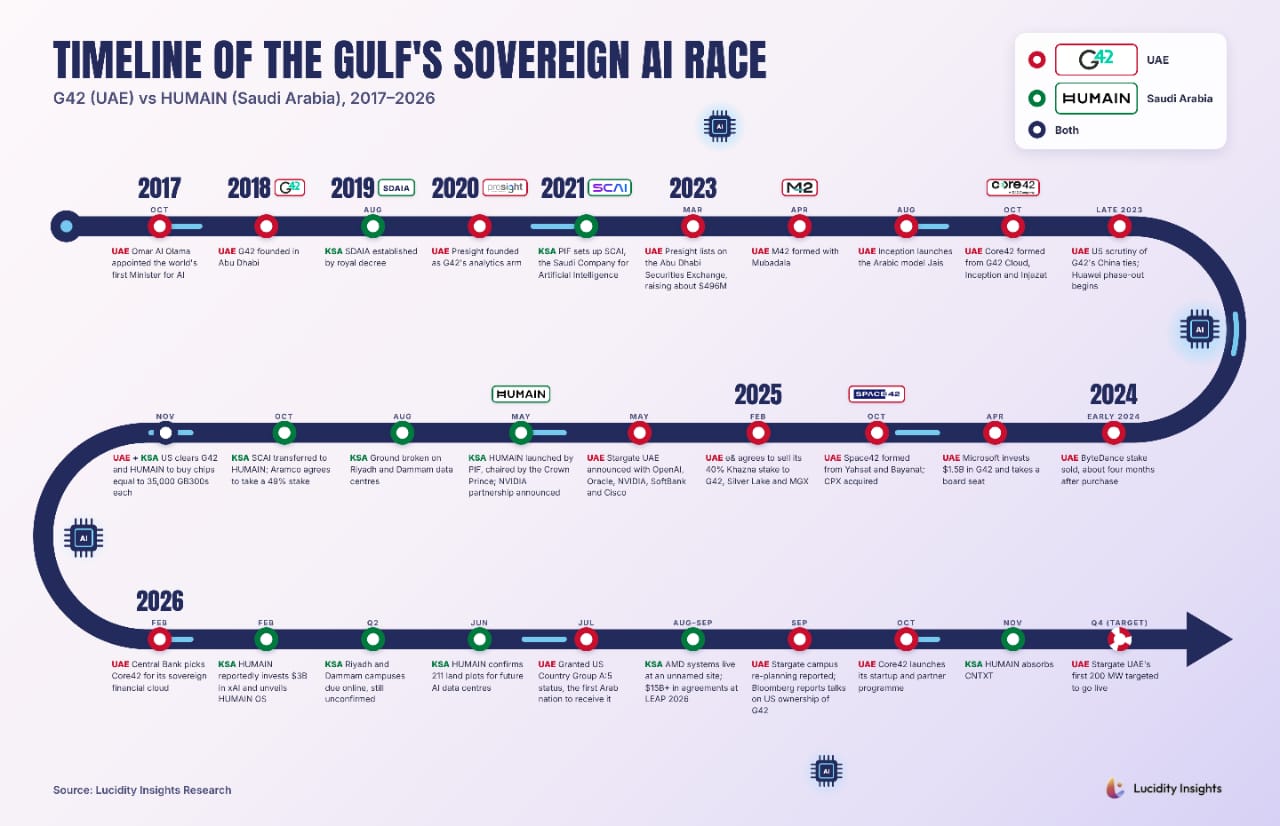
G42 vs HUMAIN timeline: seven years against eighteen months
Is G42 ahead of HUMAIN?
G42 is the first mover, with a seven-year head start. It is the champion of the UAE, one of the world's most committed backers of AI at scale, and on the measures that can be verified today, it is further along. The gap is less about megawatts than about maturity.
- Revenue and proof of business: G42 has two listed subsidiaries with audited numbers, Presight and Space42, which together earned about $1.4 billion in 2025. HUMAIN has disclosed no revenue figures.
- Customers: G42 counts the UAE Central Bank, Abu Dhabi government entities and OpenAI as anchor clients. HUMAIN's CNTXT purchase is partly a way to buy a customer base it has not yet built organically.
- Applications: G42 owns real sector businesses in health, space, security and analytics. HUMAIN's applications are newer, and their adoption numbers have yet to be published.
- Models: both have credible Arabic-first models, Jais and ALLaM. This is the closest contest, and neither is a frontier model on the scale of the leading US labs.
- Compute: both flagship builds are landing around late 2026. G42's first phase has OpenAI as a named tenant; HUMAIN has more partners but fewer confirmed sites.
- US access: the UAE now buys under a standing A:5 rule, while HUMAIN still needs case-by-case licences.
Where HUMAIN leads is speed and scale of ambition. No company has signed this many partnerships this quickly, and Saudi Arabia's advantages in land, power and market size are real. If it delivers even half of its 6.6 GW pipeline, it will outbuild the UAE on raw capacity in the next decade.
The verdict: two roads to sovereign AI
The question of who is ahead is, in the end, the wrong one. G42 and HUMAIN are not running the same race. They are two separate champions, with separate philosophies and separate end games.
The UAE is building a springboard. It bets that American and Western AI companies need a trusted, approved base from which to reach the markets they cannot easily serve alone: the Middle East, Africa, South Asia and much of the Global South. G42 is the gateway, and access is what it sells.
Saudi Arabia is building a national stack. HUMAIN's mission is to give the Kingdom its own AI, on its own soil, in its own language, running its own government and economy. Scale is what makes that possible, and its home market is the prize.
G42 has the head start, the revenue and the access; HUMAIN has the scale, the capital and the speed. Each can succeed without the other failing. The real test of the next six months is not which one wins, but whether each can deliver on its own promise, and which of the two models other nations decide to copy.
So what? What G42 and HUMAIN mean for Gulf founders
For startups, two different champions mean two very different markets, and two different ways to win.
In the UAE, G42 is a platform to build on. In October 2026, Core42 launched a partner programme that lets startups and software vendors bring their products onto its sovereign cloud and build with Microsoft Azure. It opened with more than 50 partners, on a cloud that already serves more than 47 Abu Dhabi government entities, and Core42's teams help partners with compliance and go-to-market. For a founder, that is a shortcut to government customers that would otherwise take years to reach, and G42's export reach can carry UAE-built products into the same markets it serves.
In Saudi Arabia, HUMAIN is a gatekeeper, and a funder. With chips, cloud, models, agents and now a services arm under one roof, HUMAIN will compete with many horizontal AI startups rather than buy from them. But it has also announced plans for a $10 billion venture fund. The smart play is to build in the gaps: vertical applications in health, logistics, education, energy and government services that HUMAIN will want to distribute and invest in, not replicate.
The lesson for founders is the one that runs through this piece. In Abu Dhabi, plug into access. In Riyadh, build for scale.