
Dubai's Economy Under Fire: 10 Charts That Reveal Its Resilience
11 September 2026•
%2Fuploads%2Farticles%2F2026%2F0911_10-charts-dubai%2Fdubai-night.jpg&w=3840&q=75)
Dubai is undeniably navigating a crisis. The war has disrupted travel, unsettled investors and raised fears of an economic slowdown—or even an exodus of residents and businesses. Yet real-time data from across the emirate tells a more surprising story. Economic growth has continued to outpace most advanced economies, despite the war; the population is still expanding, airport traffic remains substantial despite several global airlines yet to reinstate their route. Property sales and property values are near record levels and the initial disruption to timely workforce salary payments receded quickly. The pressures are real, but so is Dubai’s resilience. These ten charts offer a clearer, data-driven picture of what is actually happening on the ground.
1. The Scope of the Crisis
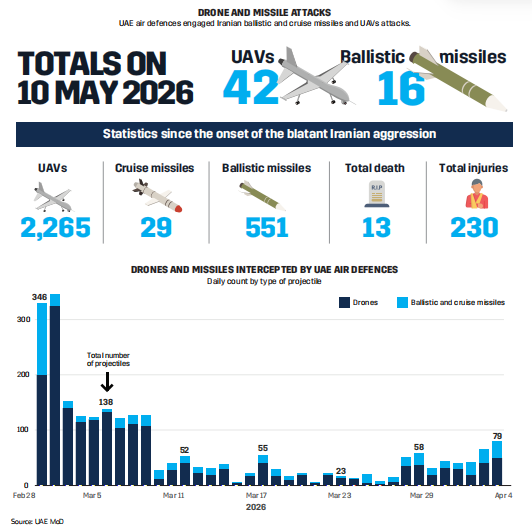
Between late February and early May 2026, UAE air defences intercepted 2,265 UAVs, 551 ballistic missiles and 29 cruise missiles fired in Iranian attacks. By the last official tally, 13 people lost their lives, and 230 were injured nationwide. Any conversation about Dubai’s economic performance this year has to start against that backdrop: this was not a market slowdown, it was a country under sustained military attack. The charts that follow meausre an economy that kept functioning underneath that.
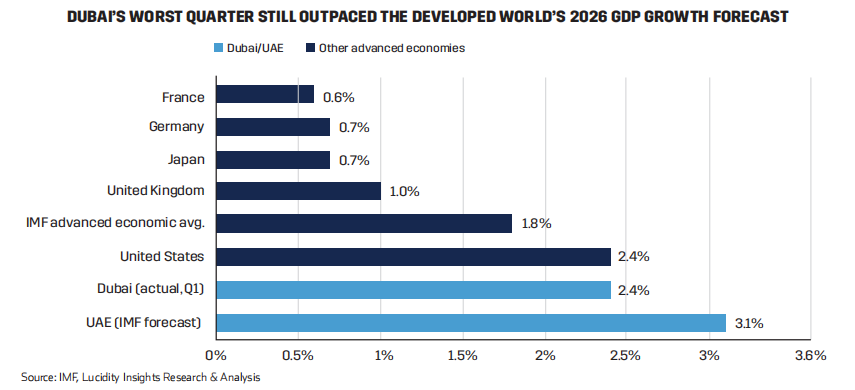
2. UAE and Dubai’s GDP still Growing Faster Than The World’s Most Advanced Economies, Despite War
Even Dubai’s slowest quarter of the war — 2.4% growth in Q1 — beat every G7 economy’s full-year 2026 forecast, while the IMF still expects the wider UAE to hit 3.1% for the year.
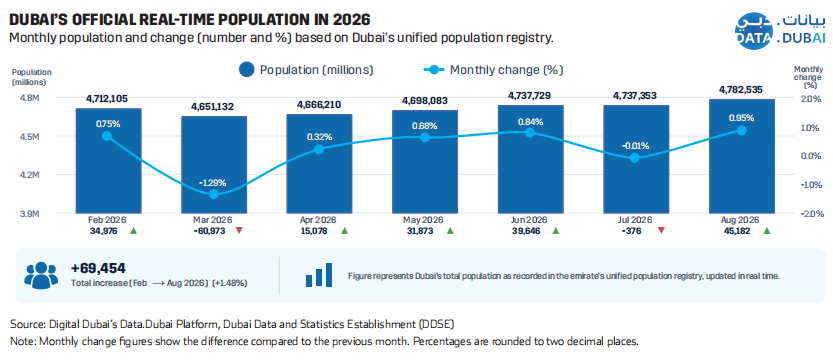
3. Despite Worries of Mass Expat Exodus, Dubai Population is Still Growing
Even Dubai’s slowest quarter of the war — 2.4% growth in Q1 — beat every G7 economy’s full-year 2026 forecast, while the IMF still expects the wider UAE to hit 3.1% for the year.
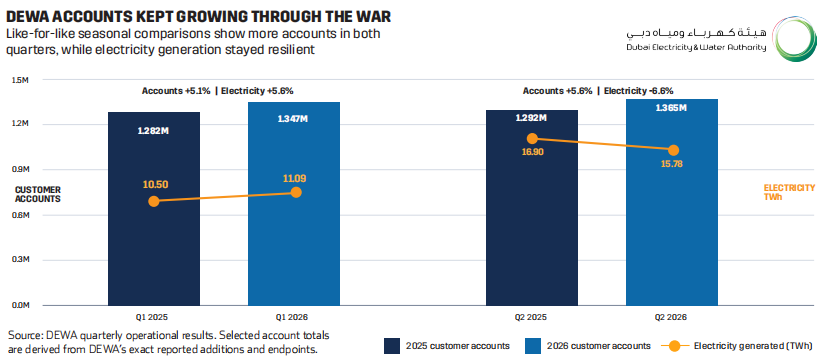
4. Dubai’s Utility Customer Base Grew Even As Electricity Output Pulled Back in Q2
Customer accounts at Dubai’s state utility – Dubai Electricity & Water Authority (DEWA) – rose in both quarters (+5.1% Q1, +5.6% Q2 YoY), but electricity output diverged — up 5.6% in Q1, down 6.6% in Q2. DEWA added 18K new accounts between Q1 and Q2, at the heat of the war.
5. New Company Formation in Dubai Doubled During the War
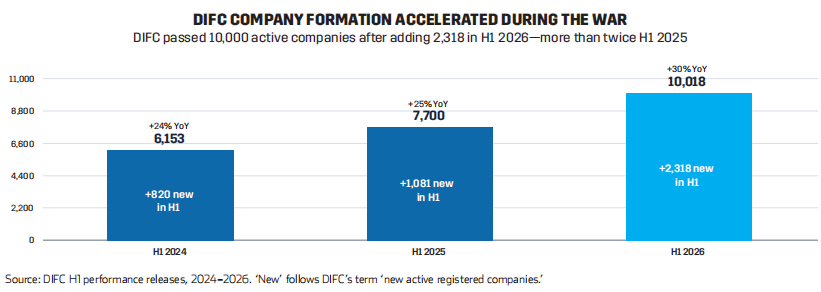
The Dubai International Financial Centre (DIFC) added 2,318 new active companies in H1 2026 — more than double the 1,081 added in H1 2025, and a 30% year-over-year jump that outpaced both prior years’ growth rates (24% in 2024, 25% in 2025). The free zone crossed 10,000 active companies for the first time, suggesting that whatever caution the war introduced elsewhere, it didn’t slow the pace at which firms were choosing to set up in Dubai. Nothing says “Dubai’s open for business” quite like this statistic.
6. Dubai Tourism Hardest Hit, But Fairing Better Than Pandemic Years
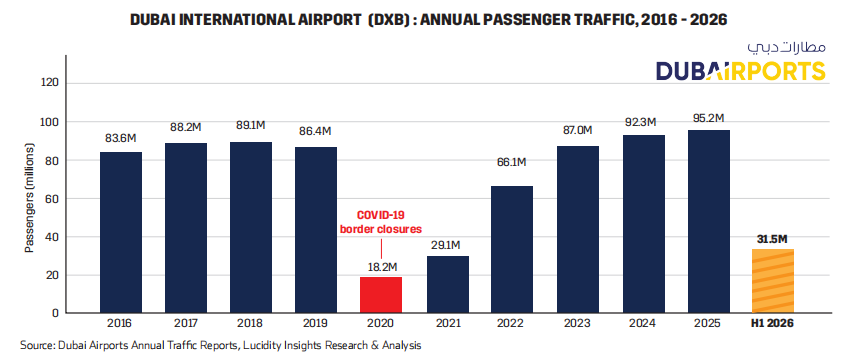
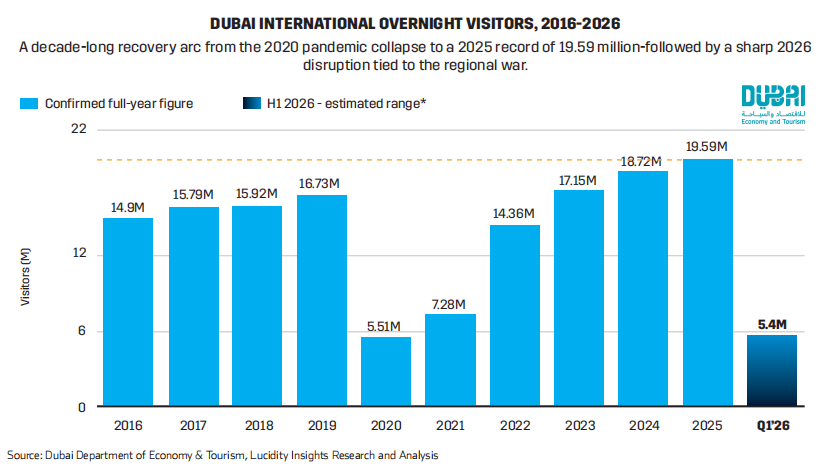
Dubai International Airport handled 31.5 million passengers in H1 2026, a 31% year-over-year decline from roughly 45.8 million in H1 2025, with Dubai Airports pointing to regional airspace disruption as the driver and flagging a stronger second half as capacity rebuilds. Overnight visitor arrivals told a similar story, opening the year at 5.4 million in Q1 — in line with prior momentum before the war disrupted international travel demand in the months that followed.
7. The UAE’s Trade Rerouted, But It Didn’t Stop. It Grew.
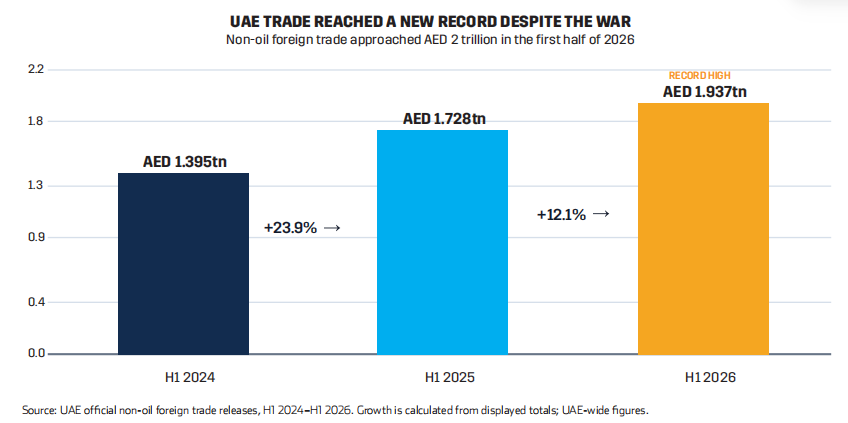
Non-oil foreign trade hit AED 1.937 trillion in H1 2026, up 12.1% from H1 2025 and 39% above H1 2024 — even as the country absorbed direct strikes and a near-total shutdown of its largest port. Record trade value masked a dramatic reshuffling beneath the surface: Jebel Ali, the UAE’s main container port, saw volumes collapse over 90% as ships avoided the Strait of Hormuz — but that traffic rerouted to Fujairah, Khor Fakkan, and other UAE ports outside the strait, keeping the country’s overall trade numbers intact.
8. Property Transactions Remain Resilient, While Average Home Prices Increase; Ultra-Luxury Property Sales Surge
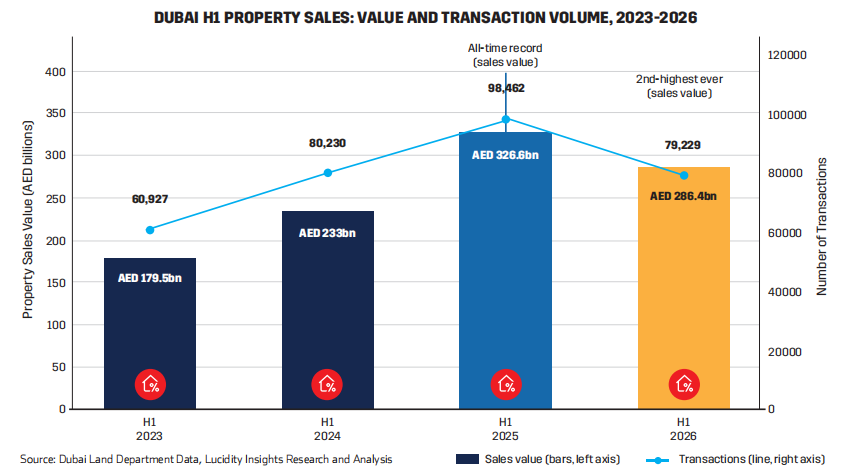
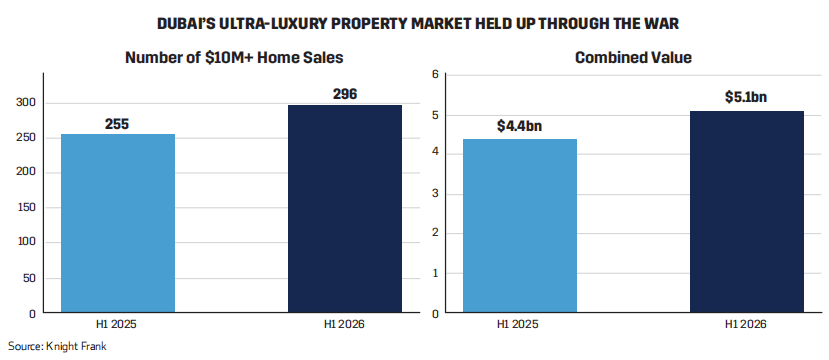
Dubai’s overall property market cooled from 2025’s record peak — H1 2026 transactions fell to 79,229 (down from 98,462) and sales value dropped to AED 286.4bn (down from AED 326.6bn) — but still posted the second-highest H1 sales value on record. The ultra-luxury segment moved in the opposite direction entirely: $10M+ home sales rose from 255 to 296 deals (+16%), with combined value climbing from $4.4bn to $5.1bn, suggesting wealthy buyers leaned in even as the broader market pulled back from its highs.
Check Also: Lucidity Insights' Special Report on MEAPT PropTech Review 2024
9. Blue Collar & Grey Collar Workforce in the UAE Salary Payments Showed Spike in Delays in February, but Quickly Recovered
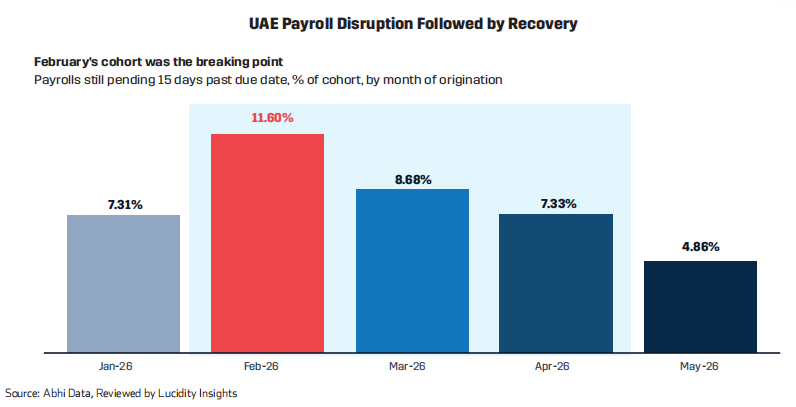
Looking at national payroll processing data from Abhi, that distributed 54,000 salary advances between March-May 2026 to their client base of the UAE’s blue collar and grey collar workforce; Abhi found that payment delays spiked sharply in February 2026, with 11.6% of that month’s payroll cohort still pending 15+ days past due — a significant jump from January’s 7.3% baseline, and more than double the 4.86% the recovery would later settle near in May. The data suggests a full recovery by April 2026, and the disruption was a sharp, short-lived shock to payment processing rather than a sustained breakdown in employer liquidity or labor market health.
10. Property Transactions Remain Resilient, While Average Home Prices Increase; Ultra-Luxury Property Sales Surge
Dubai’s overall property market cooled from 2025’s record peak — H1 2026 transactions fell to 79,229 (down from 98,462) and sales value dropped to AED 286.4bn (down from AED 326.6bn) — but still posted the second-highest H1 sales value on record. The ultra-luxury segment moved in the opposite direction entirely: $10M+ home sales rose from 255 to 296 deals (+16%), with combined value climbing from $4.4bn to $5.1bn, suggesting wealthy buyers leaned in even as the broader market pulled back from its highs.

%2Fuploads%2Fdubai-startup-guide-2025%2Fcover%2520dcde%2520startup%2520guide%25202025.jpg&w=3840&q=75)