
Crisis or Catalyst? How War Is Quietly Rewiring the Middle East's Startup Economy
04 April 2026•
%2Fuploads%2Farticles%2F2026%2F0404_crisis-or-catalyst%2Fcrisis-or-catalyst-cover.jpg&w=3840&q=75)
Executive Summary: The State of GCC Tech (April 2026)
-
Saudi Arabia Resilience: Anchored by Vision 2030 and domestic capital; GDP growth remains steady at 4%.
-
UAE Market Sensitivity: Highly integrated with global capital; facing a "perception risk" despite robust physical defense systems.
-
Energy Impact: Brent crude volatility acts as a fiscal buffer for governments but increases OPEX for SMEs.
-
The "Rewiring": A shift from global reliance toward disciplined, revenue-focused models and regional capital depth.
The Gap Between Headlines and Reality
There is a version of the Middle East that exists in global headlines, and a version that exists on the ground. The gap between them has never been wider — or more consequential.
I've been watching the events unfold closely from Dubai and Riyadh. Five weeks into an active conflict, the GCC's major cities remain open, functional, and — in many respects — remarkably resilient. Sheikh Mohammed bin Rashid was seen walking through Dubai Mall with senior government officials in the first days of the war, speaking calmly with residents and visitors. Regular public briefings have kept populations informed. Advanced air defence systems have intercepted the vast majority of incoming threats. This is not a region in collapse.
But in global capital markets, perception does not need to be accurate to be influential. And right now, the perception is doing significant economic damage to a region that has spent two decades building something genuinely worth paying attention to.
Over the past twenty years, the UAE, Saudi Arabia, and their GCC neighbours have executed one of the most deliberate reinventions in modern economic history. They built world-class cities, built new industries, positioned themselves as global destinations for capital and talent, and quietly assembled some of the fastest-growing startup ecosystems outside Silicon Valley. That progress has not paused; but global confidence in it has become more fragile.
What this conflict is exposing, however, is that not all of these economies are equally insulated from this conflict. This is a story of how globally integrated economies absorb shocks differently from domestically anchored ones — of how capital, talent, and confidence move under pressure, and what that reveals about the structural foundations of the Middle East's evolving startup economy.
And the insights here don’t just apply to the Middle East. They apply to economies across the world. As Larry Fink, Chairman and CEO of Blackrock, the world’s largest asset manager with over $14 trillion in assets under management said in a recent interview, “If the war drags on for a year, energy prices will rise even further and the global economy will enter a recession."
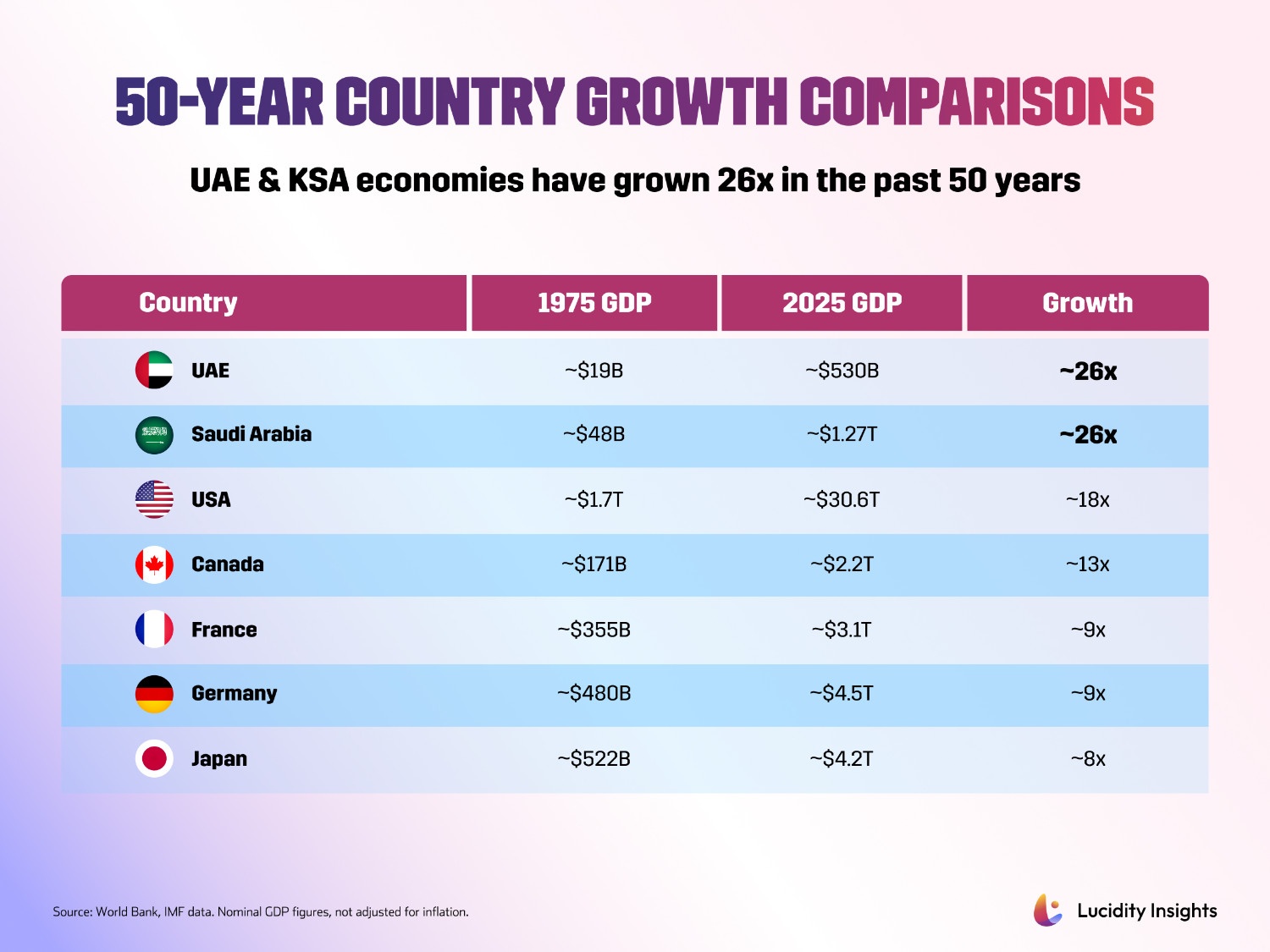
A Region Built on Diversification — With Tech as Its New Growth Engine
To understand the current moment, it is important to zoom out. The Middle East — particularly across the GCC — is no longer an economy anchored to a single sector, even if it once was.
Tourism, hospitality, aviation, and real estate have all emerged as major economic pillars. In 2025, the UAE's tourism sector contributed US$79 billion to GDP, while Saudi Arabia generated US$80 billion in tourism spending, driven by 122 million domestic and international visitors. Dubai International Airport handled over 95 million travellers — the world's busiest for international passengers for the eleventh consecutive year.
But the quieter, more consequential transformation has been in technology. The UAE is now home to 17 unicorns — billion-dollar startups spanning fintech, AI, e-commerce, and mobility, according to Lucidity Insights' Unicorn Tracker. Telegram is headquartered in Dubai. Binance established Abu Dhabi as its key regulatory base in 2025. The UAE is also home to home-grown Unicorns such as Souq.com (acquired by Amazon in 2017), Careem (acquired by Uber in 2019), Property Finder, Kitopi, and Tabby. Between 2020 and the end of 2025, the UAE startup ecosystem raised over US$16.6 billion. Saudi Arabia's ecosystem raised approximately US$10.5 billion over the same period, supported by a rapidly maturing venture landscape and deep state-backed capital, that have produced 7 unicorns of its own, including Jahez, Tamara, and Ninja.
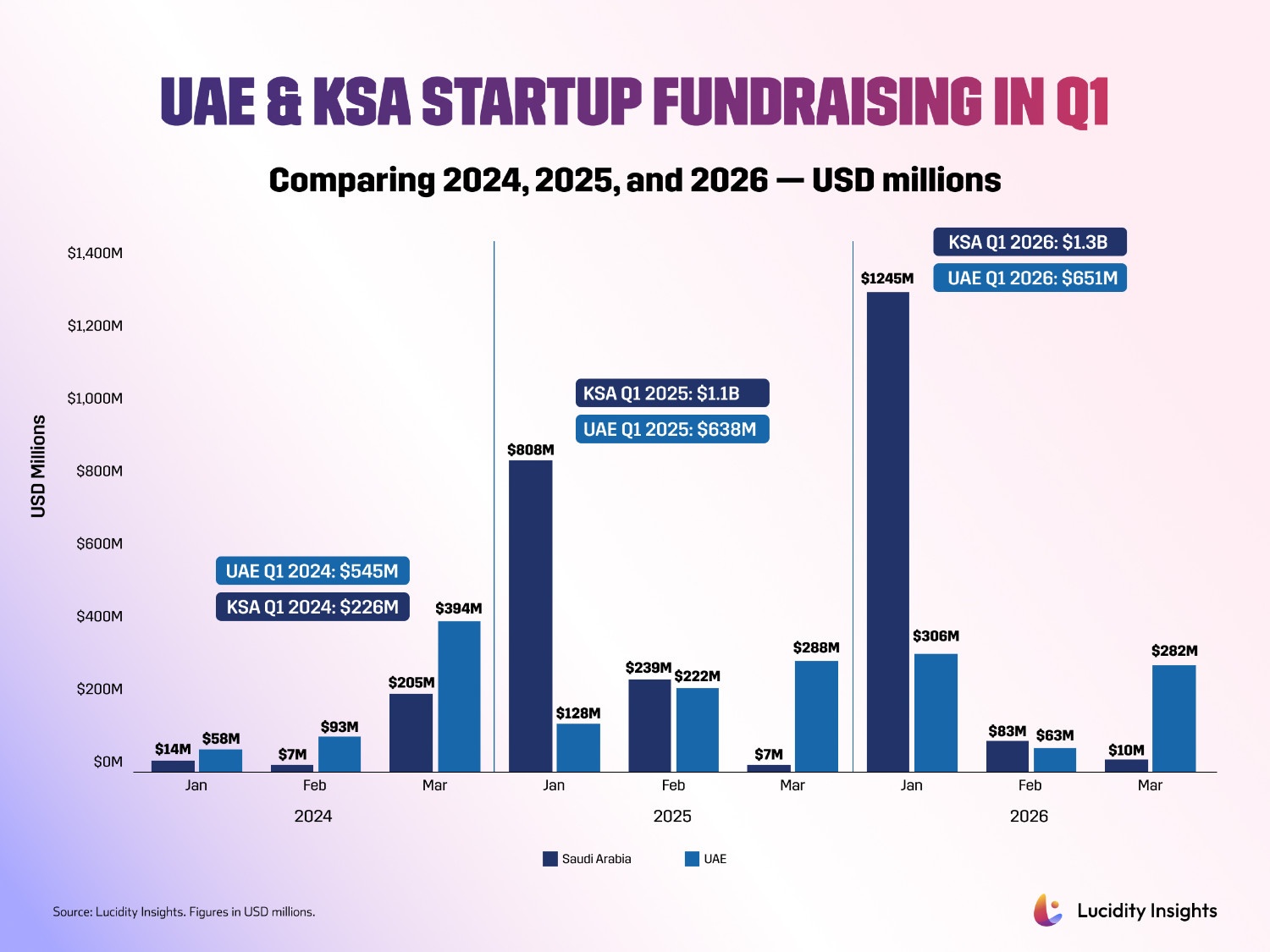
Despite the war starting on February 28th, Q1 2026 startup fundraising figures seem to be keeping pace with fundraising figures posted in Q1 2025 for both Saudi Arabia and the UAE. It should be noted that Ramadan fell mostly into March 2025 and February 2026, which typically decrease funding figures across the region, most especially in Saudi Arabia.
Looking forward, the conflict is not testing the region's ambition. It is testing the structural depth beneath it — and the consequences of that may begin to diverge for different markets as the war continues.
Saudi Arabia: Insulated by Design
Saudi Arabia's relative resilience is not simply a function of geography — it reflects a more structurally anchored system. But insulated does not mean untouched.
The Kingdom has not been immune to spillover from the conflict. Iranian strikes have reached Saudi territory: Aramco's Ras Tanura refinery was forced to shut down for 16 days after drone debris caused a fire in early March, Shaybah has faced repeated targeting, and ballistic missiles have been launched toward Riyadh. Yet the nature and intensity of this exposure differ meaningfully from its neighbours. A mere fraction of the 2,400 projectiles the UAE has had to defend against.
Saudi Arabia's exposure has been more intermittent and more narrowly concentrated: largely on oil refineries, production fields, and US military assets. Crucially, the Kingdom retains strategic flexibility, with the ability to reroute significant oil exports via Yanbu, bypassing the Strait of Hormuz entirely.
That difference is beginning to show in the data. In its March 2026 interim Economic Outlook, the OECD held its Saudi Arabia 2026 GDP growth forecast steady at 4%, while the UAE's outlook has been revised slightly downward from 5.6% to 5.0% (Notably, still a higher growth forecast than its neighbour).
The structural buffer extends beyond geographic proximity to conflict into capital formation. In 2024, Saudi-based investors accounted for 47% of all investor participation in the Kingdom's startup ecosystem, with international investors representing just 29% of the mix, according to MAGNiTT — insulating the ecosystem from the volatility of global capital flows now affecting more internationally exposed markets. Vision 2030 provides an additional layer of stability: the Kingdom's push into technology, fintech, gaming, and digital infrastructure is not cyclical — it is a long-term state-backed commitment.
However, this resilience must be viewed in context. Despite posting a strong GDP growth of 4.5% in 2025 — the Kingdom's best performance in three years — Saudi Arabia enters this period carrying the weight of fiscal tightening. A widening budget deficit prompted targeted spending cuts and stricter capital discipline across major government-backed projects. For companies reliant on public sector contracts, this translated into delayed payments, paused initiatives, and a more constrained operating environment than the headline growth figures suggest. Conversations with senior executives across the Kingdom point to a familiar pattern: marketing budgets frozen, discretionary spending curtailed, and a cautious wait-and-see posture replacing what had, until recently, been confident forward planning.
The distinction is not between disruption and stability, but in its degree. Capital continues to move, but with greater selectivity. For founders and investors operating in Saudi Arabia, the ecosystem remains active — but it has become materially more demanding.
The UAE: When Perception Becomes the Risk
The UAE's disruption is of a different nature — but it would be a mistake to attribute it entirely to perception.
Since February 28, the country has absorbed over 2,400 projectiles — mostly drones, but also ballistic missiles and cruise missiles targeting US bases, airports, ports, and key energy infrastructure. The vast majority have been intercepted by the UAE's defence systems, and the relatively low death toll — 12 people over five weeks — reflects just how effective those systems have been. Leadership has remained calm, visible, and measured throughout, with government communications steady and transparent.
On the ground, life continues with a surprising degree of normalcy. Restaurants and retail outlets are open, offices remain active, and businesses are quietly adjusting. But intercepted missiles are still missiles launched. For those observing from the outside, that distinction matters. Risk, particularly in global capital markets, is assessed through headlines, not nuance.
The economic impact is now outpacing the physical one. Tourism has softened. A segment of expatriates has temporarily relocated, with some global firms, such as McKinsey & Company, Goldman Sachs, Morgan Stanley and Citigroup have given employees the option to relocate temporarily.
Consumer sentiment has pulled back. For a city built on hospitality, real estate, aviation, and a high-spending resident base – of which 90% are expats, even modest shifts in behaviour compound quickly. Across the hospitality, F&B, events, entertainment, and real estate sectors, hiring pauses, unpaid leave, and tighter cost controls are becoming more common — pressures that do not remain contained. They move outward, eventually reaching broader parts of the economy, including the startup ecosystem.
The more fundamental pressure point is capital. Unlike Saudi Arabia, where the majority of startup funding is domestically or regionally anchored, the UAE’s ecosystem has been built on a far greater reliance on international capital. In H1 2024, 58% of all investors active in UAE deals were foreign, and by H2, US-based investors alone accounted for 42% of that international base — nearly doubling year-on-year. All indications suggest this trend only accelerated into 2025.
This exposure extends beyond startups themselves. The venture capital and private equity firms backing these companies are, in turn, raising capital from a similarly global mix of limited partners — many of whom are international institutions. When sentiment shifts at the LP level, it cascades downward through the entire funding ecosystem.
In stable conditions, this global investor mix is a strength. It brings depth, liquidity, and access to some of the world’s most sophisticated capital. But in periods of geopolitical uncertainty, that same openness becomes a point of sensitivity. International investors tend to assess risk through broad narratives rather than local nuance.
The result is a holding pattern. Investment decisions are delayed. Previously committed capital is reassessed. Funding tranches are paused. Not because the underlying opportunity has disappeared, but because the region’s risk is being priced — however imprecisely — as a single risk category.
The Oil Factor: Buffer and Stressor
Another force is quietly reshaping the picture. The disruption of the Strait of Hormuz — through which roughly 20% of the world's oil supply flows — has sent global energy markets into volatility, pushing prices to their highest levels in years. The ripple effects are tangible and global: in Egypt, the government has ordered shops, restaurants and cafes to close by 9pm nightly to conserve electricity, as the country's monthly oil import bill doubled from $1.2 billion in January to $2.5 billion in March. In Australia, two states have made public transport free and the federal government has halved its fuel excise tax — at a cost of A$2.55 billion to the taxpayer — after petrol prices surged 27% and fuel stations in regional areas began running dry. Aviation, logistics, and transport are feeling the strain worldwide, and second and third-order effects are only beginning to unfold.
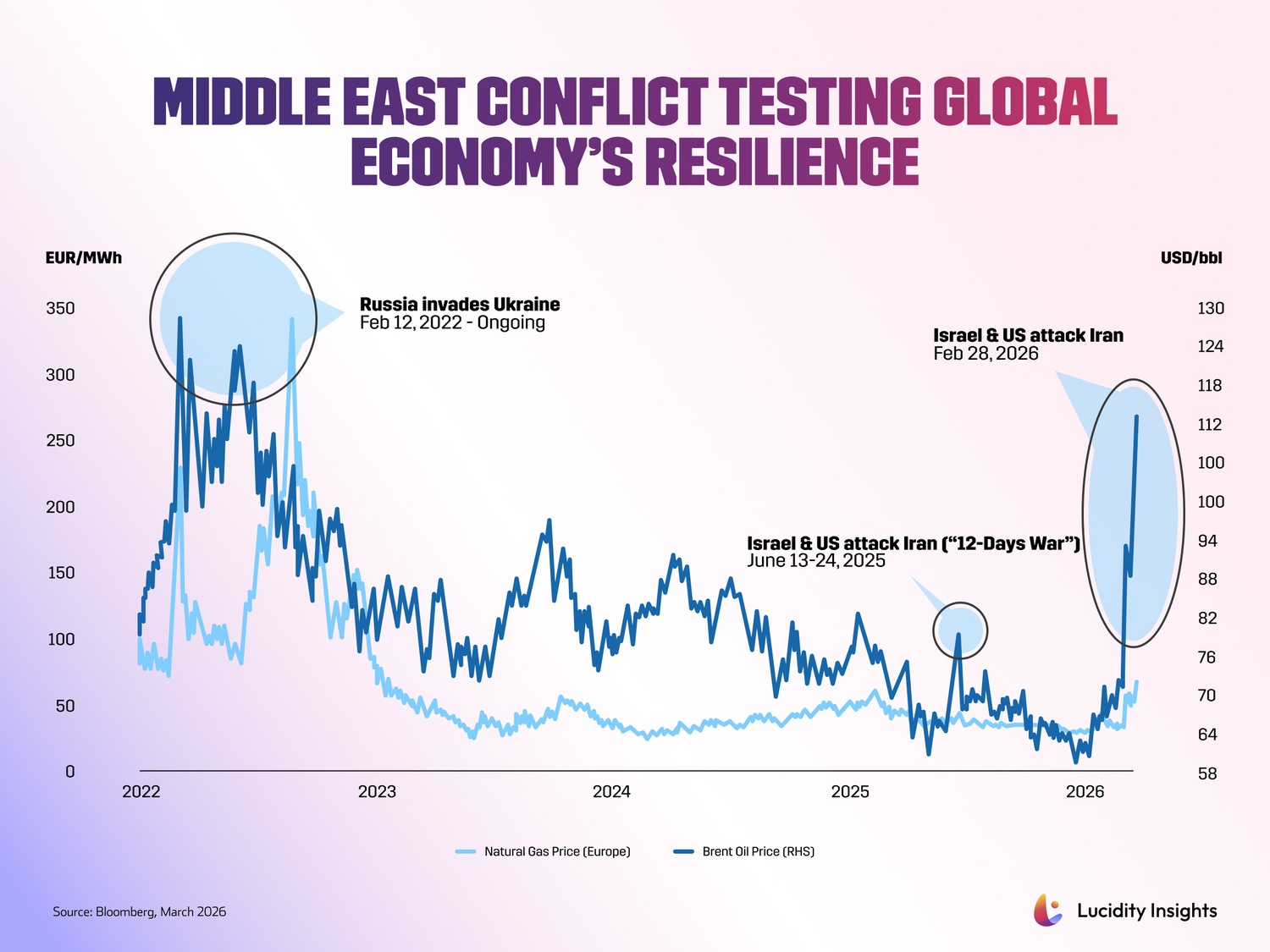
For oil-producing nations, the dynamic should, in theory, invert — higher prices translate into stronger revenues, fiscal surpluses, and increased sovereign liquidity – some of which go towards economic stimulus packages. In Saudi Arabia, where Brent above $100 per barrel materially strengthens the fiscal position, that buffer is real. But it comes with an important constraint: high prices only matter if oil can reach the market.
Recent events have exposed that limitation. In Saudi Arabia, Ras Tanura was shut for 16 days, output was reduced by an estimated 25% in March, and key export infrastructure has come under repeated targeting. The result is a disconnect between pricing and realization — the windfall exists on paper, but is partially constrained in practice.
The UAE has faced similar pressures. Iran deliberately targeted Fujairah — the terminus of the UAE's only crude export pipeline bypassing the Strait of Hormuz — hitting it at least three times in four days in mid-March and damaging the manifold systems that manage oil flow through the port. The Shah gas field and Habshan complex were also temporarily taken offline following drone strikes.
Across the wider Gulf, the disruption has been even more severe: QatarEnergy declared force majeure on LNG shipments following damage to Ras Laffan - the world’s largest LNG processing and export facility; and Kuwait and Bahrain have faced significant infrastructure pressure of their own. ADNOC's CEO Sultan Al Jaber described the coordinated targeting of energy infrastructure as "global economic warfare" — a characterisation that reflects both the scale of the assault and the resolve with which the region has responded.
The recovery response has been notable. By late March, crude loadings at Fujairah had recovered to 1.9 million barrels per day — 57% above the 2025 average — as ADNOC restored export capacity at pace. Saudi Arabia has rerouted significant volumes via Yanbu - along the Red Sea, maintaining export flows despite sustained pressure on Gulf infrastructure. The windfall is real, if partially constrained — and both governments have demonstrated the operational resilience to defend it.
The region is no longer defined by oil. But in moments like these, it remains the system’s most powerful lever — when it flows. Recent attacks on energy infrastructure across the Gulf have made that conditionality increasingly visible. The fiscal buffer is real, but it depends on pipelines, terminals, and refineries continuing to operate without disruption.
At the same time, the impact at the micro level is far more immediate and far less ambiguous. Rising energy costs are pushing up operating expenses and compressing margins for startups and SMEs that lack the balance sheet resilience of larger corporations.
Oil, then, plays a dual role. It acts as a stabiliser at the top of the system when infrastructure holds — while simultaneously exerting pressure from below at the micro-economy level - directly impacting business costs and consumer wallets, regardless of whether it does.
Talent in Motion
Alongside capital, talent is also shifting. Roughly 90% of the UAE’s population is expatriate — including an estimated one million Western professionals. A portion of this globally mobile workforce has opted to temporarily relocate, often continuing their roles remotely. Not all will return, and many professionals who had planned to move to Dubai and the wider region have, for now, paused those decisions.
The contrast with Saudi Arabia is notable. With expatriates making up closer to 40% of the population, and with less direct exposure to perceived regional risk, talent flows there have remained comparatively stable.
Even in an era increasingly shaped by AI and automation, this moment is a reminder that human capital remains central to how ecosystems function. In environments where talent density drives innovation, even modest outflows can have outsized consequences — slowing momentum, fragmenting teams, and reducing the speed at which companies build and scale.
A Capital Reality Check
This moment surfaces a structural truth: not all capital bases are created equal. Dubai has built one of the Middle East's most dynamic startup hubs — but one built on significant reliance on international capital and global talent. Abu Dhabi and Saudi Arabia, anchored by vast oil-backed sovereign wealth, are considerably more insulated from shifts in global sentiment.
In late March 2026, Dubai announced a Dh1 billion (US$272 million) stimulus package — covering fee deferrals, customs grace periods, and simplified residency processes. The intent is clear and the signal is strong. But its direct impact on growth-stage startups reliant on an ability to consistently fundraise from both local and international investors remains limited.
Saudi startups, meanwhile, fundraised and deployed $2.2 billion in 2025. High-growth companies across the region are increasingly looking to the Kingdom for scale, capital, and IPO pathways. In the current environment, that trend could accelerate. The principle is becoming clear: in times of stability, global connectivity is an advantage. In times of uncertainty, capital depth is decisive. And war is bad for business, wherever you are in the world - especially when the the war is taking place somewhere so fundamentally critical to the energy supply driving global economies.
Crisis or Catalyst?
The answer is both.
War is introducing friction into the Middle East's startup ecosystem — not through widespread physical destruction necessarily, but through the economic weight of risk being recalculated. Capital is slowing. Talent is shifting. Confidence is being tested.
But it is also accelerating structural evolution — reinforcing the importance of domestic capital, stress-testing diversification strategies, and pushing business leaders and startup founders toward more disciplined, sustainable models.
For regional founders, this moment is clarifying. When capital is abundant, inefficiencies can be overlooked. When it tightens, discipline becomes essential — a lesson already learned through the global VC downturn that has persisted since 2022.
Across the region, founders are extending runways, rationalising costs, and returning their focus to revenue and unit economics. A meaningful recovery is not expected until the latter half of the year - and that’s if the war ends tomorrow. Rebuilding international confidence will take time — perception typically lags reality, and its impact on capital flows is disproportionate in both directions.
Amid all of this, one thing remains clear. There is the version of the Middle East that exists in global headlines — and there is the one being built on the ground. The latter continues to adapt, evolve, and grow, even under pressure. And when this moment passes, it is likely to leave behind stronger leadership, more disciplined startups, and more resilient companies and economies than those that entered it.

%2Fuploads%2Fdubai-startup-guide-2025%2Fcover%2520dcde%2520startup%2520guide%25202025.jpg&w=3840&q=75)