AI's New Power Corridor: The UAE and Saudi Arabia
26 October 2026•

The fastest way to understand why the Middle East is becoming a hotbed for AI is to stop thinking about “apps” and start thinking about infrastructure, policy, and power. The region’s leading markets—especially the UAE and Saudi Arabia—aren’t just adopting artificial intelligence. They’re building the conditions that make AI inevitable: sovereign-grade cloud capacity, national AI strategies, dedicated institutions, and partnerships with the world’s most important AI platform players.
The opportunity is material. In 2018, PwC estimated that artificial intelligence could contribute US $320 billion to the Middle East economy by 2030 — roughly 2% of projected global AI gains and equivalent to about 11% of regional GDP. That estimate was made before the generative AI surge, and before ChatGPT and Claude turned frontier models into everyday enterprise tools.
Since then, global AI impact projections have expanded, with some estimates placing total economic upside at US$17 trillion or more by 2030. If the Middle East were to capture even 2–3% of that value, the regional impact would range from approximately US$340 billion to over US$500 billion this decade. The precise figure may vary, but the trajectory is unmistakable: AI’s economic upside for the Middle East is not incremental—it is structural. That kind of prize does not attract marginal reform. It demands nation-state strategy.
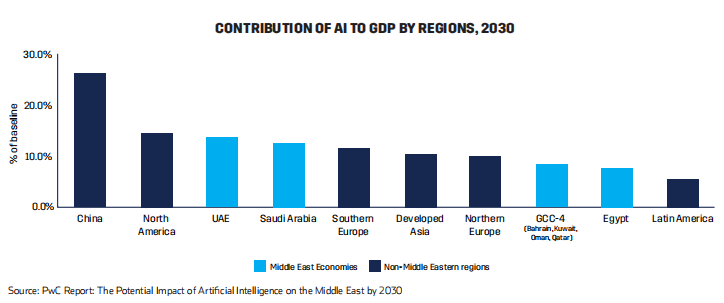
The Middle East did not become an AI hotspot by accident. It did so by making artificial intelligence a matter of national strategy — and then funding it like infrastructure. While much of the world treated AI as a product cycle, the UAE and Saudi Arabia treated it as economic architecture. The result is not just adoption momentum, but structural positioning in the global AI race.
The UAE: Speed, Infrastructure and Deployment
The UAE was among the first movers globally, and they moved decisively on AI. In 2017, it launched its National Strategy for Artificial Intelligence 2031 and appointed the world’s first Minister of State for AI. That wasn’t just a symbolic gesture; it embedded AI into federal governance and accelerated coordination across ministries.
By 2019, the country had established the Mohamed bin Zayed University of Artificial Intelligence (MBZUAI), creating a domestic research-to-deployment talent pipeline at a time when most nations were still debating AI ethics frameworks. But policy only matters if infrastructure follows.
Microsoft launched its Azure cloud regions (areas that operate multiple data centers) in both Abu Dhabi and Dubai in 2019. AWS opened its UAE region in 2022 with three Availability Zones (i.e. three physically distinct data center clusters that operate independently of each other).
Google Cloud serves the market from its nearby Gulf regions in Doha and Dammam. These hyperscaler commitments represent billions in capital expenditure and significant installed data center capacity — the plumbing that allows AI workloads to run securely and at scale.
Energy is becoming the quiet constraint in the AI race. AI workloads are compute-intensive by design, and that intensity is materially increasing electricity demand — particularly through hyperscale data centers. The International Energy Agency (IEA) estimates that data centers consumed around 485 terawatt-hours (TWh) of electricity in 2025, 17% more than a year earlier, while demand from AI-focused data centers rose by roughly half.
This is where parts of the Middle East begin to look structurally advantaged. Gulf economies benefit from centralized infrastructure planning, available land for hyperscale development, and comparatively competitive energy costs. In an AI economy constrained by compute and power availability, the ability to align digital expansion with national energy strategy is not a luxury—it is leverage.
The UAE exemplifies this alignment. It operates a modernized grid, diversified generation capacity, and stable baseload power, including nuclear energy from the Barakah plant, whose four reactors supply about a quarter of the country’s electricity. Dubai’s Mohammed bin Rashid Al Maktoum Solar Park — one of the world’s largest single-site solar developments, at 3,860 MW today and targeting more than 8,000 MW by 2030 — anchors long-term renewable expansion, while Moro Hub, whose solar-powered data center opened at the park in 2023, brings solar-powered data center capacity into the digital infrastructure stack.
The UAE has since raised its clean-energy target, covering both renewables and nuclear, to 35% of its energy mix by 2030–31. In a world where AI growth is colliding with power constraints, that combination of reliability, scale, and planning discipline may prove decisive.
Why else has the UAE become a hot bed for AI adoption? The UAE also benefits from its digitally fluent population. Internet penetration stands at around 99%, and smartphone adoption is near universal. GDP per capita (PPP) is among the highest globally. Enterprise budgets exist; government procurement moves quickly; AI does not struggle to find buyers in this market.
The UAE’s model-building efforts — from Falcon 40B and Falcon 180B to the Technology Innovation Institute’s Falcon-H1 Arabic in January 2026 and MBZUAI’s K2 Horizon, a family of six fully open models released in September 2026 — have added global visibility. But its deeper advantage lies in being a fast, well-capitalized deployment hub: an international sandbox where AI can be tested, scaled, and governed. If the global AI race has hubs of invention, the UAE is positioning itself as a hub of execution.
Saudi Arabia: Scale, Sovereignty And Compute Power
Saudi Arabia’s AI trajectory is different — and arguably more industrial than that of the UAE. In 2020, the Kingdom formalized its National Strategy for Data and AI under Vision 2030, explicitly framing AI as a pillar of economic diversification. Where the UAE optimized for speed, Saudi Arabia is optimizing for scale.
Over the past few years, cloud infrastructure expansion has accelerated. Google Cloud opened its Dammam region in 2023. AWS is set to launch its Saudi region in December 2026, backed by a US$5.3 billion investment, and Microsoft’s Saudi Arabia East datacenter region is due to open to customers in November 2026.
These are not incremental upgrades; they are all signals that the Kingdom intends to host, not just consume, AI workloads.
The most consequential signal, however, is compute ambition. Partnerships tied to sovereign AI capacity — including HUMAIN’s partnership with NVIDIA to build “AI factories” of up to 500 megawatts over five years — indicate a willingness to treat compute like industrial infrastructure. HUMAIN, the national AI company launched by the Public Investment Fund in May 2025, is targeting 1.9 gigawatts of datacenter capacity by 2030. How that capacity is financed is also changing: as the Kingdom reins in fiscal spending, HUMAIN has begun courting outside investors and is planning a listing in Riyadh and New York by 2029. In the AI era, megawatts could be equated to strategic advantage.
Saudi Arabia is also building Arabic language AI sovereignty, deploying national models such as ALLaM into enterprise-grade platforms. HUMAIN’s ALLaM 34B, launched in August 2025, also powers its consumer app, HUMAIN Chat. The intent is clear: reduce dependence on foreign language models and strengthen local digital ecosystems.
Where the UAE built a high-velocity AI ecosystem in a small, agile market, Saudi Arabia is building national-scale AI capacity in a much larger economy. One is optimized for global integration; the other for industrial depth.
Both countries have laid out somewhat similar foundations but are playing fundamentally different roles. The structural similarities are obvious: National AI strategies embedded in executive government; sovereign capital aligned to long-term digital infrastructure, now increasingly supplemented by outside investors, as both G42 and HUMAIN look to raise external capital; deep partnerships with hyperscalers such as AWS, Microsoft Azure, and Google Cloud, and a policy posture that encourages deployment across government, healthcare, education, and energy.
Both also benefit from strong energy economics and centralized infrastructure planning — advantages that matter when AI growth becomes constrained by power availability. But their positioning within the global AI race differs.
The UAE functions as a global AI deployment hub — fast, internationally connected, digitally advanced, and highly attractive for multinational AI experimentation and rollout. Saudi Arabia, on the other hand, is emerging as a sovereign compute and AI industrial platform — building domestic capacity at scale, aligning megawatt power with GPU clusters, and embedding AI into national economic transformation.
The next test for that corridor is how reliably it can support AI at scale. Building capacity is one part of the equation; ensuring continuity as businesses and public services come to depend on it is another. That requires dependable power and connectivity, redundancy across locations, and robust arrangements for data backup and recovery. The region’s advantages in energy, capital and speed remain significant. Translating those advantages into lasting value will depend as much on the reliability of the infrastructure as on the pace of its expansion.
Together, the UAE and Saudi Arabia are forming a new power corridor in the AI economy. Neither the UAE nor Saudi Arabia currently competes with the United States or China in frontier model volume.
But that is not the point.
In an era where AI advantage increasingly depends on infrastructure, energy, deployment velocity and the ability to deliver reliable services at scale, both countries are building durable leverage.
The Middle East is not trying to replicate Silicon Valley. It is building the substrate on which the next phase of AI growth will run. And in the infrastructure era of artificial intelligence, that may just be the smarter play.
Discover how the Middle East is out-building global tech hubs and what this massive ecosystem shift means for founders and investors in The State of AI 2026.