
AI & Proptech: How Reno App is Using AI to Transform Real Estate's Most Unpredictable Layer
22 April 2026•
%2Fuploads%2Fai-2026%2Fspotlights%2Freno%2Freno-ai-cover.jpg&w=3840&q=75)
%2Fuploads%2Fstartups%2FUAE%2Freno.jpg&w=3840&q=75)
Real estate has digitized transactions, payments, and asset management, embedding data into nearly every stage of ownership. Yet one of its most capital-intensive layers remains structurally ungoverned: renovation. Once ownership transfers and upgrades begin, institutional discipline gives way to informal coordination. Contractors operate across fragmented channels, budgets evolve without standardized benchmarks, and capital is deployed with limited predictive visibility.
For Marc Michel, Co-Founder and CEO of Reno, this reflects a structural data gap within the real estate lifecycle.
“Renovation is one of the most valuable phases in the real estate lifecycle, yet it still operates like it’s the 90s,” he says. “Homeowners are juggling contractors on WhatsApp, tracking budgets in Excel, and relying on goodwill to stay on schedule. We believed that if execution could be structured, risk could be structured. And once risk is structured, capital can follow.”
Reno is building what it describes as an operating system for renovations — an infrastructure layer where artificial intelligence supports execution governance, cost normalization, and underwriting logic. Since launch, the company has completed more than 120 projects and raised $3.6 million in equity and debt financing, positioning it to scale its AI-driven execution model across the Middle East.
1) The Structural Blind Spot in Real Estate
Renovation sits at the intersection of developers, contractors, and lenders, yet remains institutionally owned by none of them. Developers deliver assets, contractors execute upgrades, and banks finance acquisitions, but the stage where capital is converted into tangible value through refurbishment has historically lacked standardized oversight.
The consequence is persistent uncertainty. Execution variables are difficult to benchmark, documentation is inconsistent, and delivery performance is rarely centralized. For lenders, renovation risk remains difficult to model because reliable historical comparability is limited.
Farah Karabeg, Reno’s Co-Founder and COO, describes what the company observed in the market. “Renovation has always been treated as an emotional process. What we identified was the absence of a governance layer. If scope is standardized, approvals are digitized, and payments are tied to verified milestones, much of the chaos becomes controllable.”
Within this structure, AI provides the technical infrastructure that embeds governance directly into execution.
2) Embedding Intelligence Where It Matters
Reno applies AI selectively, targeting points where ambiguity historically generates financial and operational risk. At the design stage, AI-generated visualizations align expectations early in the lifecycle, reducing downstream friction. More consequential is the normalization of Bills of Quantities.
By standardizing contractor language and benchmarking line items against historical project data, Reno transforms opaque negotiation into structured comparison.
Execution oversight follows the same logic. Baseline video capture establishes a digital reference point. Contractor updates are converted into structured logs, inspection workflows are generated according to scope, and progress is validated against predefined milestones.
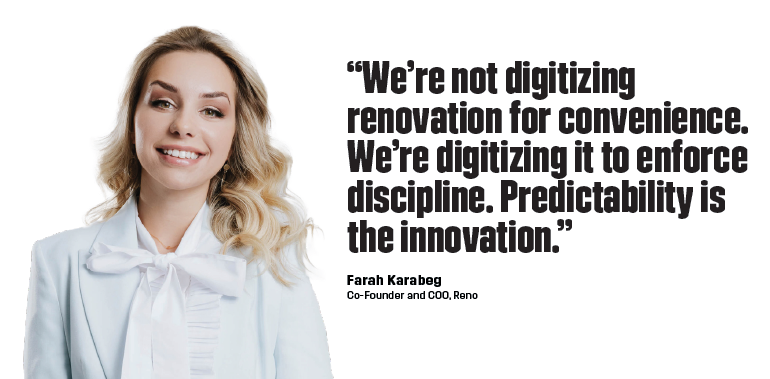
Oversight scales through system logic, with interventions triggered by deviations from defined thresholds. As Karabeg notes, “We’re not digitizing renovation for convenience. We’re digitizing it to enforce discipline. Predictability is the innovation.”
3) From Execution to Underwriting
The most strategically differentiated aspect of Reno’s model lies in how execution data is integrated with capital deployment.
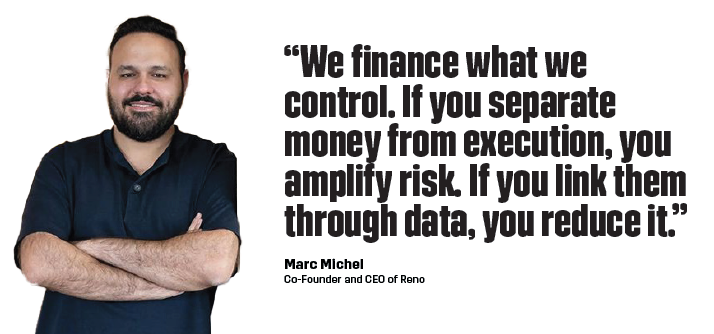
Traditional renovation financing is constrained because lenders lack structured insight into delivery risk. Reno links capital release directly to verified milestones within a controlled execution environment. Funds are disbursed in tranches following inspection validation, while retention mechanisms and behavioral signals inform underwriting decisions. Marc summarizes the principle: “We finance what we control. If you separate money from execution, you amplify risk. If you link them through data, you reduce it.”
As projects accumulate, Reno’s dataset expands to include contractor reliability, cost variance, timeline adherence, and payment performance. Underwriting sharpens as intelligence compounds, allowing financing capacity to scale alongside predictability.
4) What Next?
Reno’s next phase focuses on predictive modeling and persona-based credit engines that further integrate governance into the platform’s core. Much of this capability will be embedded in Reno App 2.0, the company’s next product iteration, which introduces AI-driven visualization, structured scoping tools, and automated quality and milestone tracking designed to transform how renovation projects are initiated and managed.
As predictive capabilities mature, renovation begins to resemble a structured financial instrument rather than a volatile project. Standardized scopes, benchmarked costs, and forecastable timelines allow capital to be deployed with greater confidence.
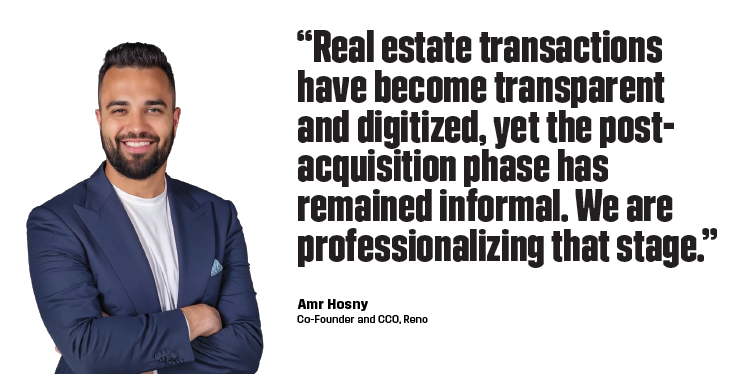
Amr Hosny, Co-Founder and Chief Commercial Officer, situates this shift within a broader industry evolution. “Real estate transactions have become transparent and digitized, yet the post-acquisition phase has remained informal. We are professionalizing that stage. Investors increasingly recognize renovation as a value lever, and value levers require structure.”
Reno’s model illustrates how AI can function as a governance layer within the built environment, structuring execution in areas where capital has historically outpaced control. By converting renovation into structured, auditable, and financeable data, the company reframes it as a repeatable and institutionalized component of the real estate value chain.

%2Fuploads%2Fproptech-2024%2Fcover25.jpg&w=3840&q=75)