
Peak Games: Turkey’s First Unicorn, a Decade in the Making
07 April 2026•
%2Fuploads%2Fturkey-unicorn-2026%2Fspotlights%2Fpeak-games%2Fpeak-team.jpg&w=3840&q=75)
%2Fuploads%2Fstartups%2Fpeakgames.jpg&w=3840&q=75)
The math is almost offensive in its simplicity. One hundred employees. Eighteen million dollars raised across a decade. Two games. And a $1.8 billion acquisition that made a 31-year-old from Istanbul the founder of Turkey’s first Unicorn.
When Zynga announced its purchase of Peak Games on June 1, 2020, the deal sent Zynga’s stock up more than five percent and made global headlines as the largest acquisition of a Turkish startup in history. What drew less attention was the arithmetic behind it: Peak had built games generating $40 million in monthly revenue with a team smaller than most San Francisco product squads. That ratio — the scale of impact against the restraint of means — is the actual story of Peak Games. It was never about invention. It was about discipline.
The e-Commerce Dropout Who Wanted to Change the World
Sidar Sahin came to gaming with context most gaming founders lack. A Bogazici University graduate, he had already helped build Trendyol — Turkey’s largest e-commerce platform — before turning to games in 2010. He had watched Trendyol build market share in an emerging digital economy by out-executing incumbents, not out-innovating them. He believed the same logic applied to mobile entertainment, and he believed Istanbul, with its deep engineering talent and proximity to the underserved MENA gaming market, was exactly the right place to test it.
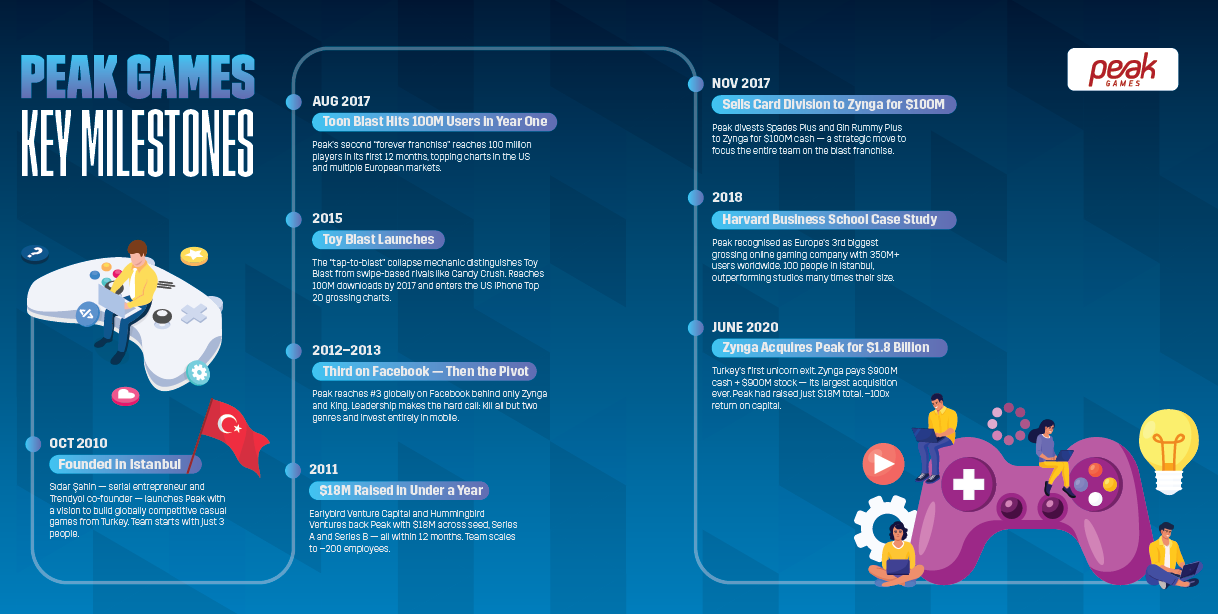
He founded Peak in October 2010 with a clear-eyed thesis: casual games were a universal language that transcended cultural barriers, something that had confined most Turkish tech companies to domestic markets. “I started Peak to change the world,” he told the Wall Street Journal in 2012. He meant it architecturally. He wasn’t building a game studio. He was building a system.
The Facebook Years — and the Decision to Leave
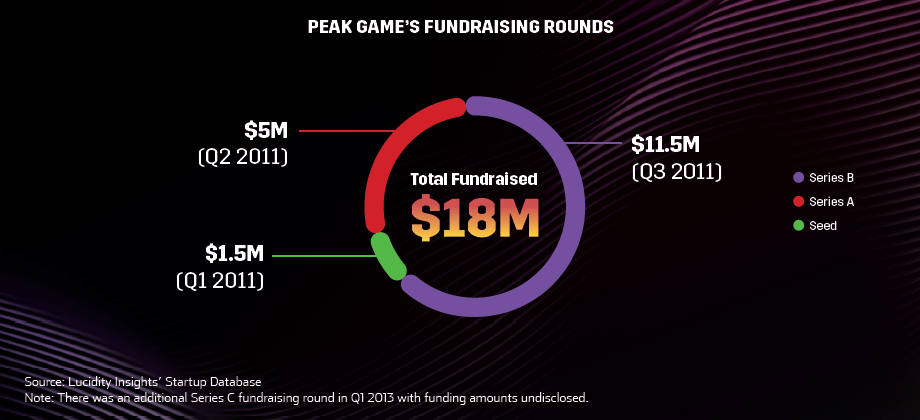
Peak’s early years looked like a conventional social gaming success story. The company raised $1.5 million in seed funding in early 2011, followed by a $5 million Series A in May and an $11.5 million Series B in September — a pace of capital formation that reflected genuine momentum. By 2012, Peak had scaled from three employees to roughly 200 and had become the third most popular game maker on Facebook globally, behind only Zynga and King.
That ranking was both a milestone and a warning sign. Facebook’s gaming ecosystem was showing early signs of structural decline as smartphones proliferated. Most incumbents were slow to respond — platform loyalty is expensive to abandon when the revenues are good. Sahin moved early. Co-founder Rina Onur articulated the bet clearly: “We started to invest in mobile not for short-term profit but because we knew it was the future. We began investing when there were only 2 million mobile devices in the region, and we had 10 million customers on Facebook.”
The pivot came with a harder decision attached. In their third year, Peak concluded that building across too many categories was diluting their execution. They narrowed to just two genres: puzzle games and card and board games. That meant shutting down profitable titles the team had built.
Most founders don’t kill games that are making money. Peak did it because scattered focus was the greater long-term risk. The discipline embedded in that choice would define everything that followed.
The Tap that Candy Crush Couldn’t Copy
The first fruits of the pivot arrived in 2015 with Toy Blast. The game introduced a “tap-to-blast” collapse mechanic that distinguished it from the swipe-based match-3 games King had made famous with Candy Crush. Players cleared colorful blocks by tapping groups, an interaction that proved more intuitive on small touchscreens and more satisfying in short mobile sessions. Toy Blast surpassed 100 million downloads by 2017 and has since exceeded 200 million lifetime installs.
Toon Blast followed in August 2017, building on the same collapse mechanics with new character universes and expanded combo systems. It reached 100 million users within its first year — a figure that put it in conversation with franchises built by studios ten times Peak’s size. Both games were developed with obsessive data iteration, with Peak’s data scientists evaluating variations in level designs, power-ups, and monetization features continuously against real-time user behavior metrics.
The competitive context matters here. Zynga had tried to build its own rival franchise — Wonka’s World of Candy — to compete in the same genre. It never came close to Peak’s engagement numbers. King, despite its decade-long dominance in match-3, had not cracked the collapse mechanic with the same depth. Toon Blast and Toy Blast didn’t just compete; they became permanently recurring fixtures in the top 10 and top 20 US iPhone grossing charts, year after year, with player retention metrics that ranked among the best in the industry.
The First Zynga Deal — and What it Signaled
In November 2017, Peak made a move that initially confused observers. It sold its card and board games division — including Spades Plus and Gin Rummy Plus, the largest spade and rummy mobile games in the world at the time — to Zynga for $100 million. Peak was cashing out a profitable unit at the top of its market. The logic was strategic, not financial. The sale eliminated a product category competing for the same internal attention as Toy Blast and Toon Blast, returned capital to focus the company’s energy entirely on its blast franchise, and established Peak’s credibility as a serious counterparty for a future transaction. Sidar Sahin retained Peak’s most valuable assets and demonstrated he knew exactly which ones those were.
By 2018, a Harvard Business School case study had recognized Peak as Europe’s third biggest grossing online gaming company with an audience of over 350 million users worldwide. The 100-person team in Istanbul had become a globally documented model of efficient, focused product development.
Turkey’s First Unicorn
The COVID-19 pandemic accelerated gaming growth across all categories as locked-down consumers sought entertainment at home. By mid-2020, Toon Blast and Toy Blast collectively had more than 12 million average daily active users and were generating $40 million in monthly revenue — a run rate approaching $500 million annually from two titles, built by a team that still fit in a single Istanbul office.
On June 1, 2020, Zynga announced an agreement to acquire 100% of Peak for $1.8 billion — $900 million in cash and $900 million in Zynga stock. The deal was Zynga’s largest acquisition in its 13-year history and would increase Zynga’s average mobile daily active users by more than 60%. It was also Turkey’s first billion-dollar startup exit.
Peak had publically raised $18 million, and an additional undisclosed Series C round across its life. The return on that capital was approximately 100x Frank Gibeau, Zynga’s CEO, framed the logic plainly: “Peak is one of the world’s best puzzle game makers and we could not be more excited to add such creative and passionate talent to our company.” Sahin, in his own statement, captured the scale of the moment: “This is a monumental partnership not only for Zynga and Peak, but for the whole mobile gaming industry. Both companies share a common vision — to bring people together through games.”
Peak’s team stayed in Istanbul. The games kept climbing the charts.
The Franchise that Spawned a Franchise
The larger consequence of the acquisition is still unfolding. Within months of the Zynga deal, Peak alumni had founded new gaming studios with levels of ambition and capital access the Turkish ecosystem had never seen. Dream Games — another Turkish Gaming Unicorn – was co-founded by five Peak veterans who succesfully raised $57.5 million before launching its first game. This became the largest Series A in Turkish startup history at the time. More than twenty studios have been founded by former Peak employees, drawing comparisons to the PayPal Mafia’s effect on Silicon Valley.
The questions left open by Peak’s story are the interesting ones. Can Istanbul sustain a second generation of gaming unicorns without the institutional advantage of Peak’s decade of failure and iteration? Will the “Peak mafia” prove that the formula was transferable, or that Sahin’s particular obsession was the irreplaceable ingredient? And as the Turkish mobile gaming ecosystem draws international capital at a scale it never attracted before, can it absorb that investment without losing the lean execution culture that made Peak exceptional in the first place?
As Lucidity Insights’ Regional Unicorn Tracker shows, Turkey recently birthed it’s 3rd Gaming Unicorn, Loom Games, and in a breathtaking record time of 7 months. Peak Games’ $1.8 billion exit is the ending of just one Turkish Gaming story. What it catalyzed in Istanbul may be a much longer one, that is still in the middle of writing itself.
Discover what’s powering Turkey’s unicorn surge in our full 2026 report - download now.

%2Fuploads%2Fturkey-unicorn-2026%2Ftur26-new-cover2.jpg&w=3840&q=75)