
Loom Games Becomes Turkey’s 3rd Gaming and Fastest Unicorn to Date
14 April 2026•
%2Fuploads%2Fturkey-unicorn-2026%2Fspotlights%2Floom%2Floom-cover.png&w=3840&q=75)
%2Fuploads%2Fstartups%2FTUR%2Floom-games.jpg&w=3840&q=75)
The numbers are hard to process. A 20-person studio founded in 2019, launches a game in 2025, reaches 10 million players, cracks the US top-20 grossing charts, and closes a majority-stake acquisition valuing the business in excess of $1 billion — all within seven months of its first game’s launch. By any conventional measure of startup timelines, Loom Games shouldn’t exist yet. Turkey’s newest gaming unicorn achieved in a single season what most studios spend a decade trying to build.
But the Loom Games story isn’t really about seven months. It’s about six years. The speed of Pixel Flow!’s ascent was not a beginner’s miracle; it was the output of a system that two Istanbul-based engineers spent the better part of a decade learning to run. Understanding why the game worked means starting long before Loom Games was ever founded.
Six Years of Groundwork, One Game
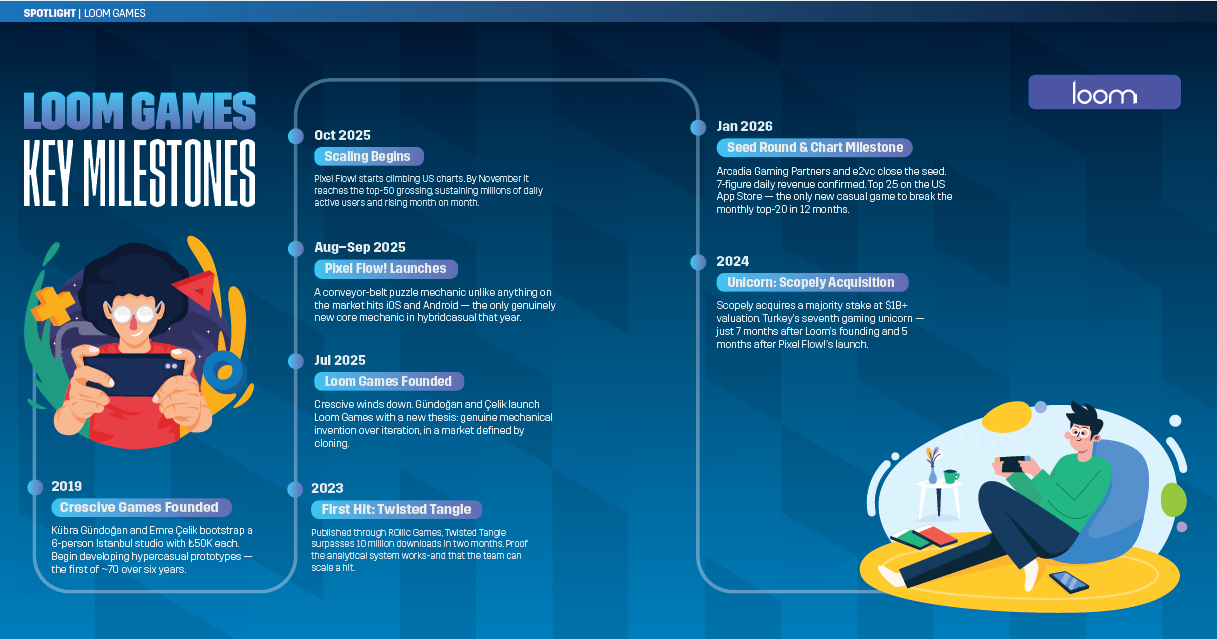
In 2019, Kübra Gündoğan and Emre Çelik were freshly graduated computer engineers with roughly ₺50,000 each — a few thousand dollars — and an idea for a mobile game studio. They named it Crescive Games, based it in Istanbul, and assembled a six-person team. They had no outside funding, no publisher deal, and no hit title. What they had was a process: build fast, analyze deeply, kill what doesn’t work, and start again.
Over the next six years, the team produced approximately 70 game prototypes. Most went nowhere. The discipline was the point. By iterating relentlessly across hypercasual concepts — games designed to be simple to install, fast to monetize, and analytically transparent — Gündoğan and Çelik built an unusually rigorous understanding of how players actually behave rather than how designers imagine they will. That rigor eventually produced a breakthrough. Twisted Tangle, developed by Crescive and published through Rollic Games, surpassed 10 million downloads worldwide within two months of its release, making it Rollic’s biggest hit of 2023. The studio had proved it could scale a hit. What it hadn’t yet done was invent one from scratch on its own terms.
The Game That Wasn’t Supposed to Work
In July 2025, Crescive wound down as an active vehicle and Loom Games was born. The founding decision was strategic and deliberately contrarian. The hybridcasual segment — games that combine the frictionless onboarding of hypercasual with the deeper monetization of mid-core titles — had become the fastest-growing category in mobile gaming, with IAP revenue up 88% year-over-year by late 2025. The opportunity was real. So was the trap: the market rewarded iteration, and most competitors were playing the iteration game, recycling proven mechanics with incremental improvements rather than building new ones.
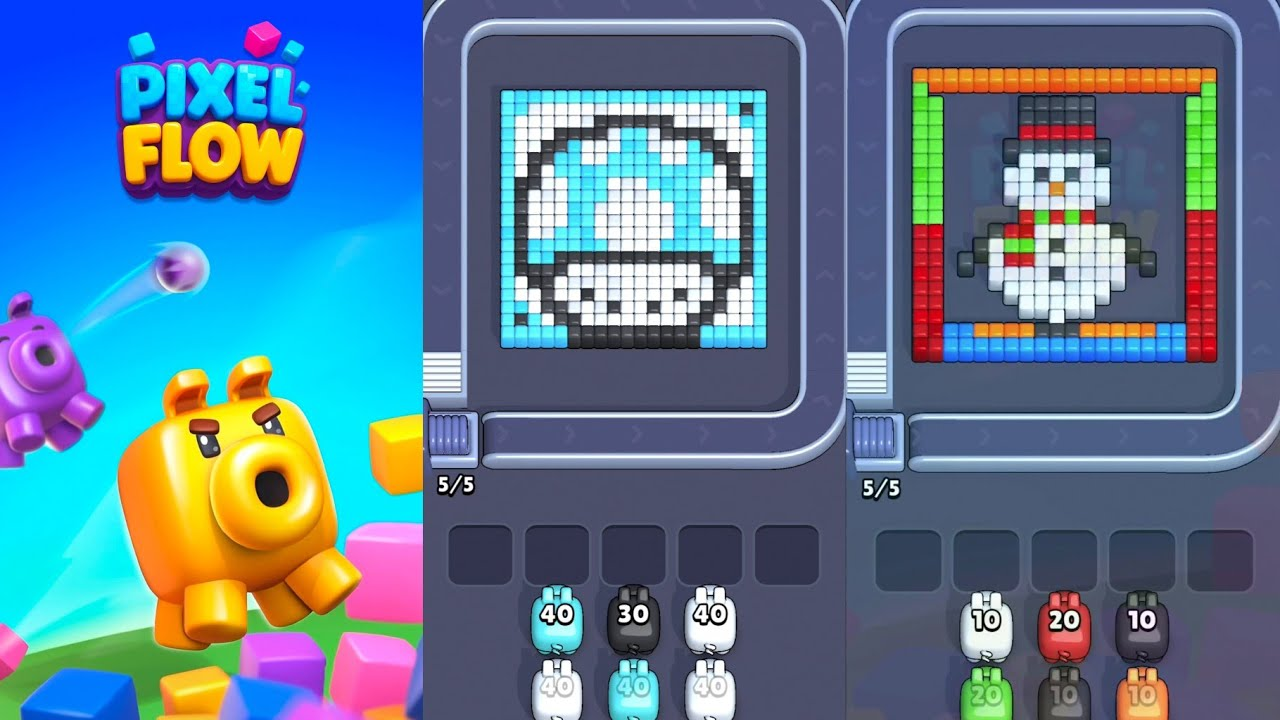
Gündoğan and Çelik bet on invention. Pixel Flow! centered on a mechanic without a direct equivalent on the market: a conveyor belt of pigs shooting colored balls at pixel cubes, clearing them when colors matched. Simple enough to grasp in seconds; deep enough in its combination logic to sustain engagement across hundreds of levels.
“Pixel Flow isn’t just a new game,” Gündoğan said at the time of the seed announcement. “It represents a completely new core mechanic and a new definition of fun.”
The framing wasn’t marketing language — it was a thesis about how to win a market where King, Voodoo, and Rollic held entrenched chart positions with franchise IP and nine-figure UA budgets.
Cracking the US Top-Grossing Games
Pixel Flow! launched in August 2025. By October it was scaling. By November it had climbed to around the top 50 on US grossing charts. By January 2026, it was generating seven-figure daily revenue from a combination of in-app purchases and advertising — the dual-stream model that hybridcasual had elevated into the dominant monetization framework of the era — and had broken into the top 25 on the US App Store’s top-grossing ranking. It was the only casual game released in the preceding twelve months to reach the US monthly top-20 grossing charts.
What those chart positions meant competitively is worth making explicit. The US top-grossing leaderboard is where incumbents park permanently. Dream Games, Supercell, and King do not cede those positions to first-time studios. The conventional wisdom in 2025 was that original IP was too expensive to launch against franchise competitors with vast marketing budgets and pre-built player bases.
Pixel Flow! did not receive that memo. Investor Akin Babayigit, whose firm Arcadia Gaming Partners had helped build some of Turkey’s most successful mobile studios, described what he was watching in unambiguous terms: “The attention it’s receiving isn’t only because it has some of the strongest metrics I’ve ever seen — it’s also because Kübra and Emre created a genuinely innovative mechanic and went on to conquer the market with it.”
The Investors Who Saw It First
The seed investment — a few million dollars from Arcadia and early-stage fund e2vc — closed in December 2025, announced publicly in early January 2026.
The sequencing matters. The money did not enable the game’s growth; it confirmed growth that was already happening. At a seed valuation of approximately $36 million, the round was modest given what the metrics were already showing. It served less as capital infusion and more as institutional endorsement: operators who understood the mobile gaming landscape at the highest level were putting their credibility behind the Loom Games thesis.
That endorsement also carried a signal for what was coming. The seed had been live for less than two months before Scopely came knocking.

Why Scopely Paid $1 Billion for Twenty People
In February 2026, Scopely — the Los Angeles-based mobile publisher behind Monopoly Go! and Pokémon Go, and a wholly-owned subsidiary of Saudi Arabia’s Public Investment Fund via Savvy Games Group — announced it had signed a definitive agreement to acquire a majority stake in Loom Games. The deal valued the business in excess of $1 billion, making Loom Games Turkey’s seventh unicorn overall and its third gaming unicorn, after Peak Games and Dream Games. The terms were structured on a multi-year, performance-based basis, meaning the headline valuation is contingent on continued growth milestones rather than paid upfront in full. Exact financial terms were not disclosed.
Scopely’s strategic logic was clear. The acquisition expanded its footprint in the hybridcasual category — an area of the market it had not previously occupied at scale — and gave it a direct presence in Turkey’s game development ecosystem, one of the most productive in the world.
For Scopely Chief Revenue Officer Tim O’Brien, the draw was the team as much as the title: “The combination of creativity, willingness to iterate, and immediate traction in the mobile game space is extremely rare and impressive.” He was also candid about the commercial case: Pixel Flow! had “delivered some of the strongest engagement metrics we’ve seen on mobile over the past year.”
Copycats had already appeared by the time the deal closed — an inevitable consequence of any breakout hit in a market where reverse-engineering is trivially fast. Defending Pixel Flow!’s chart position against well-funded clones without a major publisher’s user acquisition infrastructure would have been expensive and uncertain. The Scopely partnership addressed that threat directly while preserving what generated it. Gündoğan and Çelik will continue to lead the 20-person team from Istanbul, with creative autonomy intact.
“This is not an exit story — it’s a new beginning,” Gündoğan said. “This isn’t about exiting early; it’s about setting up Pixel Flow for long-term growth and impact.”
Defending the Hit, Building the Next One
The open questions are not small ones. The $1 billion valuation is performancecontingent — whether Loom actually clears that threshold depends on Pixel Flow! sustaining growth in a market that is already trying to clone it out of existence. The test of the Scopely partnership is whether institutional scale amplifies the creative edge that made the game possible, or gradually smooths it into something more manageable and less distinctive. And the larger question hanging over the Loom story is the one that applies to every hit-driven studio: can a team that built one genuinely original mechanic build a second one? Dream Games spent years building Royal Match before its next title. Loom Games is starting that second-act pressure with a far shorter runway of institutional credibility to fall back on.
What is not in doubt is the pattern Loom Games represents within Turkey’s gaming ecosystem. Peak Games, Gram Games, Dream Games, Rollic — Istanbul has produced a cluster of globally competitive mobile studios that reflects something structural about the talent network, the investor community, and the analytical culture that has developed there over two decades. Loom Games is the latest proof point, and the most compressed one yet. Six years of craft that looked, from the outside, like six months of luck.

%2Fuploads%2Fturkey-unicorn-2026%2Ftur26-new-cover2.jpg&w=3840&q=75)