
INSIDER ONE: How a Turkish SaaS Team Beat Silicon Valley at Its Own Game
13 April 2026•
%2Fuploads%2Fturkey-unicorn-2026%2Fspotlights%2Finsider%2Finsider-cover.png&w=3840&q=75)
%2Fuploads%2Fstartups%2FTUR%2Finsider-one.jpg&w=3840&q=75)
When Insider One (formerly known just as ‘Insider’) raised its $121 million Series D in March 2022 and crossed the $1.22 billion valuation threshold, it became something the MarTech industry had not seen before: Insider One became one of just a handful of female-led B2B SaaS companies anywhere in the world to reach the coveted Unicorn status. That milestone was notable. What preceded it was more interesting. Over ten years, six cofounders from Istanbul had quietly built enterprise marketing software trusted by more than 1,000 of the world’s leading brands — Samsung, Toyota, Singapore Airlines, GAP, Vodafone, Estée Lauder — while expanding to 29 countries across five continents before a single sovereign wealth fund had written them a cheque. By the time Qatar Investment Authority led that Series D, the proof of concept wasn’t a pitch deck. It was a customer list.
Six Co-Founders, One Thesis
The founding story begins not in a coworking space in San Francisco or a university dorm in London, but with a language school in Fethiye, Turkey. Hande Cilingir — LSE economics graduate, Shanghai Normal University (上海师范大学) postgraduate, and investment consultant across PepsiCo and Vestel in China — had co-founded an English language school with Serhat Soyuerel. They exited it successfully. The experience planted a specific frustration.
“Having successfully exited my first company,” Cilingir would later say, “I realized that marketers worldwide were struggling to achieve their ultimate goal — deliver a seamless and individualized customer experience.”
What she had seen running a small business was true at enterprise scale too: the tools that existed were fragmented, expensive to implement, and built around the needs of IT departments rather than marketing teams. In 2012, Cilingir, Soyuerel, and four co-founders — Arda Koterin, Mehmet Sinan Toktay, Okan Yedibela, and Muharrem Derinkök — sat down at six desks in Istanbul and started building an alternative.
The Architectural Bet
The gap they were targeting was structural. Enterprise marketing technology had been assembled over decades through acquisitions and boltons, leaving marketers dependent on stitched-together stacks that required specialist implementation partners and months of integration work before a single campaign could run.
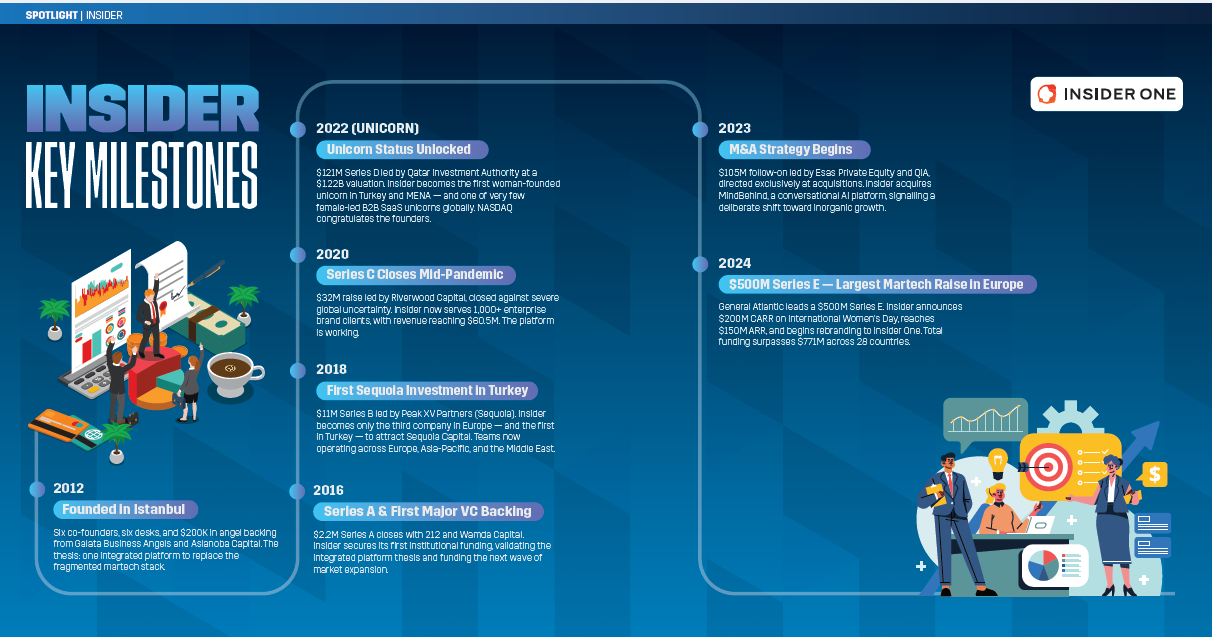
Customer data lived in one system, personalization in another, channel execution in a third. Insider’s founding bet was that a single platform — one that integrated data, AI, and channel delivery natively — could remove that complexity entirely. The goal was deployment in minutes, not months, and zero dependency on IT. That architectural decision would prove to be the source of everything that followed, but in 2012 it was just a hypothesis backed by $200,000 in angel funding from Turkish investors: Galata Business Angels and Aslanoba Capital.
The Long Road to Credibility
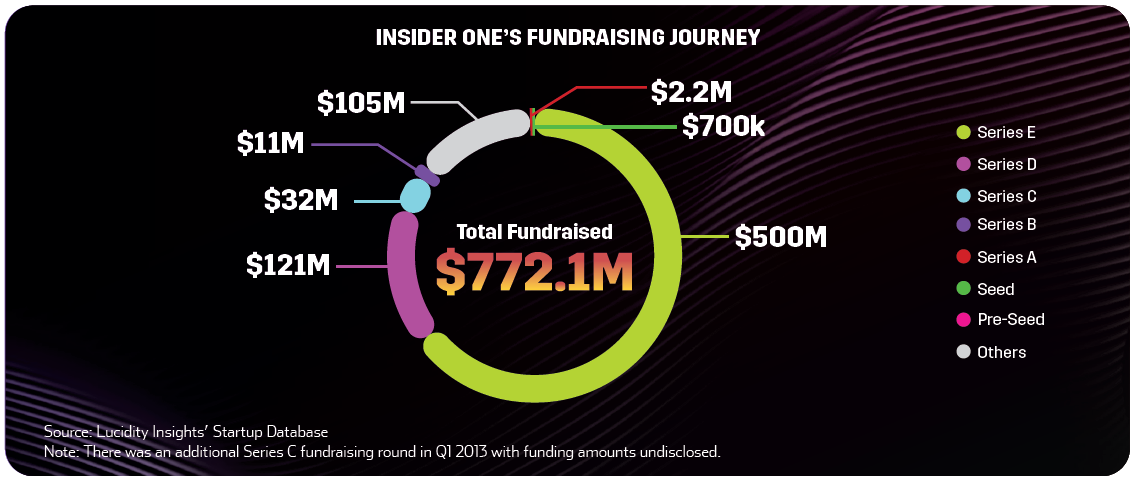
The early years were less about product and more about trust, built country by country. Insider joined the Endeavor network in 2014 — a relationship that would accompany every subsequent expansion — and closed a $700,000 seed round in 2015. A $2.2 million Series A followed in 2016, backed by 212 and Wamda Capital. An $11 million Series B followed in 2018, led by Peak XV Partners, with Doğan Holding, Wamda Capital, and others participating — and with it came a signal that the rest of the industry would eventually register: Insider became Insider became the first in Turkey to attract investment from Sequoia Capital.
For a startup from Istanbul, this was not an incremental funding announcement. It was a credibility signal that opened doors in markets the company had not yet entered. By then, Insider had teams operating across three continents.
Expanding Everywhere All at Once
What made the expansion unusual was that it was built simultaneously, not sequentially. Most enterprise software companies build a dominant position in the United States and then export it. Insider inverted that model. It opened offices in Southeast Asia, the Middle East, Latin America, and Europe in parallel — each one requiring local hires, local relationships, and local product adaptations.
Cilingir has described the compounding effect of this approach with characteristic directness: “People think we started Insider once, but we started it 29 times. When we first expanded to Malaysia, we started Insider again. When we expanded to Korea, to Mexico, to the US — each time, we started Insider again. And over ten years expanding to 29 different countries, I multiply those two numbers. We started Insider 290 times.” The discipline required to do that — to build a genuinely local enterprise sales motion in markets as different as Japan, Brazil, and the UAE, repeatedly, without a dominant home market to subsidise the effort — is the less visible story beneath the funding headlines.
When Proof of Concept Pays Off
By the time the pandemic arrived, Insider had 1,000 enterprise brand clients and was closing its $32 million Series C, led by Riverwood Capital, in July 2020. That the round happened mid-pandemic, against a backdrop of severe global uncertainty, spoke to something the numbers were already beginning to show: the platform was working. Revenue reached $60.5 million in 2020 and would climb to $85 million by 2022. The product itself had matured into what the company called a Growth Management Platform — an AI-native layer that connected customer data across sources, predicted future behaviour in real time, and executed personalised experiences across twelve natively supported channels, from email and SMS to WhatsApp, web, and app.
The architecture Cilingir and her cofounders had sketched on those six desks in 2012 had become, a decade later, a platform trusted by one third of the Fortune 500.
$772M Raised to Birth a Unicorn
The unicorn moment arrived on March 9, 2022. Qatar Investment Authority led the $121 million Series D at a $1.22 billion valuation, with participation from Sequoia, Riverwood Capital, 212, Wamda Capital, Esas Private Equity, and Endeavor Catalyst. The capital was earmarked for global expansion, R&D, and a hiring push that Insider projected would create more than 2,000 jobs over four years. What the announcement also crystallised was the significance of who had built it. NASDAQ publicly congratulated the founders.
Pieter Kemps of Sequoia captured the investor thesis: “Companies that can deliver delight for their customers are the ones that win. And Insider is doing just that: using next-level individualization to help brands deliver delight to their customers. And without a doubt, this is the future of CX.” The round did not mark the end of Insider’s growth phase — it marked the beginning of a different one. A $105 million follow-on in May 2023, led by Esas Private
Equity and QIA, was directed exclusively at M&A, funding the acquisition of MindBehind, a conversational AI platform, and signalling a deliberate shift toward inorganic growth. The company announced $200 million in committed annual recurring revenue in March 2024 — a milestone it chose to announce on International Women’s Day. Revenue reached $150 million ARR by mid-2024, with 1,500 customers across 28 countries and a team of 1,100 from 51 nationalities. In November 2024, General Atlantic led a $500 million Series E — described by Cilingir as the largest investment ever made by marketing technology companies in Europe — bringing total funding to over $771 million and marking the beginning of a new chapter, including a rebranding to Insider One.
The Final Frontier: America
What the next chapter looks like is genuinely open. The Series E was explicitly structured around US market expansion, where Insider has historically been underweighted relative to its global footprint. Whether a company built with emerging markets at its core can establish the same kind of enterprise trust in North America that it commands in Southeast Asia and the Middle East is a question the next few years will answer. The M&A strategy, meanwhile, raises its own question: at what point does acquiring product companies to complement the platform risk complicating the very simplicity — one platform, no IT dependency — that drove the growth in the first place?
And as AI capabilities become table stakes across the martech category, does Insider’s integrated architecture remain a differentiator, or does the market eventually catch up?
“When we founded Insider,” Cilingir said on announcing the Series E, “we set out to prove to the world that successful software companies can be established worldwide outside of Silicon Valley.”
The proof exists. The next question is whether the company built for everywhere can now win the market it has so far approached last.

%2Fuploads%2Fturkey-unicorn-2026%2Ftur26-new-cover2.jpg&w=3840&q=75)