
Hepsiburada: After 20 Years, Turkey’s eCommerce Giant becomes the Country’s first Unicorn to IPO
11 April 2026•
%2Fuploads%2Fturkey-unicorn-2026%2Fspotlights%2Fhepsiburada%2Fhepsiburada-cover.jpg&w=3840&q=75)
%2Fuploads%2Fstartups%2FTUR%2Fhepsiburada_logo.jpeg&w=3840&q=75)
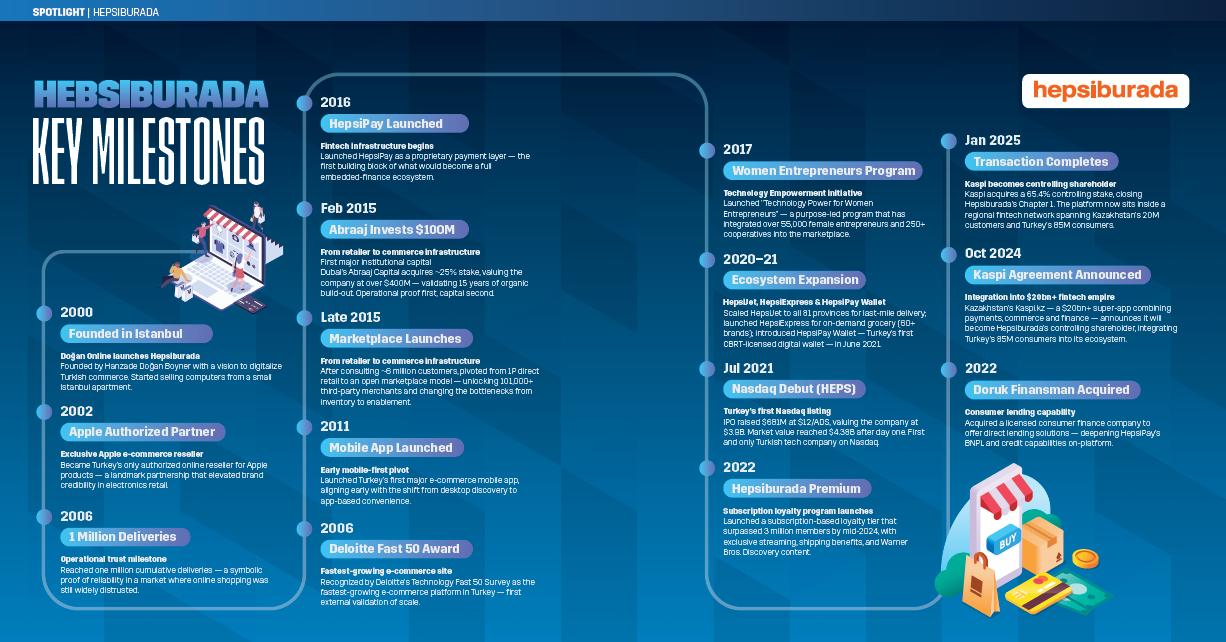
Hepsiburada took fifteen years, from 2000 to 2015, to reach one million annual deliveries—modest by today’s standards, but a reflection of Turkey’s nascent e-commerce market and the challenges of building trust and infrastructure from the ground up when you’re a first-mover. That’s the unglamorous math behind Turkey’s first homegrown e-commerce platform: fifteen years of operational repetition before institutional capital arrived, another six years before Nasdaq, and two decades before becoming part of a $20bn+ regional fintech empire.
Most e-commerce success stories are framed as inevitabilities—right founders, right timing, right market wave. Hepsiburada’s trajectory is more instructive precisely because it wasn’t inevitable. It’s what happens when someone commits to building category infrastructure through multiple cycles, long before consensus says it will work.
This is a story about making customers believe that ordering online isn’t a gamble—it’s a habit. And in Turkey’s early internet economy, that required something more patient than venture-backed blitzscaling: it required a slow and steady building of trust, compounded over time.
The Founder Who Played the Long Game
Hepsiburada’s public filings describe Hanzade Vasfiye Doğan Boyner as the founder and chair since the company’s inception in 2000, and note her broader entrepreneurial track record, including founding Nesine, Turkey’s biggest sport betting and lottery platform, in 2002.
Public profiles add a second layer of context: she comes from the Doğan family, one of Turkey’s best-known business families. That could have been an easy shortcut to relevance. Instead, the more accurate frame is more inspiring—Hepsiburada is what it looks like when someone commits to building category infrastructure through multiple cycles, long before the market consensus says it will be easy.
There’s also a simple scene that captures the ambition in her own words. On the day of the Nasdaq listing, Doğan wrote that Hepsiburada began “from a small apartment in Istanbul” and that the vision from day one was to “lead the digitalization of commerce in Turkey.”
You can feel the subtext: this wasn’t “sell stuff online.” It was “make online commerce work as a system.” That framing matters because it explains the patience required. If the goal was quick scale and an exit, the path would have looked different. If the goal was to build commerce infrastructure for a country, the timeline stretches—and the operational discipline becomes non-negotiable.
The Year Hepsiburada Became Retail Infrastructure
In late 2015, Hepsiburada launched its marketplace—the architectural shift that separates “we sell products” from “we enable commerce.”
A marketplace changes what you’re building. You’re no longer optimizing a single catalogue and checkout flow. You’re constructing a platform where thousands of merchants can plug into demand, logistics, payments, and customer trust that took you fifteen years to accumulate. It’s the move that turns a company into a category.
Capital arrived the same year, signaling that the thesis was working. The Financial Times reported that Dubai’s Abraaj Capital acquired 25% of Hepsiburada in a deal valuing the company at over $400m, with Abraaj’s stake around $100m. For context: Hepsiburada had recorded TL1bn ($408m) in sales in 2014, having grown 25-fold over the previous decade. That’s the pattern: operational proof first, then capital, then acceleration.
The marketplace model also fundamentally changed the bottlenecks. The constraints stopped being “how many SKUs can we stock?” and became “how do we enable 10,000 merchants to deliver consistent experiences?” The answer wasn’t clever marketing. It was logistics capabilities, payment services, and the operational scaffolding to support a growing merchant ecosystem.
This is also where the story becomes less romantic and more impressive. Platforms don’t win by being clever once; they win by being dependable a million times.
Hepsiburada Goes Public
By mid-2021, when Hepsiburada listed on Nasdaq, the company was no longer pitching a vision—it was pricing two decades of earned infrastructure.
The IPO raised $681m at $12 per ADS, valuing the company at $3.9bn at pricing. Reuters reported the market value reached $4.38bn after the first day’s move. For context, this made Hepsiburada one of the first Turkish tech companies to achieve a U.S. public listing—a milestone that mattered less for the valuation itself than for what it represented: Turkey’s consumer internet was now globally investable.
The timing also mattered. 2021 was peak emerging-market tech euphoria. Companies like Coupang (South Korea), Ozon (Russia), and MercadoLibre (Latin America) were all trading at elevated multiples, and investors were hunting for “the next regional e-commerce champion.” Hepsiburada walked into that window carrying a 20-year operational track record—not a typical growth-at-all-costs narrative. Coverage described a clear set of mechanics around how the company intended to deploy capital. Reuters reported that proceeds would fund investments in logistics infrastructure and expand initiatives including grocery delivery and digital payment services. That is the platform thesis, stated plainly: when you have demand and merchants, you invest into rails that make the system faster, easier, and stickier.
At the time of listing Doğan said, “Turkish e-commerce is at an inflection point and we have ambitious plans to continue leading digitalization of commerce,” adding: “Our story resonated with international investors.”
That’s the Nasdaq story in one clean line: Hepsiburada became the vehicle through which global capital could express a view on Turkey’s consumer internet.
Building Before the Smartphone Era
it was Already Becoming a Habit Hepsiburada’s early milestones are not flashy—which is exactly the point. Scaling e-commerce in an emerging market is less about viral growth than about operational repetition.
The company started with computers—a deliberate choice. In early internet markets, that category is a litmus test. Customers compare specifications, prices, and reliability; if you consistently deliver the right product, in the right condition, on the right timeline, trust compounds. By the company’s own timeline, 2006 marked a symbolic threshold: the one millionth cumulative delivery. By 2011, it launched its first mobile app, aligning itself with the shift from desktop discovery to app-based convenience—years before mobile commerce became the default in Turkey.
Those are the quiet building blocks of a platform brand. Trust in online commerce isn’t won through slogans; it is won through the basics, repeated at volume—fulfilment consistency, customer service, returns, and payment experiences that suit local expectations.
For Turkey’s digital economy, that kind of reliability mattered. Hepsiburada was growing up in a market that was still deciding whether online shopping could be trusted at all. The question wasn’t whether e-commerce would work eventually; it was whether any single company could earn enough consumer confidence to make the category feel safe.
What Hepsiburada Actually Built

To tell this story cleanly, you have to resist reducing Hepsiburada to “Turkey’s Amazon.” The comparison is familiar and sometimes useful, but what matters is the architecture of the ambition.
From public filings and IPO-era coverage, the logic resembles a flywheel: earn demand through selection and brand; widen selection and availability by onboarding merchants; then invest into the rails that remove friction—logistics capabilities, payment services, and adjacent categories that deepen retention.
By the time of the Nasdaq listing, the company was operating across multiple layers:
-
Marketplace infrastructure: 101,000+ merchants plugged into a single demand engine
-
Logistics backbone: Fulfilment and delivery capabilities that enabled faster, more reliable service
-
Payment rails: Embedded financial services that reduced friction and improved conversion
-
Category expansion: From computers to a horizontal marketplace spanning electronics, fashion, home goods, and grocery
The bottlenecks at this scale stop being marketing. They become fulfilment reliability, payment acceptance, service quality, and the operational ability to support a merchant ecosystem at national scale.
This is also the part of the story that’s hardest to romanticize—and therefore the most valuable to understand. The competitive moat wasn’t a brilliant product insight or a viral marketing campaign. It was two decades of compounding operational advantages: customer trust, merchant density, logistics reach, and brand synonymy with “online shopping” in Turkey.
Act Two: Hepsiburada Becomes a Node in a $20bn+ Fintech Ecosystem
In October 2024, Kazakhstan’s Kaspi.kz—itself a $20bn+ super-app combining payments, e-commerce, and fintech—announced it would become Hepsiburada’s controlling shareholder. The transaction closed in January 2025.
For Hepsiburada, the logic is ecosystem integration. Kaspi brings proven playbooks for connecting commerce, payments, and financial services at scale—capabilities it has refined across Kazakhstan’s 20 million consumers. For Kaspi, Hepsiburada offers a beachhead into Turkey’s 85 million consumers and an established merchant network of 101,000 sellers.
Doğan framed the transaction as “a significant milestone,” pointing to what had been built: 10,000 employees, 101,000 merchants, 12 million customers. Those aren’t vanity metrics—they describe a marketplace as national infrastructure, the kind of platform that touches jobs, small business digitization, and consumer behavior at scale.
The pattern to watch: the best platforms don’t end when they “exit.” They become nodes in larger systems. Hepsiburada spent 20 years earning consumer trust and merchant density in Turkey. The next chapter is about what happens when that foundation sits inside a broader ecosystem of payments, logistics, and embedded finance.
The question is no longer whether Hepsiburada can accelerate e-commerce adoption in Turkey—but whether it can position itself as a regional platform, consolidating commerce across Turkey, Central Asia, and beyond. The infrastructure has been built. The next chapter will be defined by how far—and how efficiently—it can scale.

%2Fuploads%2Fturkey-unicorn-2026%2Ftur26-new-cover2.jpg&w=3840&q=75)