
How Dream Games Built a Unicorn on One $5 Billion Game
12 April 2026•
%2Fuploads%2Fturkey-unicorn-2026%2Fspotlights%2Fdream-games%2Fdream-team-cover.jpg&w=3840&q=75)
%2Fuploads%2Fstartups%2Fdreamgames.jpg&w=3840&q=75)
Between 2021 and 2025, Royal Match generated $5.8 billion in lifetime revenue from a single mobile puzzle game. The company that made it—Dream Games—raised $467.5 million in venture capital to get there.
That’s the capital efficiency story behind Istanbul’s most valuable gaming studio: 19 months from incorporation to unicorn status, 36 months from launch to dethroning Candy Crush as the world’s #1 puzzle game, and six years from seed to a $5 billion private equity transaction that delivered 10-15x returns to early investors.
Most mobile gaming success stories follow the hit-or-miss playbook: launch multiple titles, hope one goes viral, scale fast, exit. Dream Games followed the Peak Games pattern: build one game, perfect it through obsessive iteration, optimize for player retention over viral growth, then scale the infrastructure that makes it last years.
The bet paid off. By 2022, Royal Match had beaten Candy Crush. By 2025, Dream Games had become the seventh-largest mobile game developer in the world by revenue—and the most capital-efficient gaming unicorn in recent memory.
The Peak Games Blueprint
Dream Games exists because of what happened at Peak Games in June 2020. That month, Zynga acquired Istanbul-based Peak for $1.8 billion, making it Turkey’s first gaming unicorn. The acquisition created an entrepreneurial wave—of the 108 Peak employees who left, 37 founded gaming companies. Dream Games became the most successful.
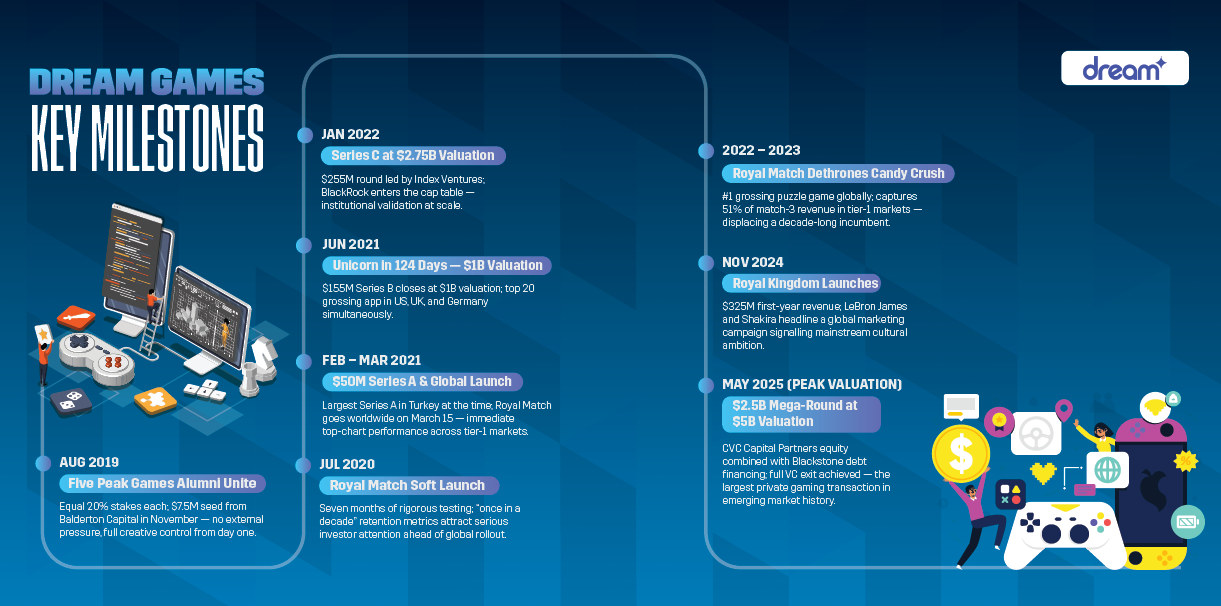
The founding team assembled in August 2019: Soner Aydemir (CEO), Hakan Sağlam (CTO), İkbal Namlı (Chief Engineering Officer), Eren Şengül (Chief Product Officer), and Serdar Yılmaz (Art Director). Each took an equal 20% stake. All had worked together at Peak, where Aydemir had been Product Director on Toy Blast and Toon Blast—two puzzle games that consistently ranked in the top 20 grossing apps.
The thesis was execution over innovation. They believed Peak’s proven approach to match-3 games—disciplined product development and relentless focus on retention—could beat even established players.
Three months later, in November 2019, they raised a $7.5 million seed round from Balderton Capital. The largest gaming seed in Turkish history.
Seven Months in the Lab
Royal Match entered soft launch in July 2020. The game spent seven months in testing while the team obsessed over retention metrics. In mobile gaming, retention is everything—a viral game that loses 90% of players after week one is worthless. A game that keeps 40% of players engaged after 30 days can generate billions. To that effect, Royal Match’s retention numbers were extraordinary. Investors later called it a “once in a decade retention.” By year-end, Dream Games was ready to go global. All they needed was capital to accelerate.
Proving the “Forever Franchise” Thesis
Most mobile games are hits or misses. Dream Games bet on building a “forever franchise”—a single game optimized for infinite retention rather than viral growth. The Series A ($50 million, February 2021, led by Index Ventures) funded that thesis. Royal Match launched Royal Match launched globally a few weeks later. Within 90 days, the data proved it: $20 million per month in revenue, 6 million monthly active users, and top 20 grossing in the U.S., UK, and Germany.
On June 30, 2021—just 4 months after the Series A—Dream Games raised $155 million at a $1 billion valuation. Index Ventures and Makers Fund co-led again. It was the largest Series B in Turkish history, making Dream Games Turkey’s third unicorn.
This is the pattern: when retention proves sustainable, capital moves fast.
Execution Over Innovation
Royal Match entered a market dominated by King (Candy Crush), Playrix (Homescapes), and Supercell (Clash of Clans)—billion-dollar studios with hundreds of employees and decades of expertise.
Dream Games had five founders, 100 employees, and one insight: execution beats innovation.
The product wasn’t revolutionary. Royal Match is a match-3 puzzle game where players help King Robert restore his castle. The genre had been defined by Candy Crush a decade earlier. But Dream Games made specific design choices that compounded over time:
-
Retention over virality. Royal Match prioritized daily habits over social sharing. Players came back because puzzles felt fair, progression was satisfying, and power-ups were more effective than competitors. No ads meant a premium experience despite being free-to-play.
-
Monetization through satisfaction. Where Candy Crush made levels brutally hard to encourage spending, Royal Match balanced difficulty. Revenue came from players who wanted boosts, not players stuck on impossible levels.
-
Polish and speed. Dream Games shipped content faster than competitors. By 2024, the title had over 4,500 levels with weekly events and seasonal updates.
The result: higher lifetime value per user and a game that could sustain itself for years without constant user acquisition spend.
Royal Match Beats Candy Crush
In mid-2022, Royal Match surpassed Candy Crush Saga as the world’s top-grossing puzzle game—a position Candy Crush had held for nearly a decade.
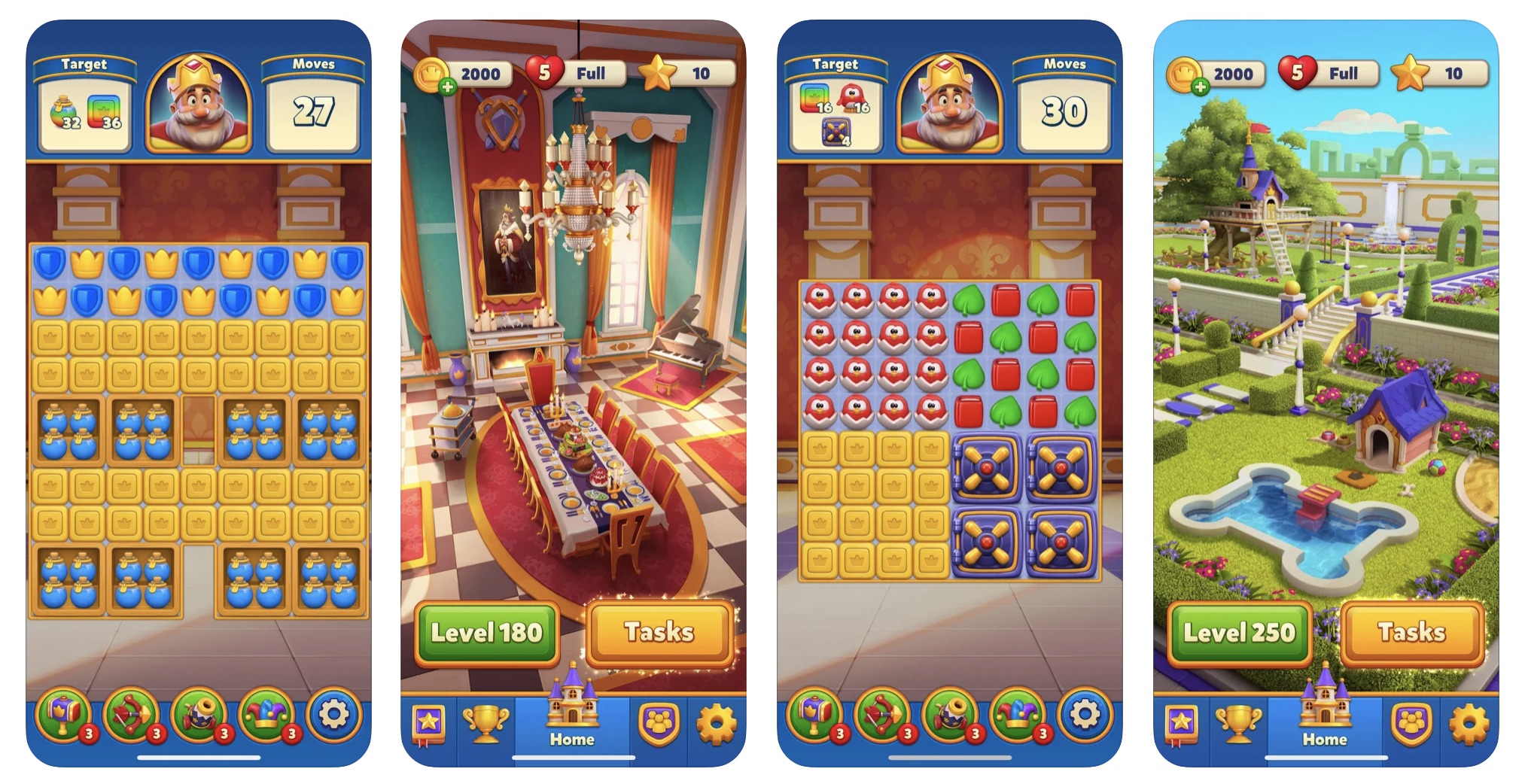
The milestone wasn’t just symbolic. In 2024, Royal Match generated $1.4 billion in revenue and captured 51% of all match-3 revenue in tier-one markets. For context: King’s entire portfolio made up the other 49%.
Dream Games added a Series C in January 2022 ($255 million at a $2.75 billion valuation, led by Index Ventures with BlackRock joining). The funding went toward user acquisition, international expansion, and talent. Dream Games grew from 100 employees to over 300 employees by 2024.
The company brought on Edwin Catmull—co-founder of Pixar—as a strategic advisor in December 2023, signaling ambitions beyond mobile gaming. By 2023, Dream Games had become one of the most profitable gaming studios in the world. Revenue hit $1.5 billion with estimated EBITDA margins above 30%.
Proving the Franchise Model
Royal Kingdom—the sequel to Royal Match—launched globally on November 21, 2024, after 19 months in soft launch. The game featured King Richard and added PvP competition, ranked play, and deeper progression. The marketing campaign was massive: LeBron James, Shakira, and Jimmy Fallon all appeared in ads.
The results validated the franchise thesis. Royal Kingdom generated $325 million in its first year, outperforming Royal Match’s first-year revenue by 2%. Critically, Royal Match’s revenue grew 1% year-over-year despite the sequel—proof that Royal Kingdom expanded the player base rather than cannibalizing it. Together, the two games generated an estimated $1.6 billion in combined 2024 revenue and reached approximately 55 million monthly active users. The figure is all the more striking given Royal Kingdom only launched globally in the final six weeks of the year, with Royal Match alone accounting for $1.4 billion of that total.
The $2.5 billion Private Equity Bet
On May 1, 2025, Dream Games announced a $2.5 billion capital raise—$1.25 billion in equity from CVC Capital Partners and $1.25 billion in debt from Blackstone and other lenders. The transaction valued Dream Games at $5 billion and represented a full buyout of venture investors. Balderton, Index, Makers Fund, IVP, Kora, and BlackRock all exited with estimated 10-15x returns. CVC became the sole equity partner while the five founders retained majority ownership and voting control. The deal closed Dream Games’ venture-backed era. The company had raised $467.5 million in equity and turned it into $5 billion in enterprise value in under six years.
CVC’s thesis centered on the “Royal Universe”—expanding beyond mobile gaming into merchandise, animation, and potentially film, similar to how Rovio built Angry Birds into a transmedia franchise. Whether that materializes remains to be seen, but the deal reflects how seriously institutional investors now take mobile gaming IP.
Reinforcing Istanbul’s Gaming Blueprint
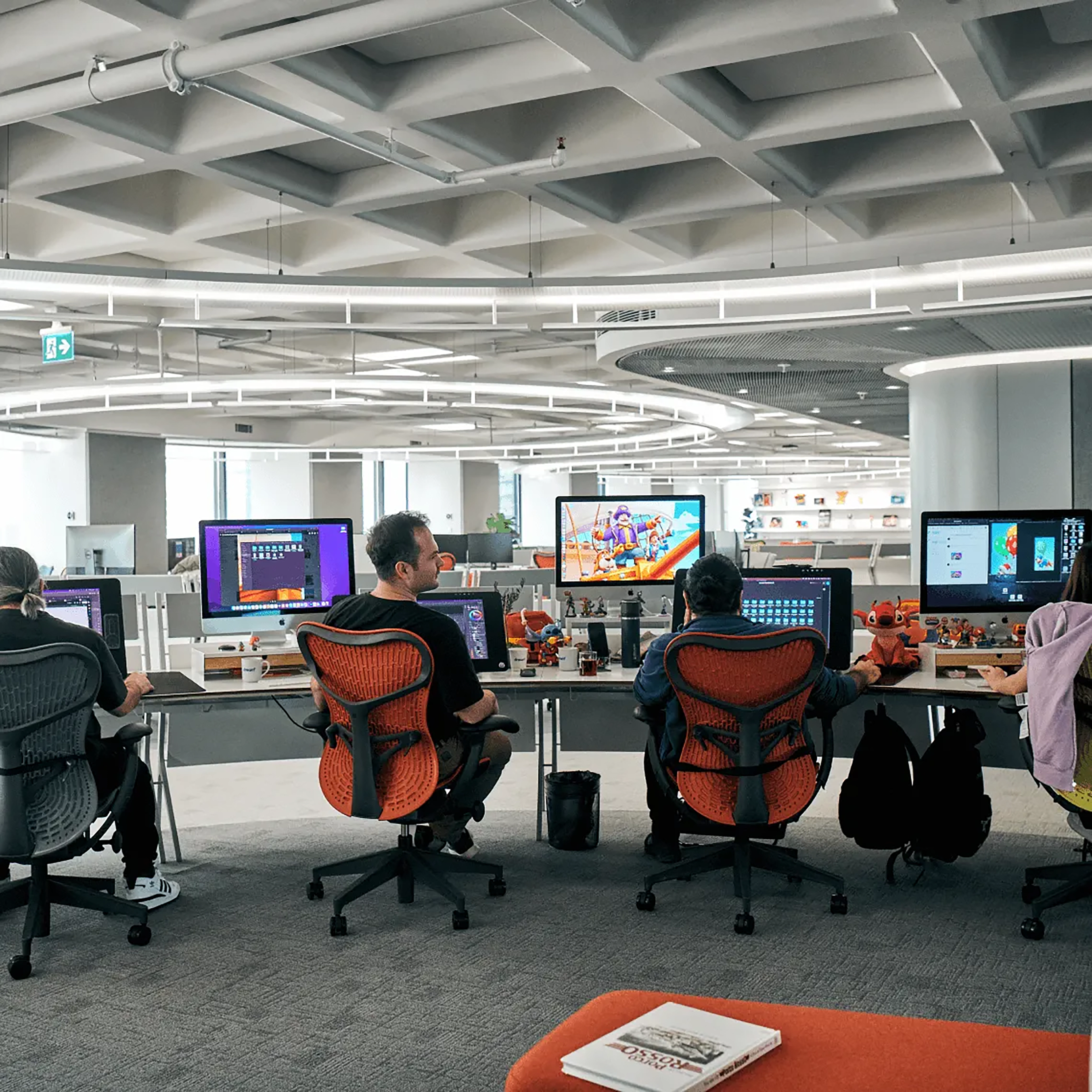
Dream Games’ trajectory offers a blueprint for gaming startups everywhere, but especially in Istanbul. The company executed on three principles: Peak DNA (the founders knew what worked), speed and focus (one game, perfected and scaled), and retention economics (optimize for lifetime value, not viral growth).
The Istanbul gaming ecosystem has now produced three major exits in six years:
Peak Games ($1.8 billion), Gram Games ($250 million), and Dream Games (valued at $5 billion). The city ranks as the world’s second-largest gaming hub by studio density after London.
But Dream Games now enters uncharted territory. The five founders who started with 20% stakes each in 2019 now sit on majority ownership of a $5 billion company. They’ve built the most valuable gaming studio in Turkish history and proven that execution beats innovation in mobile gaming.
The question is whether they can maintain that execution under private equity ownership. CVC’s transmedia vision for the “Royal Universe” is ambitious—but it’s also a distraction from the core business of making great mobile games. Can Dream Games stay disciplined and patient while backed by a firm that expects financial returns on a timeline? The answer will define the next chapter—not just for Dream Games, but for the entire Istanbul gaming ecosystem that’s watching closely.
Discover what’s powering Turkey’s unicorn surge in our full 2026 report - download now.

%2Fuploads%2Fturkey-unicorn-2026%2Ftur26-new-cover2.jpg&w=3840&q=75)