Copilots: From Adoption to Integration
27 October 2026•


Artificial intelligence in 2026 is still not defined by full autonomy. For most organizations, it is defined by copilots. AI copilots are humanin-the-loop AI systems embedded into workflows that draft, summarize, analyze, retrieve, and recommend — while leaving final decisions to people.
They assist but do not act independently. That distinction explains both their rapid enterprise adoption and their institutional acceptability.
Across global surveys, nearly nine in ten organizations report using AI in at least one function. AI has moved beyond standalone tools and into embedded workflow infrastructure.
AI chatbots and assistants are now the most widely scaled AI tool: 47% of respondents say their organizations are rolling them out across the enterprise. Microsoft alone reported more than 30 million paid Microsoft 365 Copilot seats in July 2026, with net additions more than doubling from the previous quarter.
In many firms, copilot adoption has been bottom-up. Knowledge workers integrate AI assistants into drafting, coding, research, and analytics tasks — often ahead of formal governance. Informal use frequently precedes structured deployment, illustrating how productivity technologies diffuse faster than policy frameworks.
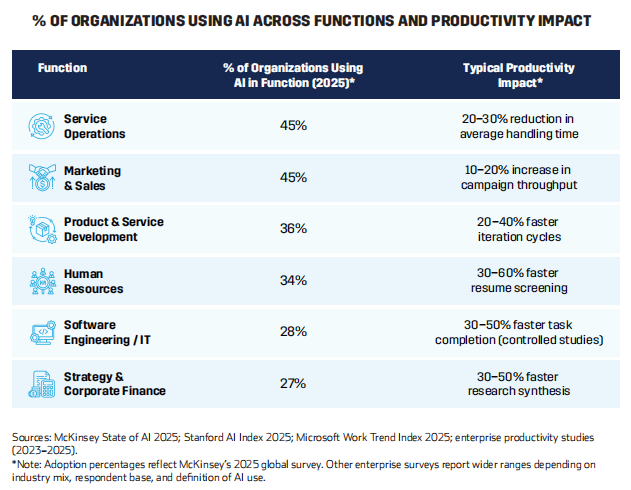
What stands out is not dominance in a single function, but broad penetration across many. In the Gulf, service operations and marketing and sales lead adoption, with 45% of organizations embedding AI into each of those workflows. Product development, HR, software engineering, and corporate strategy follow, with product development showing the biggest jump since 2023, from 13% to 36%. No unit is fully transformed — yet few remain untouched. Copilots are no longer experiments; they are distributed productivity layers.
The impact is measurable but pragmatic, and uneven. In service operations and engineering, efficiency gains show up in reduced handling times and faster task completion.
In marketing, finance, and HR, improvements manifest as compressed cycles and lighter cognitive loads rather than structural redesign. The largest controlled studies also show who gains most: less-experienced workers improve the most, while on tasks beyond what the model can reliably do, output can get worse rather than better.
Across functions, the pattern is consistent: copilots augment work. They accelerate information flow, reduce repetition, and shorten decision loops, but they do not replace judgment. Machine-assisted workflows are becoming a baseline expectation across enterprise environments, even if operating models have not yet been rebuilt around them.
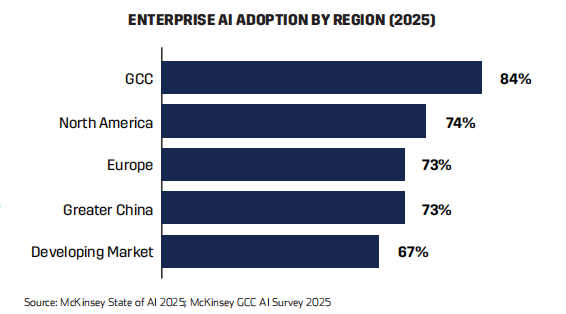
Regional differences are narrower than assumed. The GCC currently reports the highest enterprise AI usage rates, with North America, Europe, and Greater China clustering closely behind. Yet enterprise-wide scaling remains limited across all regions. Even in the GCC, fewer than one-third of organizations report scaling AI beyond pilot phases — a pattern broadly consistent globally.
The defining feature of this phase is institutional pacing. Copilots have proven they deliver efficiency gains. The strategic question now is whether organizations remain at the assistance layer — or redesign workflows around these tools. McKinsey’s 2026 survey shows why it matters: eight in ten respondents say AI has improved their own productivity, yet only 37% report any effect on enterprise earnings, little changed from a year earlier. Among the small group of high performers, nearly three-quarters have fundamentally redesigned workflows around AI.
Copilots may appear incremental, but at scale they reset productivity baselines. The transformation is subtle. The cumulative effect is not.
Regional adoption levels vary, but the differences are narrower than often assumed. The GCC reports the highest overall enterprise AI usage, while North America, Europe, and Greater China cluster closely together in adoption rates. Across regions, however, enterprise-wide scaling remains limited. In the GCC, fewer than one-third of organizations report scaling beyond pilots, a pattern broadly consistent with global surveys.
Unpack the frontiers of agentic AI and discover how autonomous systems are actively reshaping enterprise operations, finance, and cybersecurity in The State of AI Report 2026.