
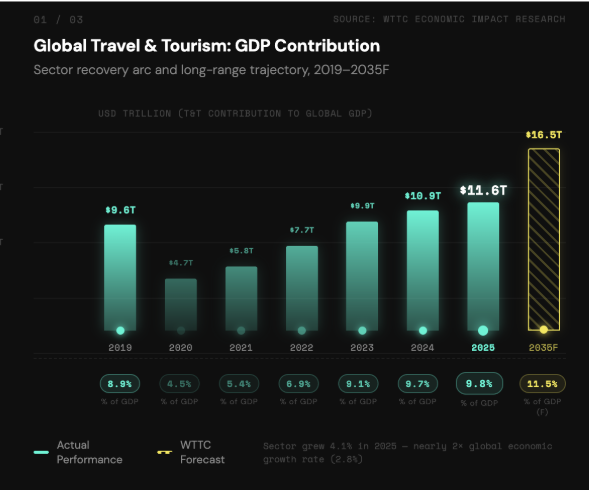
The End of Travel Search: How AI Is Rewiring the $11.6 Trillion Travel Industry
27 April 2026•
%2Fuploads%2Fopinions%2FOpinions%2520Covers_qais.jpg&w=3840&q=75)
The modern traveller does not have a search problem. They have a choice problem.
Open any travel platform and you are met with thousands of flights, hundreds of thousands of hotels, and an avalanche of reviews that promise clarity but deliver overwhelm. We built an industry of extraordinary abundance — and in doing so, created a new kind of friction, altogether. Decision fatigue is not a fringe experience. For most travellers, it is the starting point.
This is the context in which AI has arrived in travel. Not as a novelty, but as a structural fix. And from where I sit, building at the intersection of technology and travel in the Middle East, we are still underestimating how profound the shift will be.
From Search to Conversation
The traditional travel interface was built around structured inputs: dates, price ranges, star ratings, and destination codes. Tools that assumed you already knew how to translate desire into a query. In reality, most of us begin somewhere far less precise — a feeling, a purpose, a set of overlapping constraints that don't fit dropdown menus.
AI changes the equation entirely. Instead of filtering, travellers describe what they want: "a beachfront resort for a multi-generational family, within X budget, close to cultural landmarks." The system interprets intent and returns curated, context-aware recommendations. The interface becomes conversational. The cognitive burden shifts from user to platform.
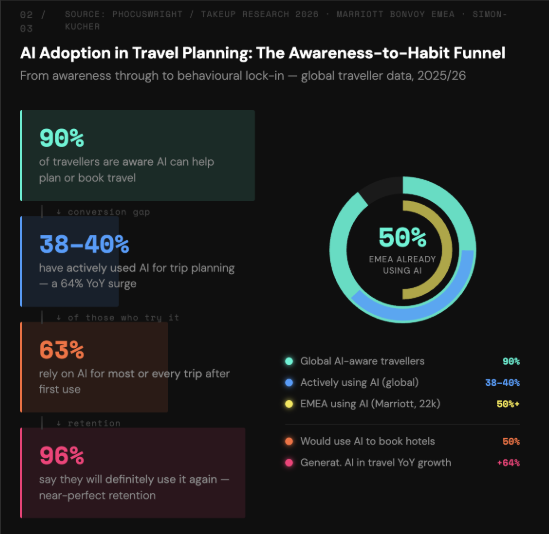
The behavioural shift is already measurable. In 2025, 42% of global travellers used AI tools for itinerary planning, with adoption strongest in Asia and the Middle East, according to Simon-Kucher's Global Travel Trends 2026 study. Across EMEA, more than half of surveyed travellers had already used AI to research or plan holidays — with 50% open to booking accommodation through AI in the future, per Marriott Bonvoy's research across 22,000 regional travellers. Global generative AI usage in travel surged 64% year-on-year in 2025, according to Amadeus.
At Almosafer, we see this play out directly. Through our ChatGPT integration and native conversational features, users access over 1.5 million hotels through natural language rather than filters. Once the friction disappears, behaviour adapts fast — and it doesn't revert.
AI That Acts, Not Just Advises
We are moving beyond recommendation. Agentic AI — systems that act on behalf of the traveller rather than simply suggesting to them — is no longer a roadmap item. It is an operational reality taking shape across the industry. Over 60% of travel businesses are already experimenting with or actively scaling agentic AI, according to Phocuswright's 2026 research.
At its most capable, agentic AI can rebook a cancelled flight proactively, suggest a restaurant based on known preferences, handle live translation, and coordinate an entire multi-stop journey without the traveller lifting a finger. A pocket concierge, always on, always contextual.
The traveller articulates a need, and the system handles the complexity.
A Region Built for What's Next
The Middle East entered 2026 having outperformed nearly every global tourism benchmark. Saudi Arabia welcomed over 122 million domestic and international visitors in 2025, generating SR300 billion in tourism spending — progress built on years of deliberate infrastructure investment that does not evaporate with short-term disruption. Dubai recorded 19.59 million international visitors in 2025, its third consecutive record year.
Like all globally connected industries, regional travel is not immune to geopolitical volatility. When uncertainty rises, traveller confidence shifts — and the industry must respond with speed and clarity. What that moment actually reveals is the value of the capabilities we are building. Agentic systems that adjust bookings, reroute itineraries, and manage disruptions in real time are not theoretical benefits. They are the difference between a travel company that abandons its customer at the worst moments, and one that earns lasting loyalty by showing up precisely when they are needed most.
The long-term structural story for the region remains intact. Saudi Arabia's Vision 2030 and the UAE's D33 agenda are generational bets on this region's role in global travel. The investment is in place. The infrastructure is expanding. The question is not whether the region recovers — it is how quickly, and which companies are best positioned when it does.
What makes the Middle East particularly compelling from a technology standpoint is the speed of its transformation. Unlike mature markets that must retrofit AI onto decades of legacy infrastructure, the region is building its digital capabilities in parallel with its tourism expansion. The opportunity to embed next-generation experiences into an ecosystem still being designed — rather than layered onto rigid existing systems — is one few regions in the world still have.
Algorithms & Ownership
As AI takes on more of the travel journey, two questions deserve direct engagement.
The first is homogenisation. If recommendation systems draw from the same data signals, will travellers increasingly be guided toward the same outcomes? The best AI in travel will need to preserve space for discovery and serendipity — not just optimise toward what the algorithm predicts you want.
The second is ownership. As AI intermediates more of the customer relationship, who holds it — the platform interpreting intent, or the provider delivering the experience? The answer will determine how value is distributed across the ecosystem. The industry needs to engage with this openly, not assume it resolves in someone's favour by default.
Building for the Traveller
The future traveller will not want to navigate fragmented platforms, compare endless options, or manually assemble a trip. They will describe a need, refine it through dialogue, and rely on intelligent systems to handle the rest.
At Almosafer, we are building toward a model where AI supports the entire journey — before, during, and after travel. Not because the technology demands it, but because the traveller does.
By absorbing the administrative friction of planning — the tabs, the filters, the endless comparisons — AI frees the traveller to focus on what travel has always been about. The experience itself. The memories. The things that no algorithm will ever replace. And that, in my opinion, is not making travel less human; it’s simply making travel more enjoyable and accessible from the onset.

%2Fuploads%2Fsaudi-tourism%2Fcover5.jpg&w=3840&q=75)