
Who’s Driving Electric Vehicles in Saudi Arabia Today?
15 October 2025•
%2Fuploads%2Fev-2025%2Farticles%2Fksa-ev-driving%2Fev-ksa-cover.jpg&w=3840&q=75)
In the heart of the oil-rich Kingdom, the emergence of electric vehicles (EVs) is stirring a quiet but significant shift. As of mid-2025, EVs make up only about 1% of all cars on Saudi Arabia’s desert-lined roads, but the momentum is building fast—and the question of “who” is driving this change touches both the people behind the wheel and the stakeholders building the ecosystem.
The Early Adopters
EV drivers in Saudi Arabia today are a small but growing segment—tech-savvy, environmentally aware, and largely middle-to-upper income. A recent consumer survey deployed across the Kingdom showed that EV ownership was around 4% within the sample of nearly 400 respondents, while another 3.7% were “lapsers”—former EV owners who had reverted back to owning and driving gas-powered vehicles. The remaining 92% were traditional (gas-powered) car owners, but notably, 97% said they would consider an EV in the future. This spells out a promising future for the uptake of EVs in the Kingdom.
Demographically, the most engaged consumers are younger males, particularly those aged 21 to 40, and affluent residents in urban centers like Jeddah and Riyadh. These drivers tend to value sleek technology, environmental impact, and national innovation.
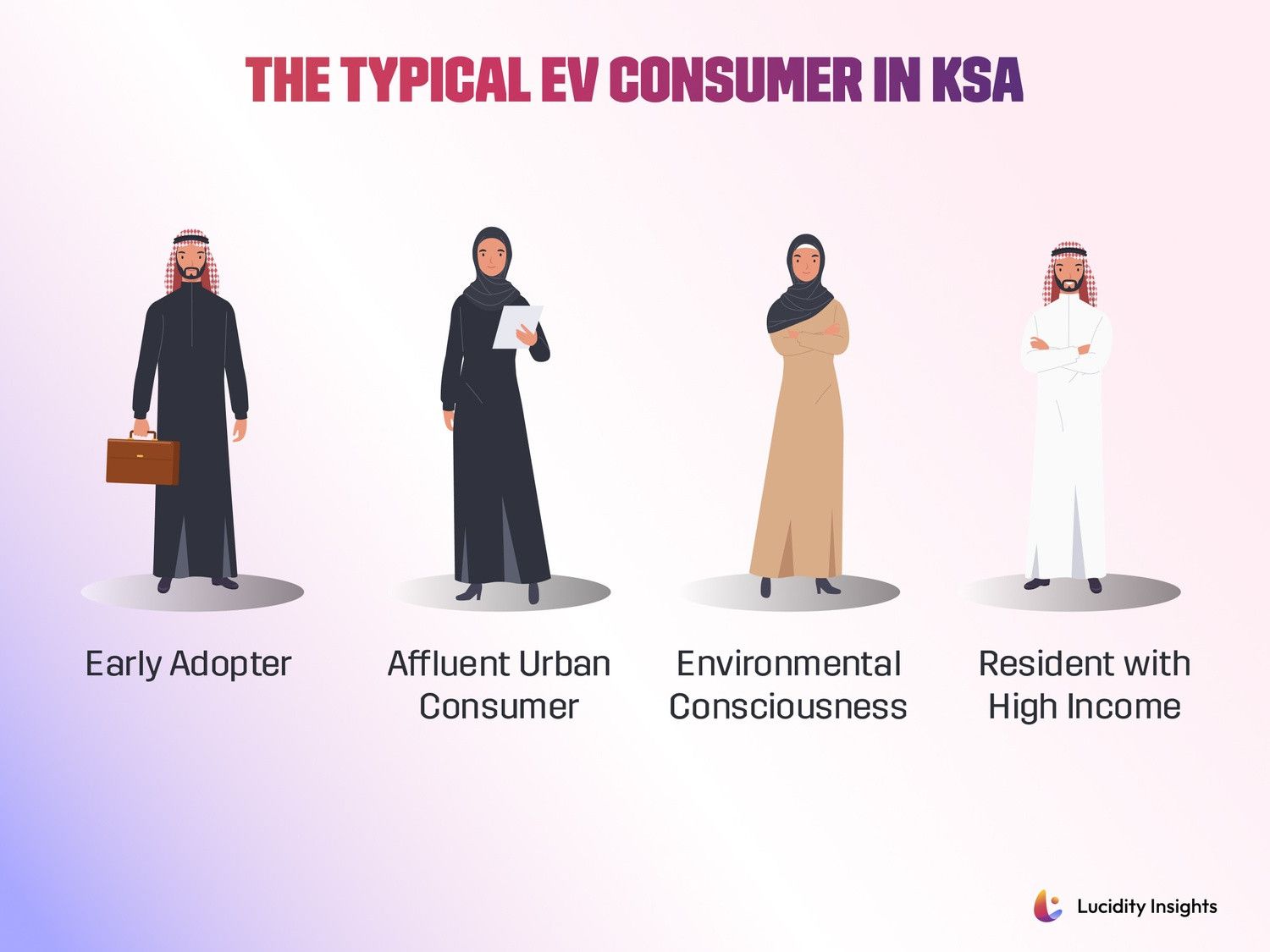
Interestingly, the profile isn’t just about income—it’s about mindset. Respondents who identified as curious about innovation, supportive of Vision 2030, and concerned about the environment were significantly more open to EV adoption - regardless of income. Most respondents, which were roughly comprised of 70% Saudi Nationals and 30% expats, said that EVs were highly regarded for their environmental benefits, just as much as EVs were seen as cool and trendy. The majority of Saudis surveyed said that they were mid-range distance drivers, meaning they typically drove somewhere between 201-400 km each week.
Barriers According to the Lapsers
One of the most interesting groups surveyed, of course, were the “lapsers”. These 16 individuals who count themselves among the earliest EV adopters in Saudi Arabia that later decided to revert back to driving gas-powered vehicles; when looked at closely, these lapsers provide a glimpse into the teething issues of Saudi’s EV market today.
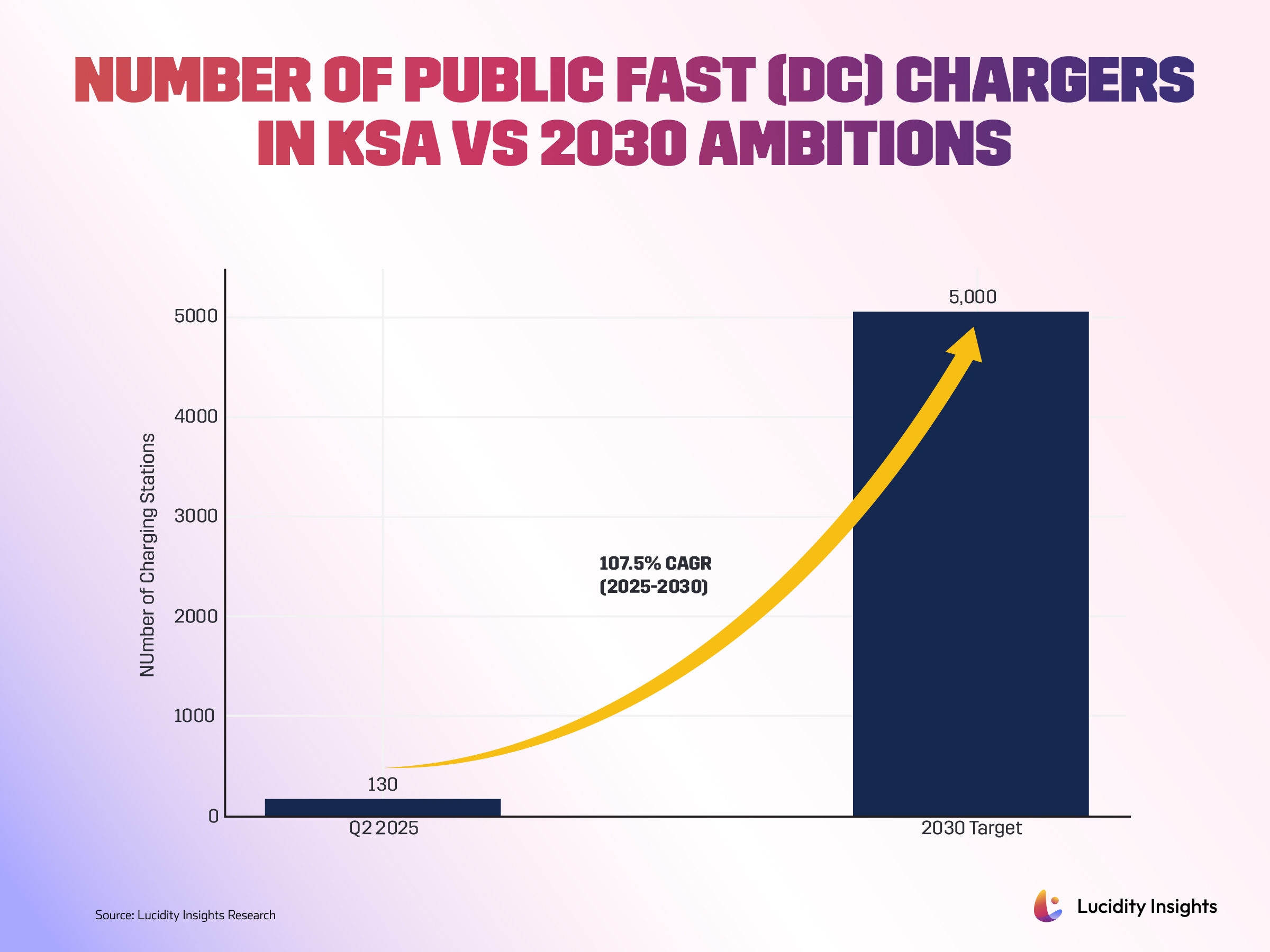
When asked why they didn’t continue driving an EV, the lapsers cited several reasons. For starters, the lack of widespread, accessible charging stations—especially for those commuting between residential areas and cities for work remained a barrier. Today, there are roughly 1200 public EV chargers across the Kingdom, of all types—providing both slow (AC) charging to fast (DC) charging. Local infrastructure player, EVIQ, owns and operates 88 fast chargers, as of mid 2025; nearly 70% of the total fast charger stock in the Kingdom. By the end of 2030, EVIQ alone anticipates installing a total of 5000 (DC) fast chargers, across 1,000 different locations.
Contrast that with Canada—a larger country in terms of land mass, with roughly the same population—and you can see why Saudi Arabia has set such ambitious goals for itself; as of March 2025, Canada has 12,955 public EV charging stations—offering nearly 33.8 thousand charging ports nationwide. 6,309 of these charging ports are DC fast-charging, spread across 2,192 station locations. Even then, many Canadian electric mobility policy experts believe Canada requires 100,000 public charging ports to meet local demand.
All of a sudden, Saudi Arabia’s ambitions to have 5,000 public fast chargers up and running as quickly as possible makes ample and contextual sense.
Other lapsers noted that the EV models and the vehicles themselves need some adjustments. Lapsers say the EVs that they purchased didn’t meet user expectations for long distance travel, especially under high-heat conditions, which led to battery efficiency degradation. Couple this degradation with limited public charging infrastructure, added to range-anxiety amongst these early adopters.
Some lapsers felt that the local EV service networks were still insufficient, with few technicians trained to handle EV-specific issues, making basic maintenance more time-consuming.
Lastly, due to the early-adoption stage of EVs in the Kingdom, many commented on the uncertainty of resale value of EVs, though it seems to be on the rise. Though all of these challenges remain for Saudi EV consumers as a whole, the Kingdom is taking major strides to address all of these issues.
Despite these barriers, EVs are increasingly seen as “cool and trendy” and no longer perceived as prohibitively expensive—especially among the young, tech-savvy and working Saudi men and women.
These are just some of the signs that perception is shifting, albeit slowly. With charging infrastructure building in the Kingdom, R&D going into developing heat-resistant batteries, and a local EV manufacturing base driving down costs to EV ownership—it seems many of these barriers will be addressed and alleviated with time.
Who’s Powering the Movement?
Beyond consumers, the real drivers of Saudi Arabia’s EV movement are institutional. At the forefront is the Public Investment Fund (PIF), which has committed over $50 billion toward building a domestic EV industry—one of twelve critical new sectors being deployed off the back of Vision 2030, to create meaningful new jobs for Saudis, and diversify the Kingdom’s economy. PIF-backed ventures like Ceer (in partnership with Foxconn), Lucid Motors’ KAEC plant, and the Electric Vehicle Infrastructure Company (EVIQ) are laying the groundwork for local manufacturing, job creation, and a nationwide charging network.
EVIQ plays a pivotal role in Saudi Arabia’s electric vehicle revolution, serving as the backbone of the nation’s emerging EV ecosystem. As a joint venture between the Public Investment Fund and the Saudi Electricity Company launched in October 2023, EVIQ is tasked with deploying over 5,000 fast-chargers across 1,000 different locations by 2030, a move that directly addresses one of the top barriers to EV adoption: charging accessibility. Beyond infrastructure, EVIQ is laying the groundwork for a commercially viable and scalable mobility sector, enabling everything from consumer confidence to cross-country travel. Its efforts are critical not just for reducing range anxiety, but for supporting local EV manufacturing, advancing Vision 2030’s sustainability goals, and positioning Saudi Arabia as a regional hub for clean transport innovation.
Saudi Arabia’s Ministry of Energy, Ministry of Transport and Logistics, alongside an interagency task force has finalized technical and licensing regulations for EV charging stations in the Kingdom in collaboration with entities like SASO, the Saudi Standards Authority, ensuring consistency and quality across deployments nationwide.
Simultaneously, the Saudi Green Initiative (SGI)—a flagship climate framework—has stated its ambition for 30% of all new vehicle sales in Riyadh to be electric by 2030, in alignment with efforts to reduce transport emissions in the capital by 50% and contributing to Saudi Arabia’s “Net-Zero by 2060” ambition.
On the municipal front, the Royal Commission for Riyadh City has embedded e‑mobility within its Riyadh Sustainability Strategy, pushing forward pilot zones, emissions reduction plans, and public-awareness campaigns around EV adoption. These bodies coordinate to offer import duty exemptions for EVs and charger equipment, align city infrastructure plans, and monitor investor compliance with infrastructure mandates through various entities in the Kingdom, which are rolling out hundreds of fast- and ultra-fast chargers in partnership with global suppliers.
Together, these ministries and municipal authorities are creating an integrated policy framework—covering regulation, infrastructure licensing, fiscal incentives, and public engagement—that forms the backbone of Saudi Arabia’s fast-track transition to electric mobility. Sources confirm that there are various policy conversations ongoing in government about potential future subsidies and rebates for EVs and the installation of home EV charging units in the future, but no official announcements have been made to date.
Looking Ahead
Saudi Arabia’s EV future is being shaped by a dynamic mix of forward-thinking consumers, bold public policy, and aggressive industrial investment. The road ahead may be long, but it’s being paved by a new generation of drivers—both behind the wheel and in boardrooms—who are steering the Kingdom toward a more sustainable, electric tomorrow.
.jpg&w=3840&q=75)
%2Fuploads%2Fev-2025%2Fcover27.jpg&w=3840&q=75)