The State of Global AI in 2026: Adoption, Scaling and Productivity
25 October 2026•

ADOPTION SATURATES, SCALING GAPS WIDEN, AND PRODUCTIVITY DIVERGENCE BEGINS.
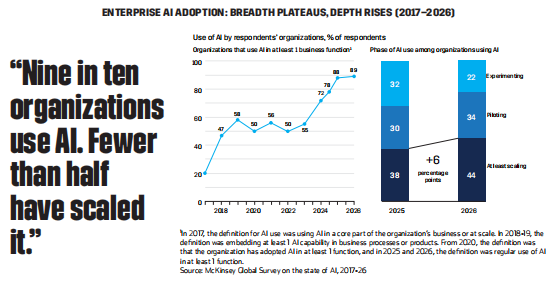
Artificial intelligence in 2026 is defined less by possibility and more by execution. Nine in ten organizations now use AI somewhere; fewer than half have scaled it anywhere. Infrastructure gaps, skills shortages, sector constraints, and firm size disparities are shaping outcomes. The global AI landscape today is characterized by near-universal enterprise uptake, widening diffusion gaps, persistent scaling challenges, and the early signs of productivity divergence.
1. AI is Now a Strategic Imperative (not just a tech upgrade)
For many organizations, AI began with chatbots. But conversational interfaces are the visible layer of a deeper shift. AI is now embedded across core functions — customer service, marketing, software development, operations, risk, and compliance.
Generative AI lowered the barrier to entry, making advanced capabilities accessible to non-technical teams. The rise of agentic systems — capable of executing multi-step workflows with limited oversight — has pushed expectations beyond augmentation toward automation.
Adoption reflects this urgency. Nine in ten organizations now report regular use of AI in at least one business function. Among those already using it, 44% say AI is at least scaling across the enterprise — up six percentage points in a year — while the share still merely experimenting has fallen from 32% to 22%. In many firms, AI is now a board-level priority tied directly to competitiveness and growth.
But the adoption curve itself has flattened: 89% in 2026 against 88% in 2025, after three years of steep expansion. The frontier has moved from whether firms use AI to how deeply.
Yet momentum masks fragility. Even now, 56% of AI-using organizations — a clear majority, four years into the generative AI cycle — have not reached scale. While tools are spreading.
2. Adoption / Diffusion is Uneven Across Countries, Firms, and Sectors
Beneath headline acceleration, AI adoption remains highly uneven.
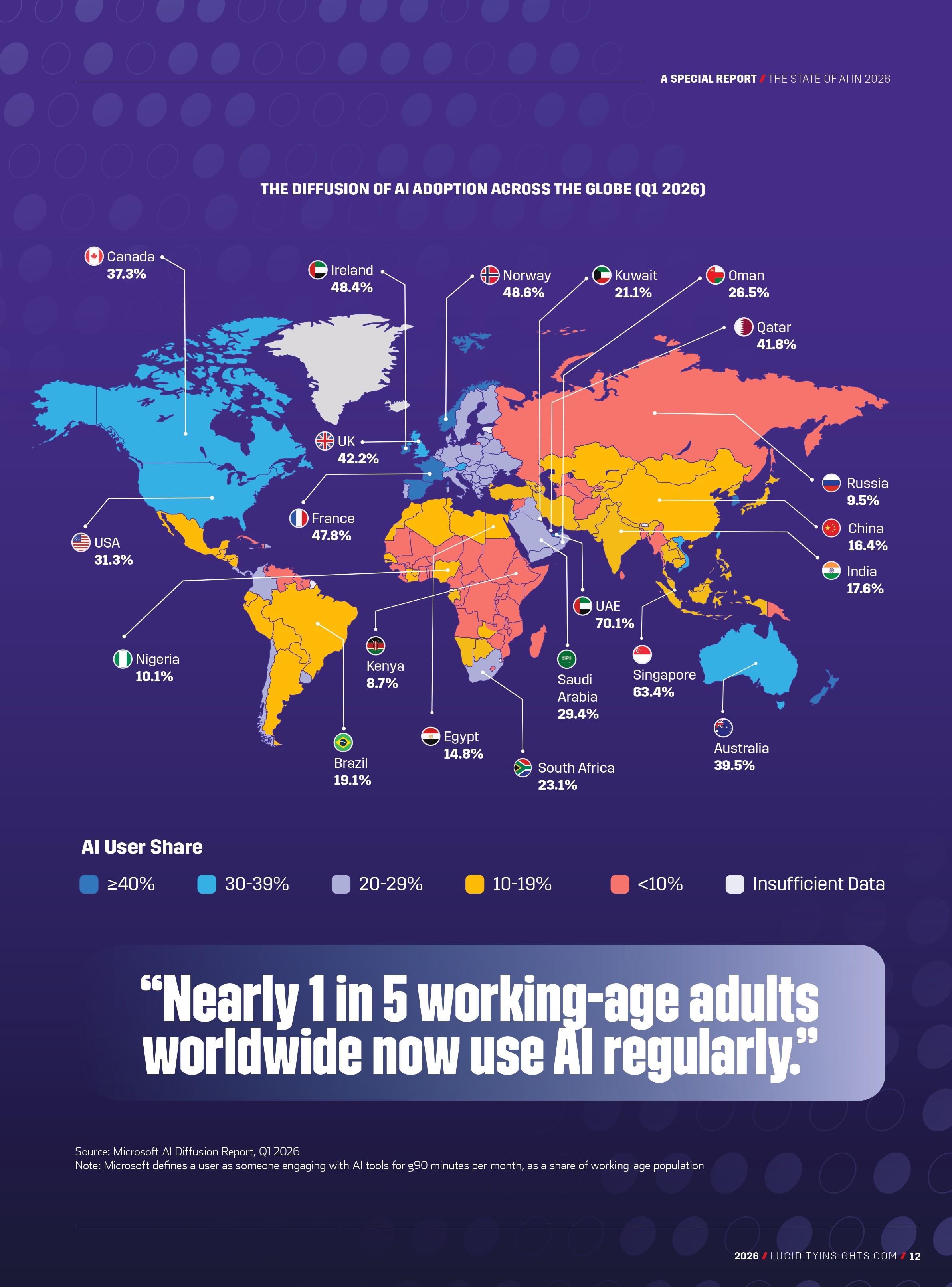
Geographically, advanced economies continue to scale faster. Countries with strong cloud infrastructure, reliable energy systems, deep talent pools, and mature digital ecosystems are embedding AI more broadly. As of Q1 2026, nearly 1 in 5 working-age adults globally use generative AI tools regularly, but usage rates vary sharply — from over 70% in the UAE and above 60% in Singapore to just over 30% in the USA, and below 10% across much of Sub-Saharan Africa.
Emerging markets are active participants, but adoption often concentrates in consumer-facing use cases rather than full operational transformation. Infrastructure, data availability, and compute access remain binding constraints.
Firm-level divergence mirrors this pattern. Large enterprises with centralized data architectures and prior digital investments hold structural advantages. Small and medium-sized enterprises face persistent barriers: fragmented data, limited capital, and difficulty attracting AI talent. Even as tools become easier to use, these constraints risk excluding SMEs from AI-driven productivity gains.
Sector variation adds complexity. Digital-native industries — technology, finance, media — are advancing more rapidly than asset-heavy or regulated sectors such as manufacturing, healthcare, energy, and public administration. In these environments, integration into legacy systems and compliance frameworks slows deployment.
Across geographies, firms, and sectors, three gating variables consistently determine outcomes: infrastructure, data quality, and skills. Where these are weak, AI adoption remains superficial regardless of ambition.
2. AI Activity is not the same as AI Impact
The most persistent pattern across markets is not a lack of AI activity, but a failure to convert activity into sustained impact. While pilots and proofs of concept are now widespread, far fewer organizations report measurable, enterprise-wide productivity or financial gains. Surveys are increasingly able to consistently measure this gap. According to a McKinsey & Company survey, 44% of organizations have scaled AI across the enterprise and 80% report individual productivity improvements, yet only 37% report any positive contribution to earnings, and just 6% attribute 5% or more of EBIT to AI.
Several structural factors explain this gap. First, AI is frequently layered onto existing workflows rather than used to redesign them. In such cases, AI automates discrete tasks but leaves underlying processes intact, limiting its ability to deliver step-change improvements. Fundamental workflow redesign is the clearest differentiator between the organizations seeing returns and those that are not. Second, data fragmentation remains a critical constraint. Many organizations lack integrated, high-quality data across functions, forcing AI initiatives to operate within silos.
Talent constraints further slow scaling. Although AI interfaces are increasingly accessible, deploying AI responsibly and at scale still requires scarce capabilities in data engineering, model oversight, risk management, and organizational change. These skills remain concentrated in a relatively small set of firms and geographies.
Infrastructure and cost dynamics compound the challenge. While model-level costs have declined, total system costs, which includes data preparation, integration, cloud infrastructure, compute, and energy, remain significant. As AI workloads grow more computeintensive, organizations encounter limits related to cloud capacity, energy availability, and legacy system integration. These factors do not prevent experimentation but raise the complexity and risk of scaling.
Agentic AI sharpens these challenges. While agents promise workflow-level delegation, most organizations are not yet equipped to deploy them at scale. Ambiguities around accountability, auditability, and control (particularly in regulated environments) mean that agentic systems remain concentrated in narrow domains such as software engineering, IT operations, and customer support orchestration rather than embedded across core processes.
4. Productivity Divergence
The uneven diffusion of AI carries significant economic and strategic implications. At the national level, differential adoption risks translating into long-term productivity divergence. Economies that fail to build AI capabilities may become increasingly dependent on foreign technologies, platforms, and infrastructure, weakening competitiveness in trade, manufacturing, and services.
These dynamics are reinforcing AI sovereignty as a policy concern. Governments are prioritizing domestic compute capacity, data localization, and national AI ecosystems, recognizing AI as a strategic asset rather than a neutral technology. Divergent regulatory and investment approaches across regions are likely to shape adoption trajectories over the coming decade.
For firms, the risk is structural disadvantage. Organizations trapped in cycles of experimentation without scaling may fall behind competitors who reinvest AI-driven gains into deeper capability building. Talent dynamics are likely to amplify this divergence if skilled workers increasingly gravitate toward firms where AI is embedded into core workflows rather than deployed superficially.
Workforce implications are equally material. As AI augments some roles and sectors faster than others, productivity and wage gaps may widen within and across economies. Workers and firms without access to effective AI tools risk falling behind even as aggregate technological capability advances.
Small and medium-sized enterprises face a particularly acute challenge. Without shared infrastructure, ecosystem support, or targeted policy measures, SMEs risk exclusion from AI-driven efficiency gains, accelerating market concentration and reducing economic dynamism.
5. From Experimentation to Transformation
Taken together, these trends suggest that AI is not merely another technology cycle but a force capable of amplifying existing inequalities if left to diffuse unevenly. The next phase will require a shift from horizontal, generic AI tools toward vertical, workflow-native applications embedded into core operations. Value will accrue to organizations that redesign processes, align governance, and invest in foundational capabilities required for scale.
The central challenge for decisionmakers is therefore not whether AI will transform economies and enterprises, but how unevenly those benefits will be distributed. Diffusion alone is insufficient. Without deliberate investment in data, infrastructure, skills, and operating model change, the gap between AI activity and AI impact, and between leaders and laggards, is likely to widen.
The next phase of AI will therefore be defined less by experimentation and more by allocation of capital, infrastructure, and institutional capacity. The transition from copilots to agents, tightening infrastructure constraints, widening productivity divergence, and the growing centrality of governance will increasingly shape where value accrues. Access to AI will not be what separates leaders from laggards. The willingness to reorganize around it will.
The State of AI 2026 breaks down why the gap between AI hype and actual profit is widening, and reveals the exact playbook billion-dollar firms are using to pull ahead.