
March 2025: Sub-Saharan African Startup Investment Craters in Q1–What’s Next?
05 April 2025•
%2Fuploads%2Farticles%2F2025%2F0405_ssa-mar-25%2Fssa-cover.jpg&w=3840&q=75)
SSA Startup Funding Craters 71% YTD; Mega-Rounds Absent in March
Sub‑Saharan Africa’s venture‑capital upcycle has paused. YTD funding through March 31st, 2025 reached US $129.7 million, a 71.4% collapse from US $463.1 million in Q1 2024. What looked like a sustained upcycle in January and February evaporated in March, leaving founders facing scarcer growth capital.
Deal Activity & Volumes
The pullback extends to deal‑flow: 57 rounds closed by end‑March, down 61.8% from 152 in Q1 2024 and barely a quarter of the 213 deals in Q1 2023. Notably, mega‑rounds (t> US $100 million) have vanished, matching March 2023’s drought and contrasting sharply with March 2024’s blockbuster financings such as Moove US $100 million Series B.
Geographic & Sector Highlights
South Africa and Nigeria remain headline grabbers, but Kenya’s strong presence deserves scrutiny: Nairobi‑based startups accounted for 11 of March’s 30 deals, albeit at markedly smaller cheque sizes. AgriTech, FinTech, and IT showed relative resilience, though overall funding declined.
Macroeconomic Context
This retrenchment mirrors broader financial conditions. Global rate hikes and a resurgent US dollar have drained liquidity from frontier markets, while inflationary pressures and elevated public‑debt ratios have squeezed fiscal space across SSA. A stronger dollar, IMF analysts note, tends to curb cross‑border bank lending to emerging economies, drying up crucial capital for startups. In response, governments from Accra to Abuja are ramping up revenue drives and peg‑related interventions—a necessary but time‑consuming effort to restore confidence.
SSA governments have pursued revenue‑enhancement, deficit reduction, and reforms to bolster investor confidence. Infrastructure projects such as Kenya’s Samburu Project and South Africa’s Square Kilometer Array may indirectly benefit startups by improving connectivity and research capacity.
Looking Ahead
With global Limited Partners (LPs) on the sidelines, founders face a clear brief: sharpen unit economics or risk fading into obscurity. The defining question for Q2 2025 will be whether a more disciplined, leaner deal‑flow can lay the groundwork for a sustainable rebound once external liquidity tides turn. In markets as dynamic as SSA, survival today may well seed tomorrow’s winners.
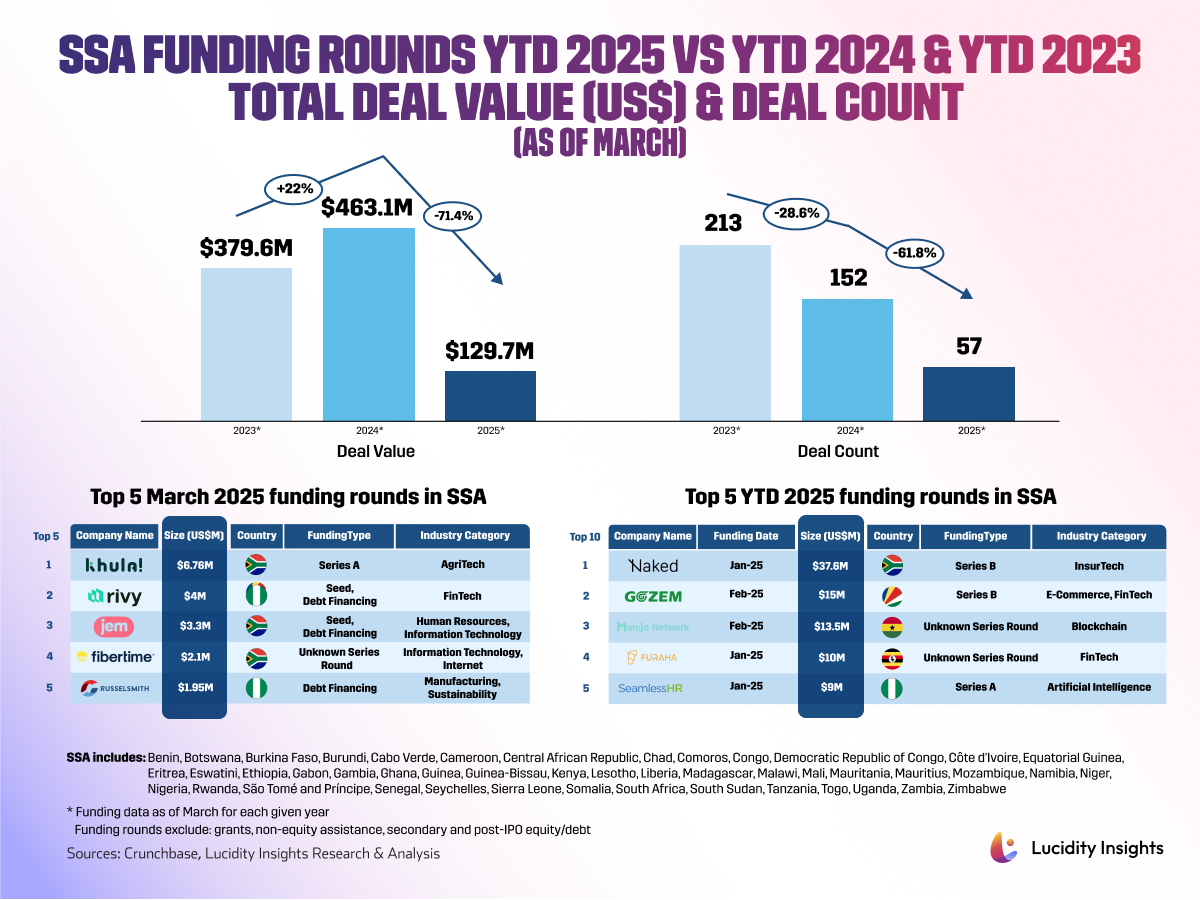
Now let’s take a look at the top 5 funding rounds of March 2025 in SSA.
#1 - KHULA! (South Africa) | AgriTech | US $6.76 Million Series A
Founded in November 2016 by Jackson Dyora, Karidas Tshintsholo, and Matthew Piper, KHULA! is a mobile marketplace which connects farmers with buyers and provides access to crucial logistics, technical expertise, and financing. KHULA rapidly gained ground in South Africa, amassing 20,000 users ranging from smallholder to commercial operators, and its valuation has reportedly increased tenfold, reflecting investor optimism in its growth trajectory.
In March 2025, KHULA secured R126 million ($6.7 million) in the first tranche of its Series A funding round led by Absa group (Bank), bringing its total funds raised to US $8.7 million. Khula is now targeting R200 million by mid-year to close its Series A, with the remainder of the round open to external investors seeking a stake in Africa’s rapidly growing agritech landscape. The funding will be used for scaling operations in South Africa, reaching more farmers, and initiating pilot programs in new markets across Africa and potentially Latin America.
#2 - Rivy (Nigeria) | FinTech | US $4 Million Seed & Debt Financing Round
Founded in 2019 by Chioma Okotcha, Uche Nnadi, and Zach Bijesse, Rivy, originally Payhippo, provides clean energy financing solutions. Initially focused on lending to small and medium-sized enterprises (SMEs), Rivy has pivoted to offering asset financing for solar energy systems. The company operates a dual marketplace model, connecting over 250 solar vendors and installers with businesses while providing the necessary financing to spread the cost of solar systems over time.
In March 2025, Rivy secured US $4 million in Seed funding and debt financing led by EchoVC and Shell’s All On, bringing its cumulative funds raised to US $8.1 million. The funds will be used to expand Rivy's clean energy financing solutions beyond Nigeria, enhance its marketplace model, and support the growth of its loan book.
#3 - Jem (South Africa) | HR, IT | US $3.3 Million Seed & Debt Financing Round
Founded by Alex Platt, Caroline van der Merwe, Nick Platt, and Simon Ellis in 2019 as SmartWage and rebranded in 2022, Jem is a WhatsApp-based HR and employee benefits platform. Jem started off by allowing companies to provide their employees with instant access to a percentage of their salaries and wages for work they have already done. It then expanded beyond that, giving enterprises a simple yet effective way to digitize their most time-consuming HR processes, helping them save time and money in order to focus on people. The product gives employees without email the ability to receive company-wide communication, access their payslips, request leave and get access to financial wellness products, all via WhatsApp.
In March 2025, Jem closed a US$3.3 million including ZAR30 million in debt financing and a ZAR30 million Seed round led by NEXT176, bringing its cumulative funds raised to US $5.6 million. The funds will be used to accelerate growth and product development, enabling Jem to launch new products that help improve the lives of deskless employees, including a savings tool, low-cost insurance, credit score support, a financial wellness helpline, and value-added services like airtime and data bundles.
#4 - Fibertime Group (South Africa) | Information Technology, Internet | US $2.1 Million Unknown Series Round
Founded in 2021 by Alan Knott-Craig, Fibertime Group provides affordable, uncapped fiber internet services on a pay-as-you-go basis, aiming to bridge the digital divide by offering high-speed internet access to underserved communities, particularly in South African townships. By 2024, Fibertime had successfully connected 9,100 homes to its network, split between 7,800 homes connected in Kayamandi and 1,300 homes in Gqeberha townships.
In March 2025, Fibertime raised US $2.1 million from Finnfund. This investment enables the company to expand to new townships and connect more homes, supporting its goal to connect up to 1.8 million homes to the internet.
#5 - RusselSmith (Nigeria) | Manufacturing, Sustainability | US $1.95 Million Debt Financing
Founded in 2005, RusselSmith is a leader in industrial innovation, providing tailored solutions in asset integrity and additive manufacturing while enhancing operational resilience and overcoming supply chain vulnerabilities for businesses across Africa. RusselSmith has collaborated with Cedrus Capital to drive sustainability in Nigeria’s energy sector and obtained approval from the Nigerian Upstream Petroleum Regulatory Commission (NUPRC) for Nigeria’s first industrial 3D manufacturing solution for the oil and gas industry.
In March 2025, RusselSmith raised US $1.95 million in debt financing from Cedrus Group Africa. The funds will be used for general working capital requirements and to progress the development of the company and its subsidiaries.

%2Fuploads%2Fcrypto-universe%2Fcover1.jpg&w=3840&q=75)