
Crypto's Q1 2026: Capital Up Four-Fold, Concentrated in Fewer Hands
02 May 2026•
%2Fuploads%2Farticles%2F2026%2F0502_q1-26-crypto%2Fq1-26-cover.jpg&w=3840&q=75)
In the first three months of 2026, crypto investors deployed $3.44 billion across 215 venture rounds. A year earlier, the same quarter saw $863.6 million across 264 rounds. That is a 298% increase in capital alongside an 18.6% drop in deal count. The capital came back, but it consolidated into larger cheques, a narrower set of categories, and a tighter group of decision-makers.
The clearest single comparison: the largest Q1 2025 venture round was Phantom's $150 million Series C. The largest Q1 2026 round was Kalshi's $1 billion Series E. The biggest cheque written this quarter was 6.7 times larger than the biggest cheque written a year ago.
The headline: stratification, not retreat
Q1 2026 venture capital came in at $3.44 billion against $863.6 million in Q1 2025. M&A was almost flat year over year: $2.14 billion in 2026 versus $2.17 billion in 2025. Total disclosed crypto capital across both quarters: $5.57 billion in Q1 2026 versus $3.04 billion in Q1 2025.
Deal count tells the opposite story. Venture rounds dropped from 264 to 215. M&A deal count fell from 54 to 46.
Bigger rounds. Fewer of them.
Prediction markets became a category
Q1 2025's venture top 10 had no round above $150 million. Phantom led at $150 million. Behind it, Mesh ($82 million), Komainu ($75 million), Raise ($63 million), and Sygnum ($58 million) ranged across DeFi infrastructure, custody, payments, and digital asset banking. Six of the ten rounds came in under $60 million.
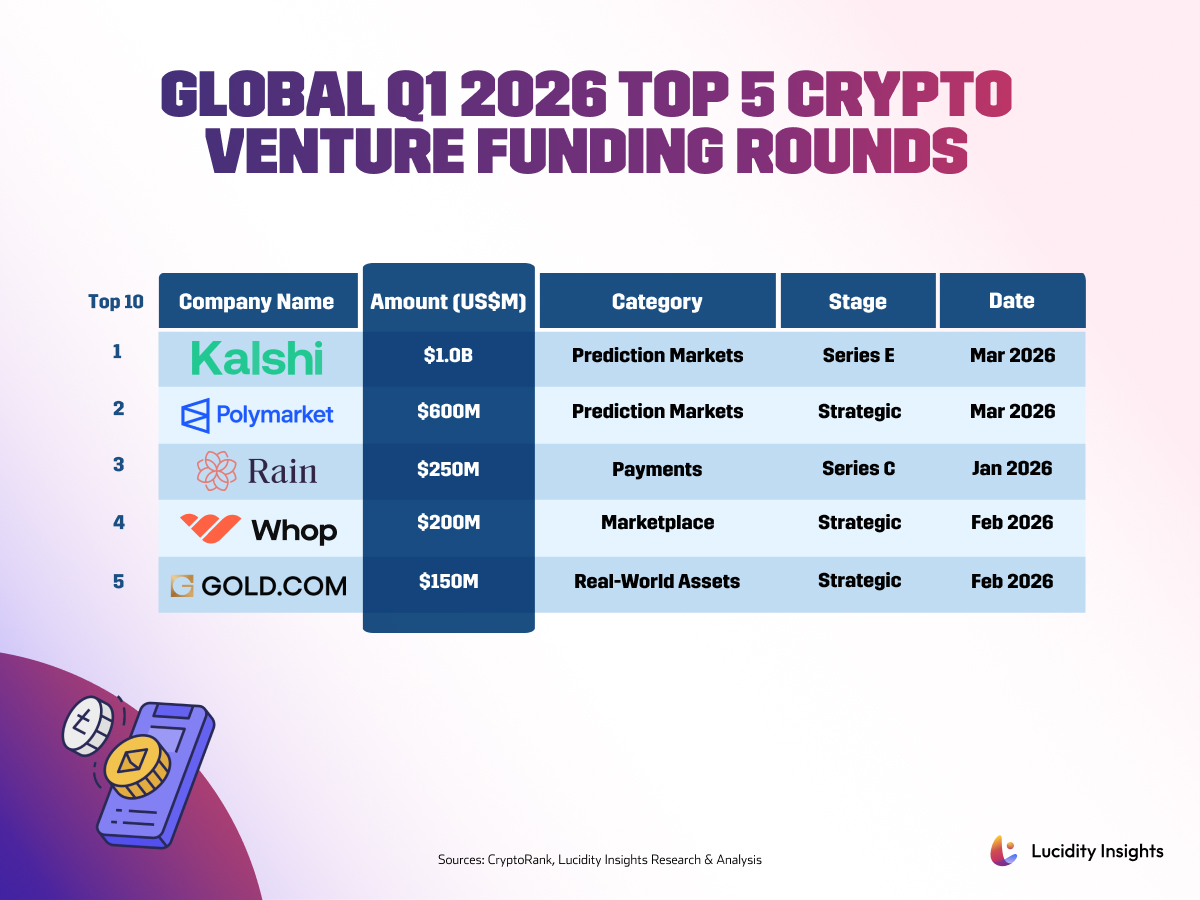
Q1 2026 looked nothing like that. Kalshi closed a $1 billion Series E led by Coatue Management on March 19, valuing the federally regulated prediction-market exchange at $22 billion, double its $11 billion valuation in December 2025. Eight days later, Polymarket received a $600 million investment from Intercontinental Exchange, following ICE's $1 billion investment into the platform in October 2025. Combined, the two prediction-market platforms raised $1.6 billion in March alone.
Coatue and ICE led the two largest crypto rounds of the quarter. Coatue is a late-stage technology hedge fund whose portfolio includes Stripe and Figma. ICE owns the New York Stock Exchange. Neither is a crypto-native investor. Both are now writing billion-dollar cheques into platforms that, twelve months ago, sat at the margins of regulated finance.
Behind the prediction markets, the rest of the Q1 2026 venture top five tilts toward financial infrastructure: Rain ($250 million Series C, ICONIQ-led, stablecoin payments), Whop ($200 million Strategic, Tether-led, creator marketplace), and Gold.com ($150 million Strategic, Tether-led, tokenised gold).
Tether's quarter
Three of the Q1 2026 venture top 10 rounds were led by Tether: Whop ($200 million, February 25), Gold.com ($150 million, February 5), and Anchorage Digital ($100 million, February 5). Combined, Tether deployed $450 million across three strategic rounds in February alone.
The companies are unrelated. Whop is a creator marketplace with 18.4 million users and roughly $3 billion in annual creator earnings. Gold.com is an NYSE-listed precious metals platform integrating Tether's XAU₮ gold-backed stablecoin. Anchorage Digital is the first federally chartered crypto bank in the United States. What unites them is that Tether wrote each cheque directly, not as part of a VC syndicate.
Tether's deal-count for Q1 2026 totals 10 according to CryptoRank's most-active-investors data, ranking it second behind Coinbase Ventures' 14. Its preferred stage is Strategic and its average round size is above $50 million. The company's posture has shifted from passive liquidity provider to active capital allocator across creator commerce, tokenised commodities, and regulated banking infrastructure.
M&A: one megadeal, then a long tail
Q1 2026 produced one M&A megadeal. Mastercard agreed to acquire BVNK on March 17 for up to $1.8 billion ($1.5 billion base plus $300 million in earnouts), the largest crypto-asset acquisition on record and 2.4x BVNK's $750 million Series B valuation from December 2024. The London-based stablecoin payments infrastructure firm processes $30 billion in annualised stablecoin payment volume on $40 million of revenue, serving 370+ enterprise clients including Deel, Phantom, and Dune. Mastercard's stated rationale is to acquire the gateway between on-chain stablecoin rails and fiat settlement before it can be disintermediated.
Below BVNK, three other Q1 2026 M&A deals disclosed terms: Fireblocks acquired the crypto tax and treasury platform Tres Finance for $130 million in January; Coincheck Group bought the Canadian asset manager 3iQ for $111.84 million; and Mirae Asset Global Investments took control of South Korea's oldest exchange Korbit for $92.27 million in February. Forty-six total M&A deals were tracked by CryptoRank in the quarter; only five disclosed terms.
Q1 2025's M&A picture was broader. Three deals cleared $150 million: Kraken's $1.5 billion acquisition of NinjaTrader, Infinite Reality's $207 million purchase of Napster, and MoonPay's $175 million acquisition of Helio. Q1 2026 had only one deal above that mark. M&A consolidation in 2026 is concentrating into a single, very large transaction per quarter rather than several mid-sized ones.
The IPO: BitGo became the first
CryptoRank shows zero crypto IPOs in Q1 2025. BitGo's January 22 listing on the New York Stock Exchange under the ticker BTGO is therefore the first crypto IPO in either quarter under a strict S-1 definition. Fold Holdings, which is sometimes cited as a Q1 2025 IPO, technically completed a SPAC merger with FTAC Emerald Acquisition Corp in February 2025, categorised by CryptoRank as a special transaction rather than a traditional IPO.
BitGo priced its IPO at $18 per share above its $15–$17 marketed range, raising $212.8 million at an IPO valuation of approximately $2.08 billion. The stock rose to $24.50 intraday on its first day before closing at $18.49. Goldman Sachs, Morgan Stanley, and J.P. Morgan led underwriting. The company reported FY 2025 revenue of $16.15 billion (+424% year over year) on a $14.8 million net loss, with 5,322 institutional clients (+103.5% YoY) and a Q1 2026 derivatives launch generating roughly $3 billion in notional volume.
The post-listing stock performance has been volatile. After peaking at $24.50 in late January, BTGO traded to $7.67 in late March before recovering to roughly $10.60 by the end of April, leaving the stock around 41% below its IPO price. Analyst commentary attributes the drawdown to expectations of a sharp growth-rate reset (consensus models 46% YoY revenue growth for 2026, versus +424% in 2025), not to operational deterioration.
The first crypto company to execute a clean S-1 IPO this cycle is an institutional custody platform, not an exchange or a consumer app.
Fold: the contrast
The closest reference point in the public record is Fold Holdings, the Bitcoin rewards fintech that listed on Nasdaq via SPAC merger in February 2025 at a $365 million valuation. FLD peaked at $14 in early trading and now trades at $1.52, a roughly 89% decline from its post-listing peak. FY 2025 revenue grew 34% to $31.8 million on a $69.59 million net loss; three analysts cut price targets in March, with an average 12-month target of $5. No going-concern warning, layoffs, or SEC enforcement action have been publicly disclosed. The story is a public crypto-fintech micro-cap whose top line grew while the market repriced unit economics that the SPAC valuation had assumed would scale faster. BitGo, by contrast, is institutional infrastructure with real operational growth being repriced for a slower forward year.
What this quarter signals
Crypto venture in Q1 2026 was four times larger than Q1 2025 by capital deployed and 18.6% smaller by deal count. Two prediction-market platforms raised $1.6 billion combined in March. Tether wrote $450 million across three strategic rounds in a single month. Mastercard agreed to pay $1.8 billion for stablecoin payments infrastructure. The first crypto IPO of either quarter is a federally chartered custody platform, not a consumer app.
The bar is higher. The cheque is bigger. The investor pool is smaller. The categories that are working — payments infrastructure, regulated rails, prediction markets, real-world assets, and institutional custody — look more like financial services and less like 2021 crypto.

%2Fuploads%2Finnovations-blockchain%2Fcover22.jpg&w=3840&q=75)