AI in Healthcare: From Clinical Validation to Predictive, Personalized Medicine
27 October 2026•

Artificial intelligence is no longer confined to laboratory benchmarks in healthcare. It is entering regulated clinical environments at measurable scale. Over the past decade, FDA authorizations of AI-enabled medical devices have grown from just six annually to 335 in 2025, with 181 more in the first half of 2026 alone. The FDA’s own list now counts 1,614 AI-enabled devices, about three in four of them in radiology.
Regulatory validation has shifted from exceptional to routine, embedding AI within formal medical oversight frameworks.
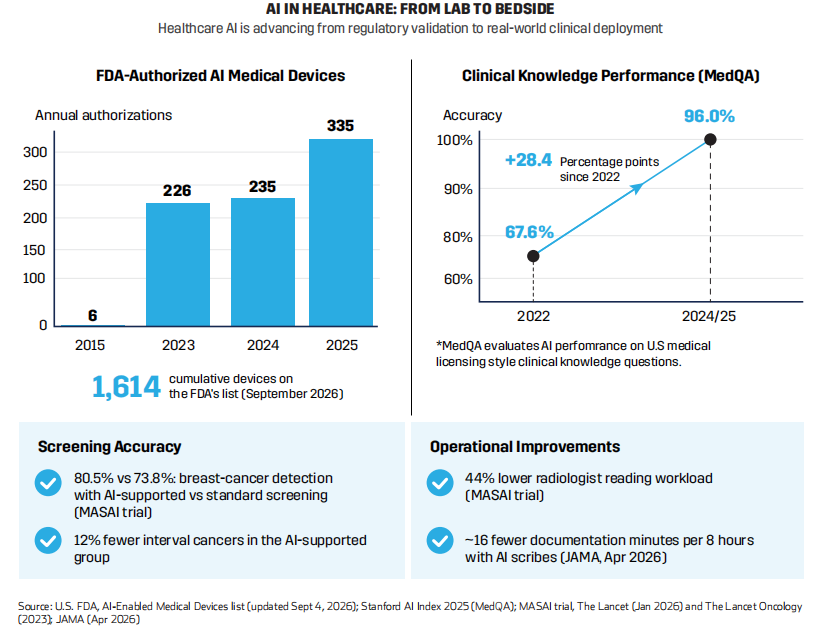
Performance gains are equally notable. Large language models now achieve 96 percent accuracy on medical licensing-style benchmarks such as MedQA, approaching expert-level reasoning in controlled settings. In clinical imaging, AI-assisted systems have delivered sensitivity improvements of five to ten percentage points in specific cancer detection trials.
The strongest evidence so far arrived in January 2026, when The Lancet published the final results of Sweden’s MASAI study, the first randomized controlled trial of AI in breast-cancer screening. Across more than 100,000 women, AI-supported screening detected 80.5% of cancers, against 73.8% for standard double reading by two radiologists, and was followed by 12% fewer interval cancers, those diagnosed between screening rounds. An earlier readout from the same trial showed radiologists’ reading workload falling by 44%. These advances move AI from theoretical capability to clinical augmentation.
Operational integration is increasingly visible, but here the evidence is more sobering than the marketing. AI scribes, which listen to consultations and draft the clinical note, have been promoted as cutting documentation time by 20 to 40 percent, even handing back one to two hours per clinician per day. The largest real-world study to date, published in JAMA in April 2026 and covering more than 8,500 clinicians at five U.S. academic health systems, found a far smaller effect: adopters spent about 16 fewer minutes on documentation per eight hours of scheduled patient care, with no significant change in after-hours charting. Clinicians who used a scribe in at least half of their visits saved around 27 minutes, but only a third of adopters did. Other studies report real reductions in burnout, which suggests the value of scribes lies as much in attention and fatigue as in minutes saved.
In tuberculosis screening, the World Health Organization has recommended computer-aided detection software for reading chest X-rays since 2021, allowing programs to screen at scale in places with few radiologists. Drug discovery is moving too. In September 2026, Insilico Medicine dosed the first patient in what it describes as the world’s first Phase III trial of a drug developed with generative AI: rentosertib, for idiopathic pulmonary fibrosis, whose biological target was also identified by AI.
Yet capability alone does not guarantee transformation. Healthcare systems remain among the most regulated and risk-sensitive environments in the world. Ethics research, bias audits, demographic validation, and postmarket monitoring are intensifying across regions. Questions of liability, reimbursement eligibility, and cross-border data governance remain central. Benchmark accuracy does not automatically translate into consistent real-world performance, and much of the evidence is still built on benchmarks: a JAMA review of 519 studies evaluating large language models in healthcare found that only 5% used real patient data.
The cutting edge is shifting toward system-level intelligence. Multimodal clinical foundation models now integrate imaging, genomics, laboratory results, and physician notes into unified reasoning systems. At the frontier, digital twin models seek to simulate patient-specific physiology, allowing clinicians to test interventions virtually before administering treatment. Though early, these approaches signal a gradual move from reactive care to predictive and preventative medicine.

Saudi Arabia offers a compelling case study of national-scale healthcare AI adoption. Under Vision 2030’s Health Sector Transformation Program, the Kingdom has invested heavily in nationwide digital health infrastructure, including unified electronic health records and AI-powered public health platforms. One flagship initiative is SEHA Virtual Hospital, launched in 2022 and now supporting more than 240 hospitals across the country, offering services in 48 main specialties and 68 sub-specialties, with an annual capacity of almost 600,000 patients — a model that earned global recognition and a Guinness World Record as the world’s largest virtual hospital. In 2025 alone, it delivered more than 16 million virtual appointments and consultations.
Beyond the virtual hospital, the Ministry of Health’s Sehhaty app, which handles appointment booking, prescriptions and sick leave, passed 31 million users in 2025, demonstrating how digital platforms are woven into everyday healthcare delivery.
While full physiological digital twins remain an emerging frontier globally, Saudi Arabia has taken a first, consumer-level step. In October 2024, the Ministry of Health added a “digital twin” feature to Sehhaty that lets users track their health status and receive AI-driven lifestyle advice. It is a personal health profile rather than a clinical simulation, but together with centralized planning and nationwide digital records, it gives the Kingdom a foundation few health systems have for moving toward simulation-driven medicine.
The defining constraint is no longer raw model accuracy. It is institutional integration. Healthcare adoption depends on interoperability with electronic health records, regulatory alignment, reimbursement frameworks, and clinician trust. AI has demonstrated capability. The next phase will determine whether health systems redesign around it.
In medicine, technological progress is necessary — but institutional trust determines scale.
Unpack the frontiers of agentic AI and discover how autonomous systems are actively reshaping enterprise operations, finance, and cybersecurity in The State of AI Report 2026.