AI in Financial Systems: Expanding Access, Managing Risk
27 October 2026•

Finance is among the most tightly regulated infrastructures in modern economies. For decades, financial decisions, from lending to fraud detection, shifted gradually from human judgment to rule-based systems and quantitative models. Those systems were automated but bounded and overseen by people.
Artificial intelligence changes the scale and speed of that transition. It does not simply follow predefined rules; it adapts and learns. The question is no longer whether finance can use AI. It is whether financial systems can trust it at scale.
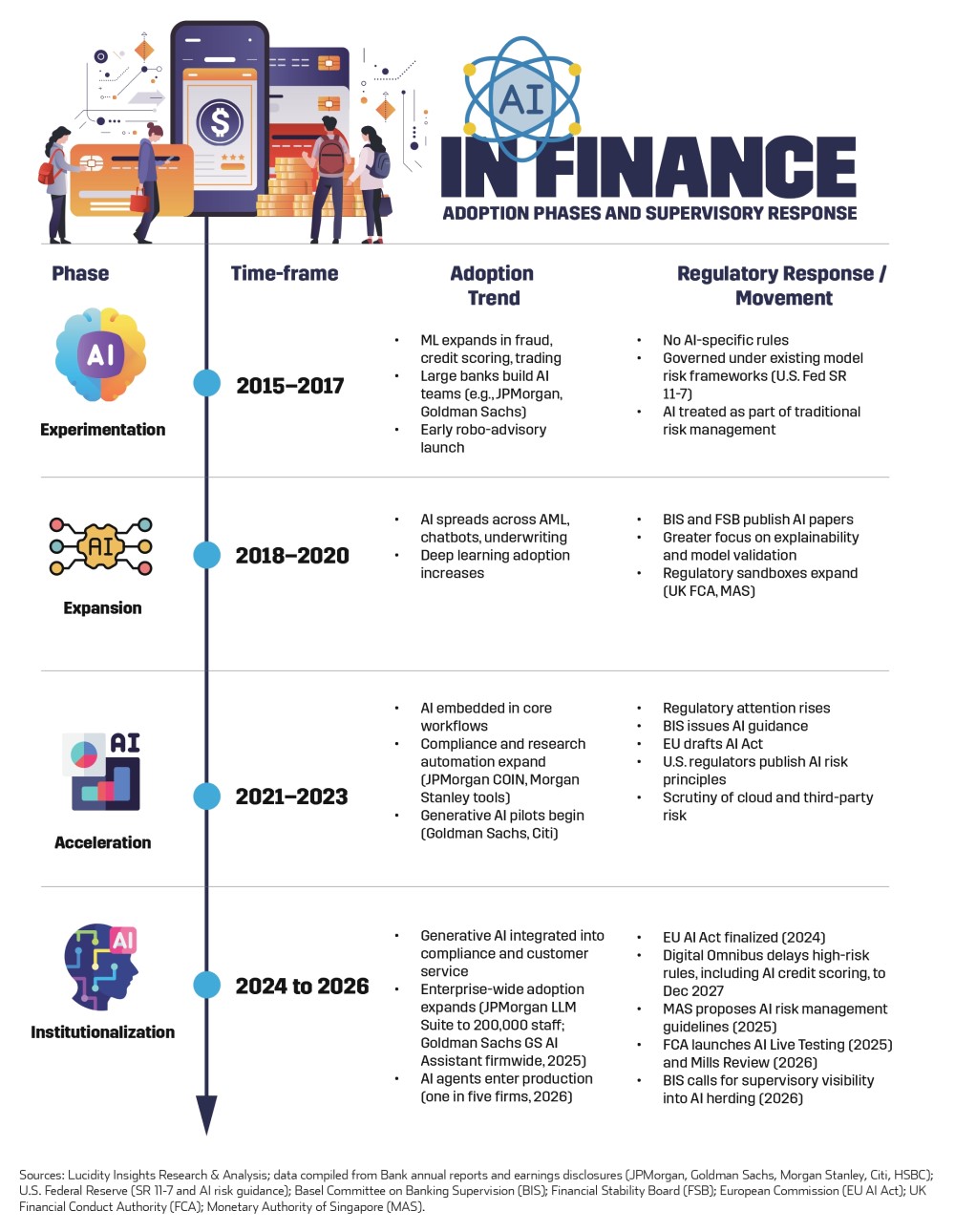
Today, about two-thirds of financial institutions report actively using AI, up from 45 percent a year earlier, and one in five has already deployed AI agents. Around nine in ten use AI to fight fraud and financial crime. What began as analytics support has become core infrastructure for risk management and compliance.
The most visible impact is faster financial decision-making. In anti-money laundering programs, mature AI systems reduce false positives by 30 to 50 percent, lowering investigative burden while improving signal quality. Advanced fraud detection models identify roughly 90 percent of fraudulent attempts in card and payments environments, shortening investigation cycles and accelerating risk assessment.
Automation reinforces the shift: as early as 2017, JPMorgan’s COIN platform eliminated 360,000 hours of annual contract review work, while Morgan Stanley deployed a GPT-powered assistant to more than 15,000 financial advisors in 2023, marking one of the first large-scale generative AI integrations in wealth management.
AI is reshaping who can access financial services. In the United States, AI-based underwriting platforms such as Upstart report that their models approve 43 percent more borrowers than a traditional credit-score-based model, at a 33 percent lower average APR, according to the company’s own 2025 study.
In Saudi Arabia, fintech lenders licensed by the Saudi Central Bank (SAMA) and the Capital Market Authority are using datadriven underwriting to speed up SME financing in support of Vision 2030 diversification goals. Saudi-headquartered erad, for example, says its proprietary risk models let it approve SME financing within 48 hours. Digital advisory platforms further lower the cost of portfolio construction and automated rebalancing, extending investment access beyond traditional high-net-worth segments.
The next step is agentic: in July 2026, the UK’s Financial Conduct Authority found that a fifth of UK adults are likely to use AI that can act autonomously, within preset goals, on their finances.
Acceleration, however, reshapes the system itself. As models compress research cycles, accelerate risk assessment, and automate execution, financial institutions face a structural trade-off between speed and stability. Governance discipline will determine whether acceleration enhances resilience or amplifies fragility.
The Bank for International Settlements has cautioned that growing reliance on concentrated AI infrastructure and similar modeling approaches could heighten the risk of synchronized behavior during periods of market stress. In June 2026 it went further, calling on supervisors to improve their visibility into “model-driven correlated exposures, herding behaviour and the potential for algorithmic collusion.”
Binding rules are still catching up: the EU AI Act classifies AI credit scoring as high-risk, but the Digital Omnibus has pushed those obligations back from August 2026 to December 2027. Financial systems depend on trust, transparency, and explainability — qualities that do not always align naturally with complex machine learning models. AI is enhancing fraud detection, speeding compliance workflows, and broadening access to capital. But finance cannot tolerate opaque automation at scale. In financial systems, speed is valuable, and stability is indispensable.
Unpack the frontiers of agentic AI and discover how autonomous systems are actively reshaping enterprise operations, finance, and cybersecurity in The State of AI Report 2026.