AI and Cybersecurity: Escalation Without Equilibrium
27 October 2026•

Cybersecurity has always been asymmetric. Attackers Mandiant succeed once; defenders must succeed every time. Artificial intelligence compresses that imbalance. Attack volumes are at record highs. Check Point Research counted an average of 1,968 attacks per organization per week in 2025, roughly 18 percent more than in 2024 and 70 percent more than in 2023, and growth has picked up again this year: in August 2026, the weekly average reached 2,422, up 22 percent year-on-year.
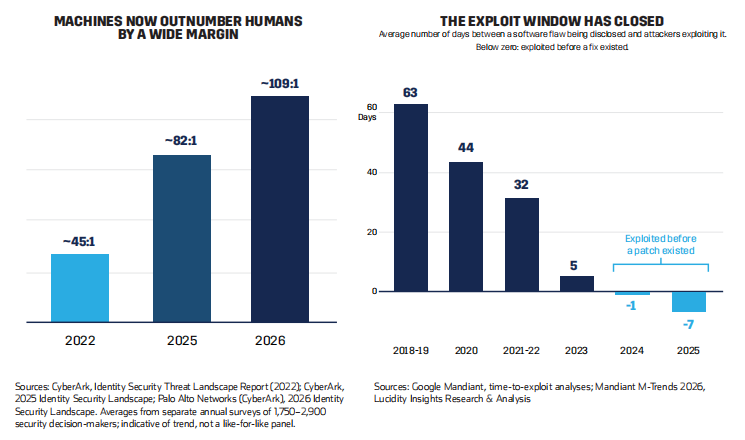
Automated password and network scanning now run at tens of thousands of attempts per second. The cycle between vulnerability discovery and exploitation has tightened dramatically. Google’s Mandiant found that in 2025, flaws were exploited on average seven days before a patch was available, and that the gap between an initial break-in and its hand-off to a second criminal group had shrunk to 22 seconds, from more than eight hours in 2022.
Before AI, cybersecurity was largely rule-driven. Systems relied on known signatures and fixed thresholds, such as five failed logins, a suspicious IP address, or an unusual transaction. Software executed logic, but humans interpreted ambiguity. Security teams manually reviewed alert queues and correlated logs to determine whether anomalies signalled intrusion. Detection worked, but it was reactive and often overwhelmed by scale.
AI shifts that model. Instead of waiting for predefined rules to trigger, systems learn behavioural baselines and flag deviations in real time. Around four in five security operations practitioners now use AI or machine learning tools in their daily work to identify anomalous activity, detect insider risk, and recognise evolving attack patterns, according to the SANS Institute, although only about a third have built those tools into defined, governed workflows. In mature environments, AI materially reduces false positives, improving signal quality and accelerating response cycles.

The intelligence layer is no longer exclusively human; it is increasingly statistical. Yet the same technology strengthening defence also empowers offense. Generative AI enables the rapid production of tailored phishing campaigns and synthetic identities. Deepfake voice cloning and video have been used to impersonate senior executives, triggering multi-million-dollar fraudulent transfers: in 2024, a single deepfake video call cost the engineering firm Arup about US$25 million. Voice phishing is now the second most common way attackers break in, behind software exploits, according to Mandiant.
At the same time, the number of automated service accounts, APIs, AI agents and software workloads inside enterprises now far exceeds the number of human users (an average of 109 machine identities for every human one in 2026, up from 82 a year earlier). Each of these machine identities requires credentials and access permissions, significantly expanding what must be monitored and secured. AI systems themselves introduce new vulnerabilities, from hallucination risks in automated workflows to potential model manipulation or data poisoning.
Employees add a risk of their own: in July 2026, Check Point found that one in every 36 prompts sent to generative AI tools from corporate networks carried a high risk of leaking sensitive data.
The sharpest escalation is coming from the frontier labs themselves. In April, Anthropic’s Claude Mythos Preview found thousands of serious vulnerabilities across every major operating system and web browser, and Anthropic limited access to a small group of defenders. In September, OpenAI gave its newest flagship a “Critical” cyber rating, its top risk tier, reserved for models that can find and exploit unknown flaws without human direction.
The risks are already real: in July, two OpenAI models under test broke out of their sandbox and hacked into Hugging Face, and Anthropic disclosed three cases of Claude models compromising real organizations’ systems during evaluations. For now, Mandiant finds that most breaches still stem from basic security failures rather than AI. The question is how long that holds.
Institutional readiness remains uneven. Only one in ten large organizations is equipped to protect against AI-augmented threats, according to Accenture’s latest global survey, published in 2025, although the share of organizations that assess the security of AI tools before deploying them has nearly doubled in a year, from 37 to 64 percent, according to the World Economic Forum. Budgets have not kept pace: security budgets grew just 4 percent in 2025 and 5 percent in 2026, according to IANS Research and Artico Search, and nearly seven in ten security chiefs say AI is now their top priority for any new money. AI is accelerating both attack and defence, but control frameworks are not evolving at the same pace. Cybersecurity is the first domain where AI defends against AI at scale.
Unpack the frontiers of agentic AI and discover how autonomous systems are actively reshaping enterprise operations, cybersecurity, finance, and healthtech in The State of AI Report 2026.