Agentic AI: When Software Starts Deciding and Acting
27 October 2026•

Artificial intelligence is entering a phase where it does more than assist; it begins to operate. The shift from copilots to agents marks the most important architectural transition in enterprise AI since the emergence of large language models.
Instead of generating drafts or answering prompts, agentic systems interpret goals, plan multistep workflows, call tools, and execute tasks with limited supervision. In practice, this means service tickets can be resolved autonomously, IT systems can self-diagnose, compliance checks can run continuously, and supply chains can rebalance in real time.
Enterprise surveys now show how far agents still have to travel. Nearly nine in ten organizations use AI regularly in at least one business function, and 44% say AI is scaling across the enterprise.
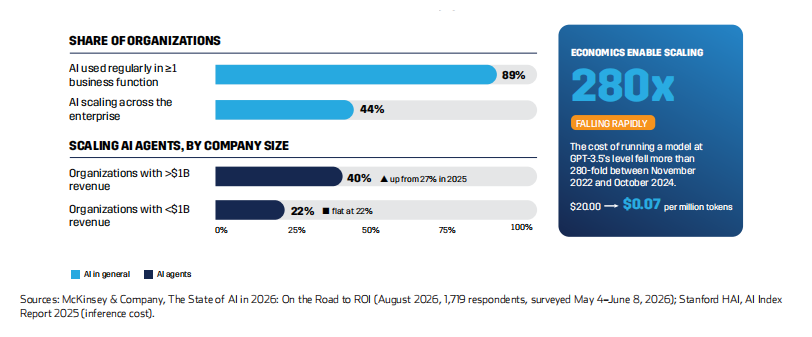
Agents trail well behind, and the gap is opening along company size. At organizations with more than US $1 billion in revenue, 40% of respondents report scaling AI agents, up from 27% a year earlier. At smaller firms, the figure has not moved from 22%. The gap between experimentation and orchestration is where the next phase will be decided, and large enterprises are already pulling ahead.
What makes this moment different from two years ago is the convergence of capability and economics. On SWEbench Verified, a benchmark built from real software bugs, the best AI systems went from resolving 4 percent of tasks in late 2023 to over 60 percent in about a year, and near 80 percent by the end of 2025.
Scores have since bunched up against that ceiling, and frontier labs have moved on to harder tests. At the same time, the cost of running a model at GPT-3.5’s level fell more than 280-fold between late 2022 and late 2024, and Epoch AI estimates that the price of reaching any given capability level is still falling by roughly 5–10x a year.
Reliability has improved while operating costs have collapsed. That combination turns autonomy from novelty into feasibility. Venture data reinforce the shift: AI-first companies are reaching meaningful revenue milestones faster than prior SaaS cohorts, suggesting strong enterprise pull rather than speculative demand.
From Experimentation to Execution
AI adoption is widespread, but scaling agents remains a minority activity, and increasingly a large-company one, even as economics rapidly improve.
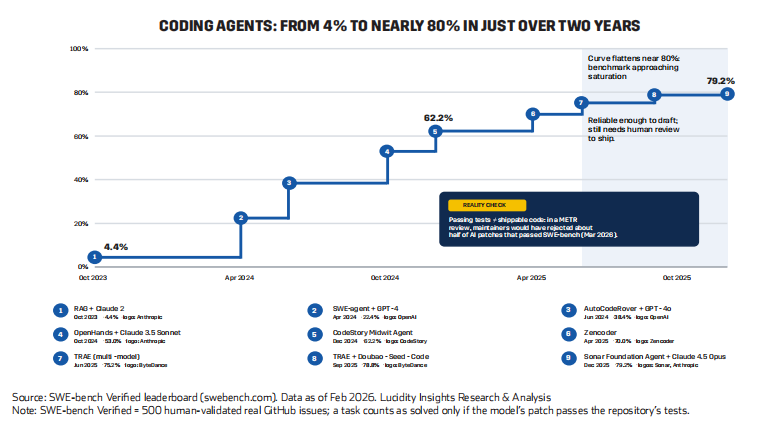
Yet the real constraint is no longer model intelligence, rather it is institutional readiness. Scaling agentic systems requires workflow redesign, governance layers, data pipelines, and new skills in MLOps and oversight. Early deployments have exposed governance gaps, particularly around auditability and unintended tool execution. Many organizations remain in pilot mode not because the systems fail, but because integration into legacy processes is hard. Benchmarks also flatter.
When METR asked open-source maintainers to review AI patches that had passed SWE-bench, roughly half would not have been merged. The implications extend beyond firms. AI adoption depends on infrastructure, data availability, and skills, and those are unevenly distributed. Recent global diffusion data show widening gaps in AI adoption between advanced and emerging economies. At the same time, autonomy amplifies risk.
Cybersecurity research shows a sharp rise in AI-enabled phishing and deepfake activity, underscoring that autonomy must be matched by stronger security controls.
The defining question now is not whether agents work. The question is whether enterprises and governments can redesign around them fast enough. Autonomy without governance compounds risk; autonomy with institutional redesign compounds advantage. Even as agents advance, most organizations still rely on human-in-the-loop systems. While agents represent the direction of travel, copilots remain the operational baseline.
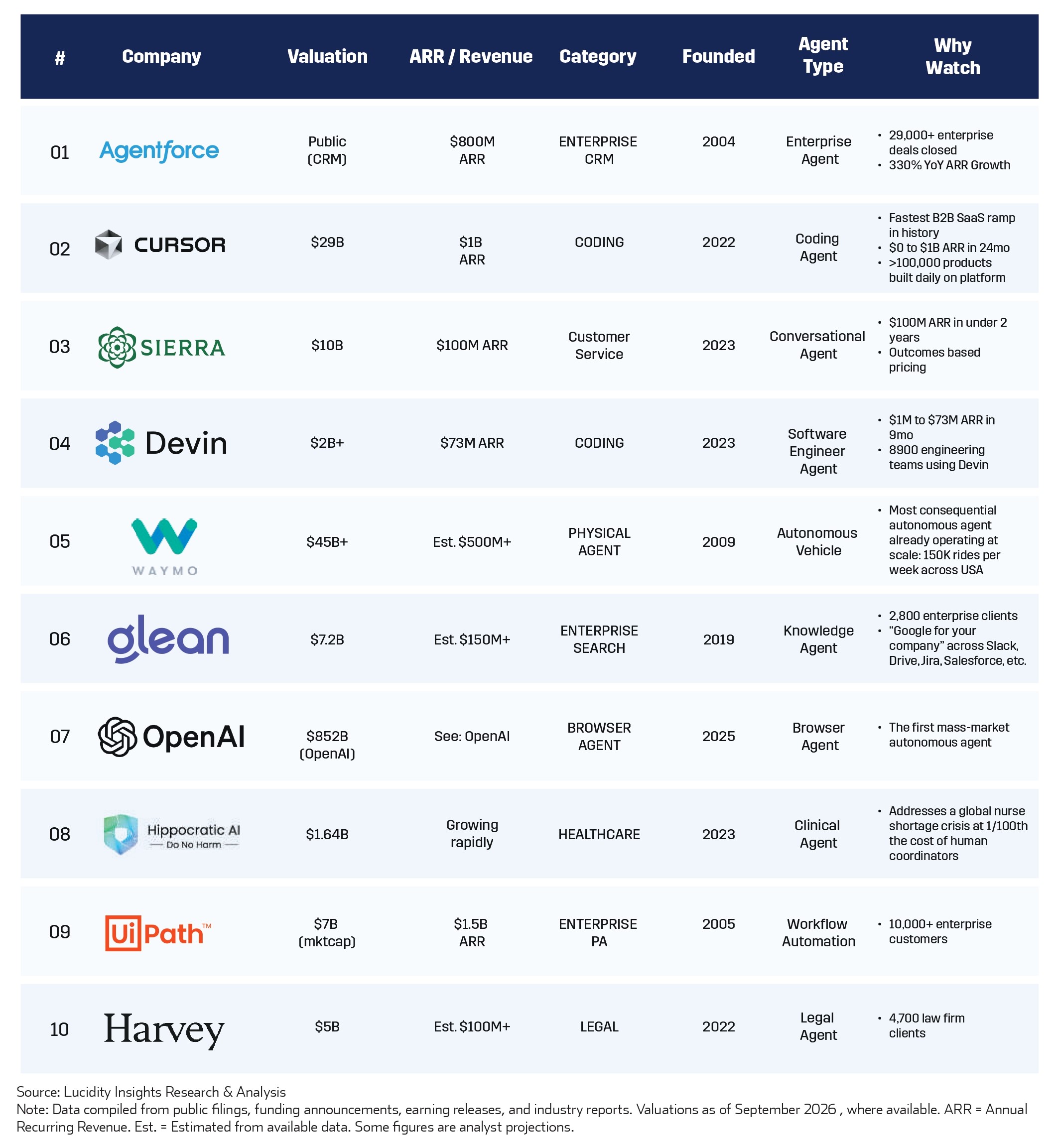
Agents Shaping 2026
Beyond chatbots, these companies are building AI that doesn’t just answer questions — it takes action, completes tasks, and operates autonomously at enterprise scale. Valuations and ARR figures as of September 2026, if available. Valuation is the latest private round, or market capitalization for listed companies.
Unpack the frontiers of agentic AI and discover how autonomous systems are actively reshaping enterprise operations, finance, and cybersecurity in The State of AI Report 2026.