
7 Graphs Explaining the Current State of Electric Vehicles Around the World
13 October 2025•
%2Fuploads%2Fev-2025%2Farticles%2F7-graphs%2F7-cover.jpg&w=3840&q=75)
1. Our Current Global EV Population
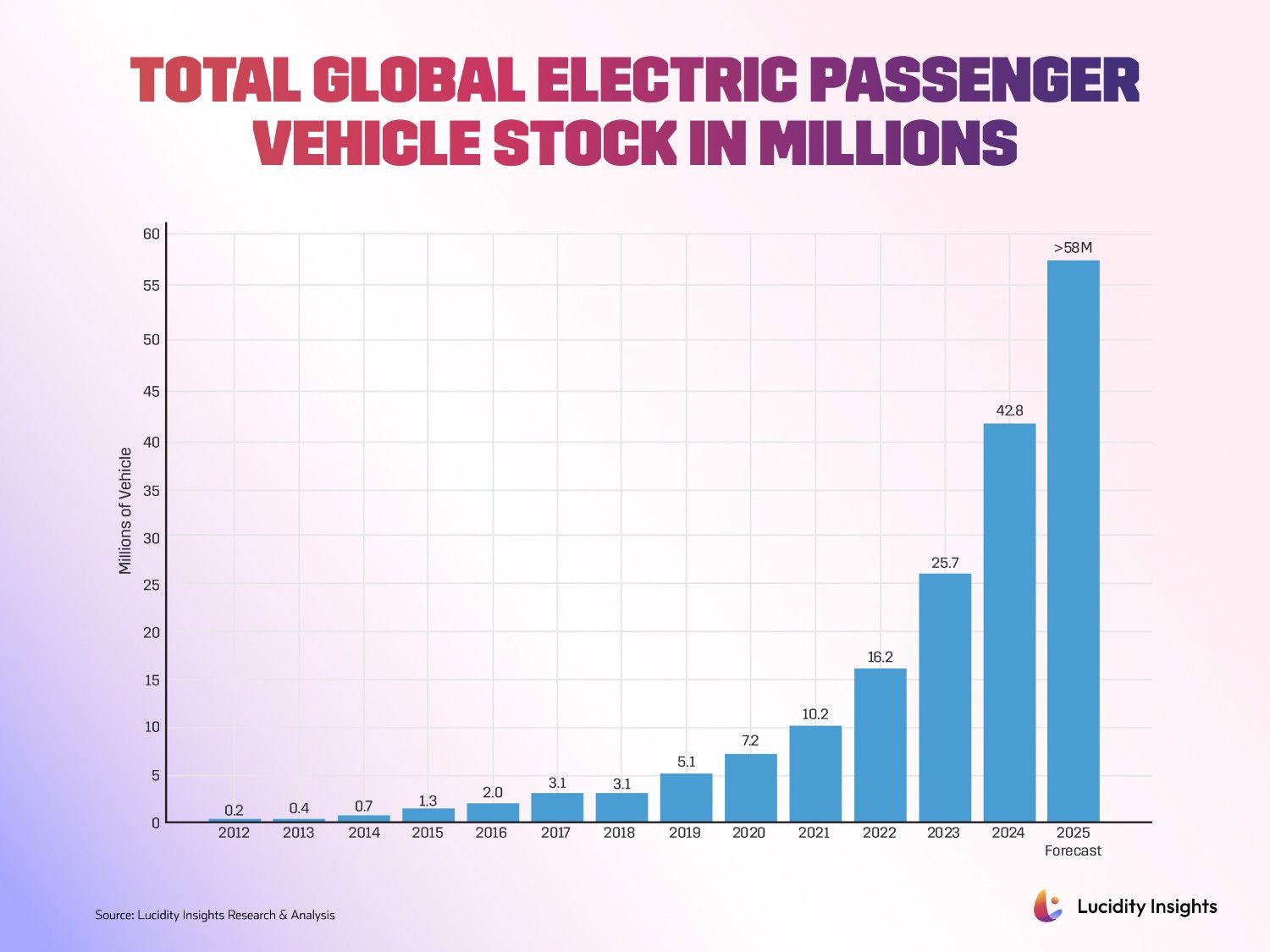
The global electric vehicle (EV) stock has witnessed exponential growth over the past decade, rising from just 0.2 million in 2012 to a projected 42 million by the end of 2025. The global electric vehicle (EV) stock grew at a compound annual growth rate (CAGR) of approximately 53.4% between 2012 and 2024. This dramatic rise is largely driven by the rapid expansion of battery electric vehicles (BEVs), which now make up over three-quarters of the global EV fleet. Supportive government policies, declining battery costs, rising climate consciousness, and an expanding selection of EV models have all contributed to this surge. Major markets like China and Europe have led the charge, but adoption is now spreading globally. As infrastructure improves and costs continue to fall, the global EV stock is expected to grow even more rapidly in the years to come.
2. Who’s Selling the Most EVs?
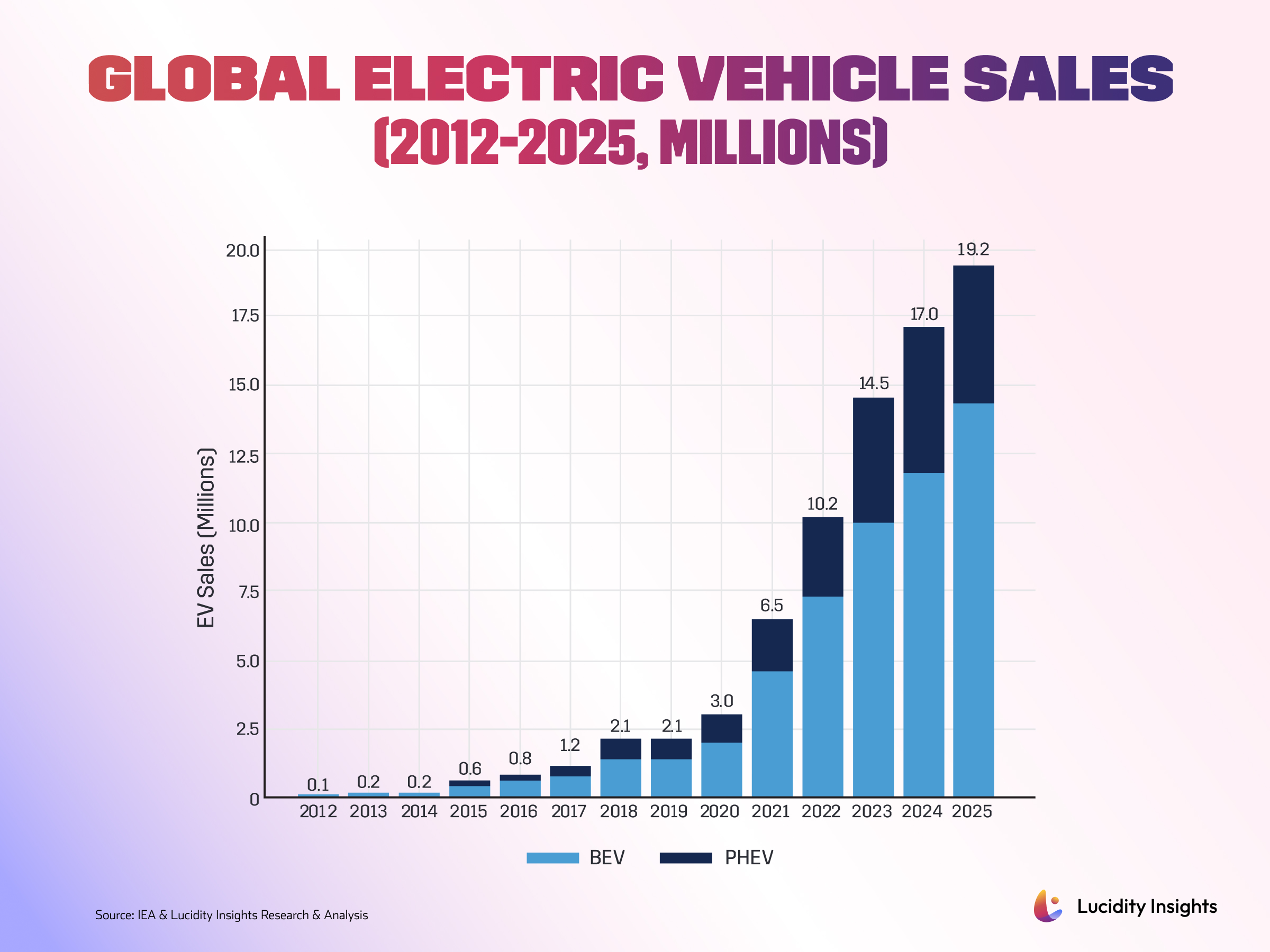
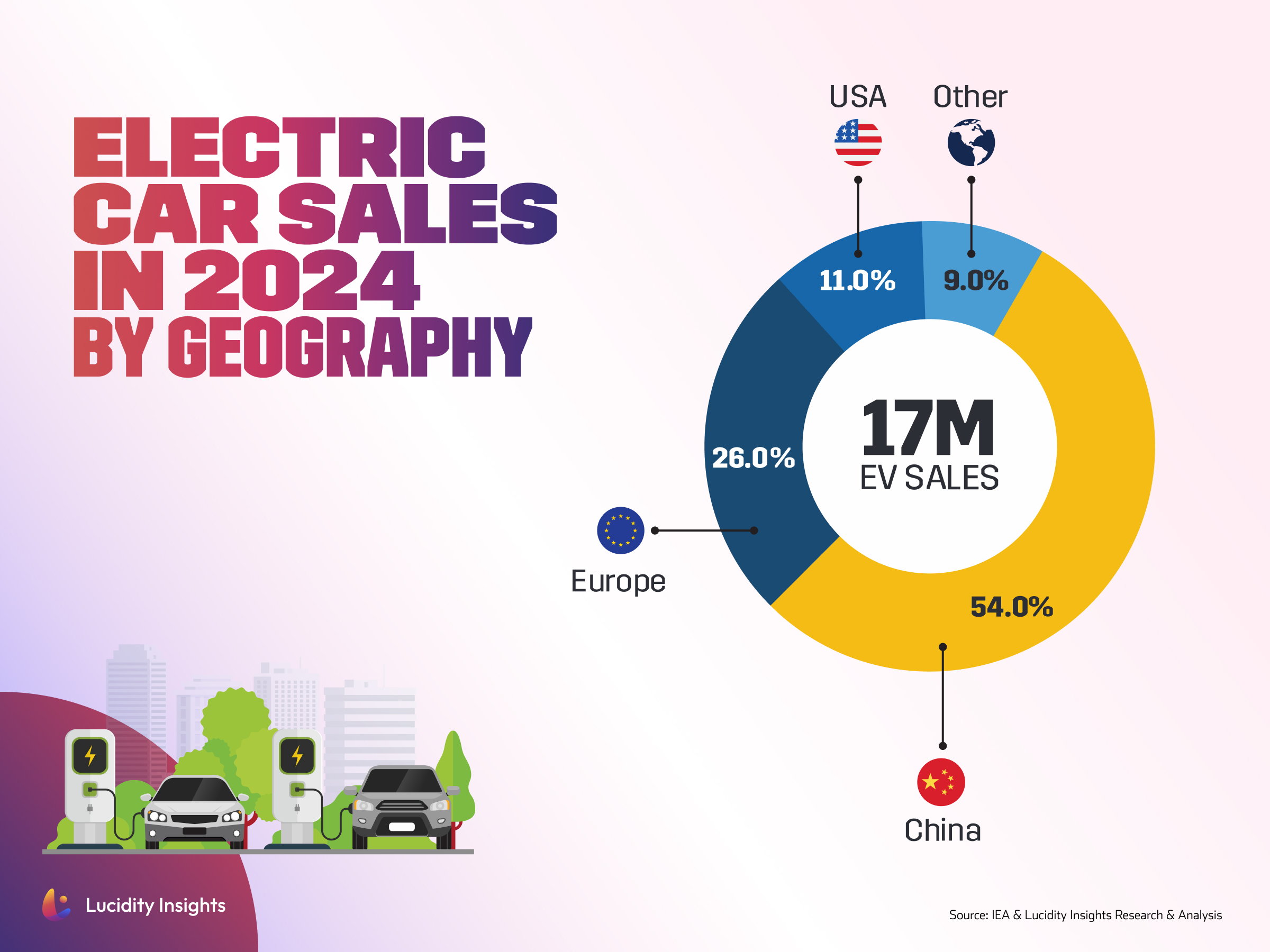
Over the past decade, annual electric vehicle (EV) sales across the world has skyrocketed from under 250,000 units per year in 2014 to sales of over 17 million in 2024, marking one of the fastest technological shifts in automotive history. Though this growth was originally led by America, the past several years has been overwhelmingly led by China, which now commands over 50% of global EV sales, thanks to aggressive state policy, massive investment in local manufacturing, and consumer-friendly pricing.
Europe remains the second-largest EV market, driven by strong climate legislation, fleet decarbonization targets, and widespread incentives. The United States continues to stay in the EV game with homegrown hero Tesla still making waves, and California and New York paving the way to what electrified mobility can look like; but as federal tax credits ease, and charging infrastructure growth slows, US electric vehicle growth is decelerating. Meanwhile, regions like Southeast Asia, the Middle East, and Latin America are laying the groundwork for a massive EV scale-up in the coming years. What was once a niche category is now a global movement transforming how the world moves.
3. Who’s Got the Most EVs on the Road?
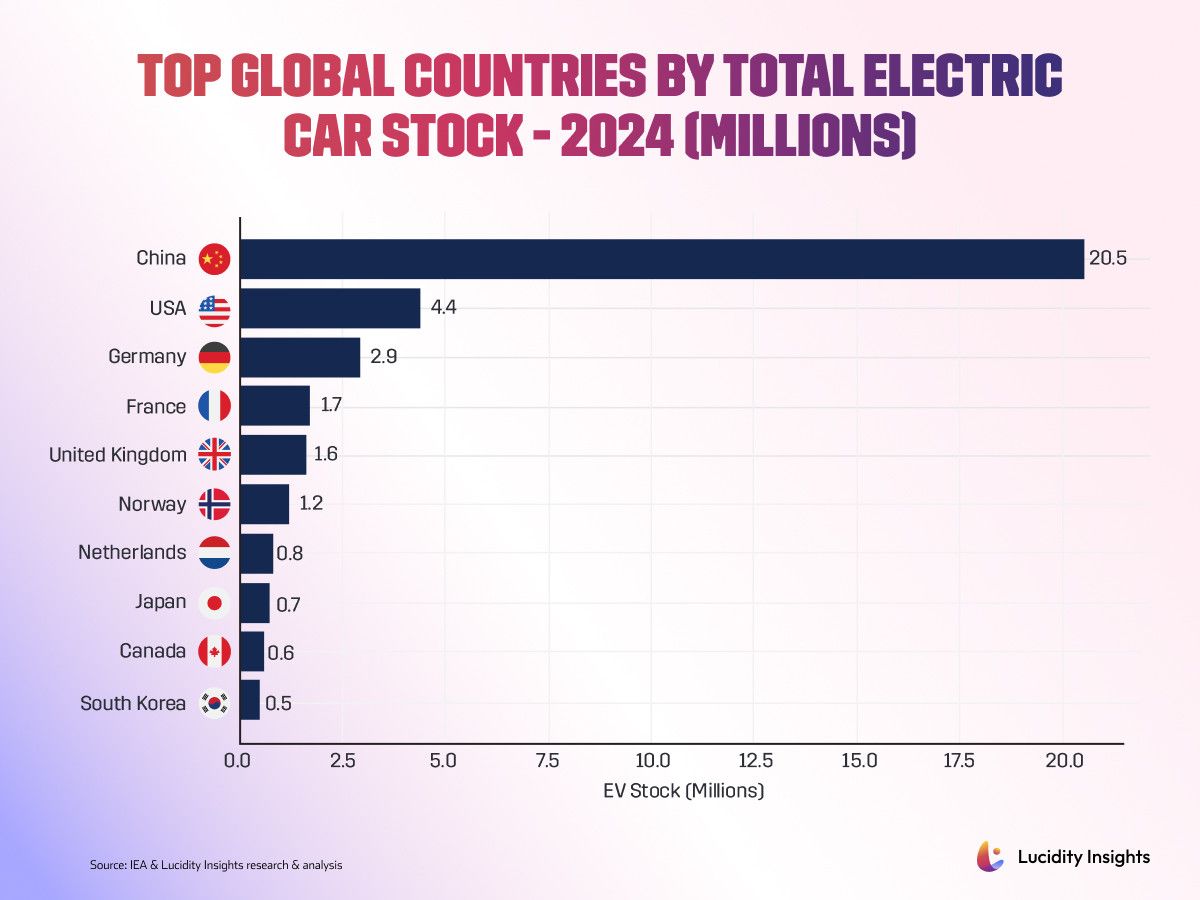
The graph below showcases the Top 10 Countries by Total Electric Vehicle Stock in 2024, illustrating which nations lead in terms of sheer volume of electric vehicles on the road. Unsurprisingly, China remains the global EV powerhouse, with over 20 million passenger electric cars — nearly half of the global stock. The United States follows in a distant second, with just over 4.4 million EVs, reflecting both its larger overall car population and slower adoption pace compared to Europe and China. Germany, France, and the UK round out the top five, signaling strong EV momentum across Western Europe. Emerging EV markets like Canada, Japan, and Norway continue to climb the ranks as infrastructure and incentives improve.
4. Who Has Electrification Fever?
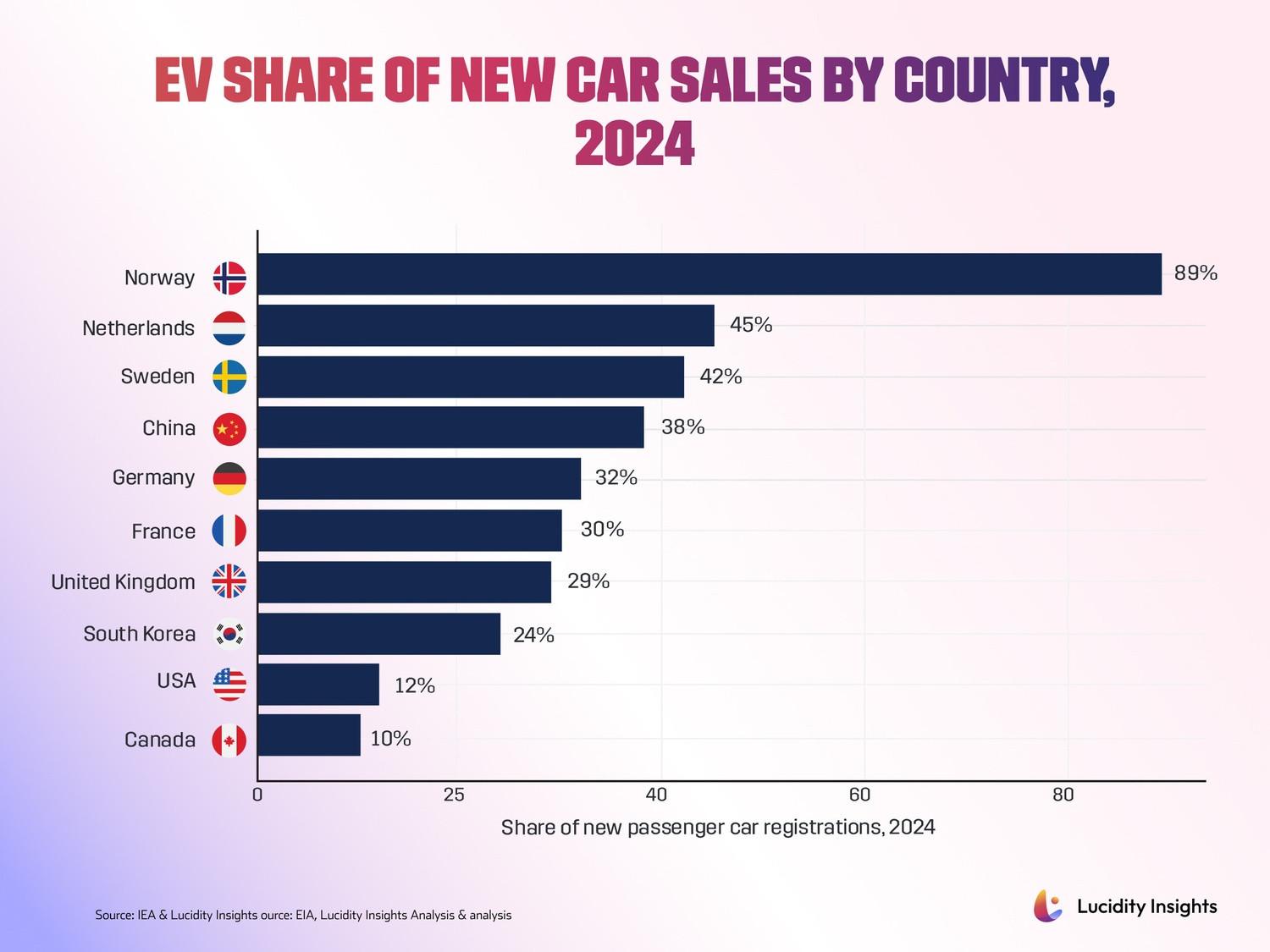
Total EV stock alone doesn’t tell the full story. The chart below ranks countries by new EV sales penetration - i.e. the percentage of new car registrations in the past year that are considered “electric vehicles”. Here, Norway stands out as the undisputed global leader, with nearly 9 out of every 10 vehicles sold in 2024 being electric; this is largely thanks to years of aggressive government subsidies, tax breaks, and public awareness campaigns.
The Netherlands and Sweden also show strong penetration rates, where more than 4 out every 10 vehicles sold in these countries were electric in 2024. In the past 10 years, China has managed to create a strong EV economy, with multiple dominant EV manufacturers; and it seems it’s population is going along for the ride; in 2024, nearly 4 out of every 10 vehicles sold in China was electric. In contrast, markets like the USA and Canada lag behind in penetration - with EV’s representing just 12% and 10% of national sales in 2024, this is simply not enough to turn the tide, and turn these countries into electric mobility nations.
5. Automaker’s Electrification Roadmap
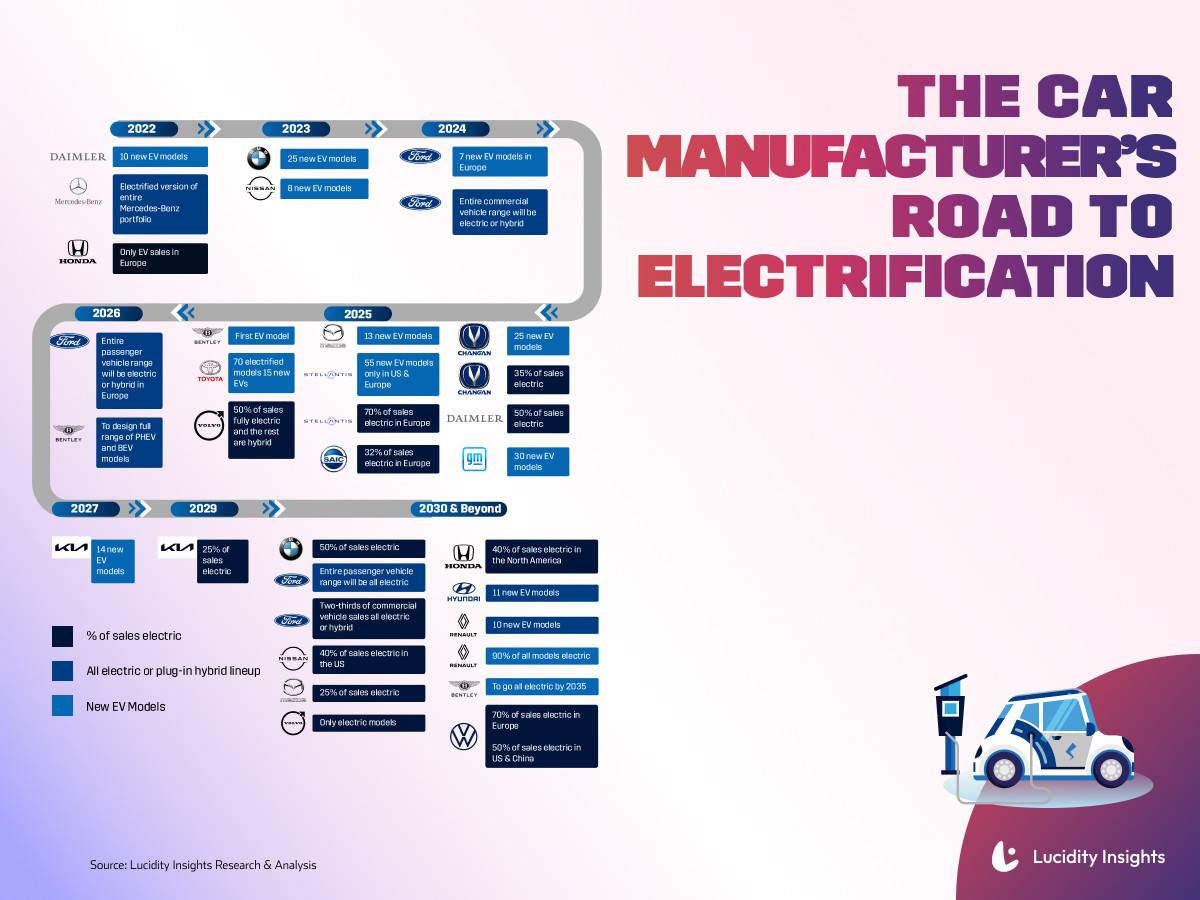
Over the past few years, the World’s Largest Automotive Manufacturers have committed to going electric and many plan to achieve carbon neutrality by 2050, if not sooner.
6. Expected Sales of EVs in 2030
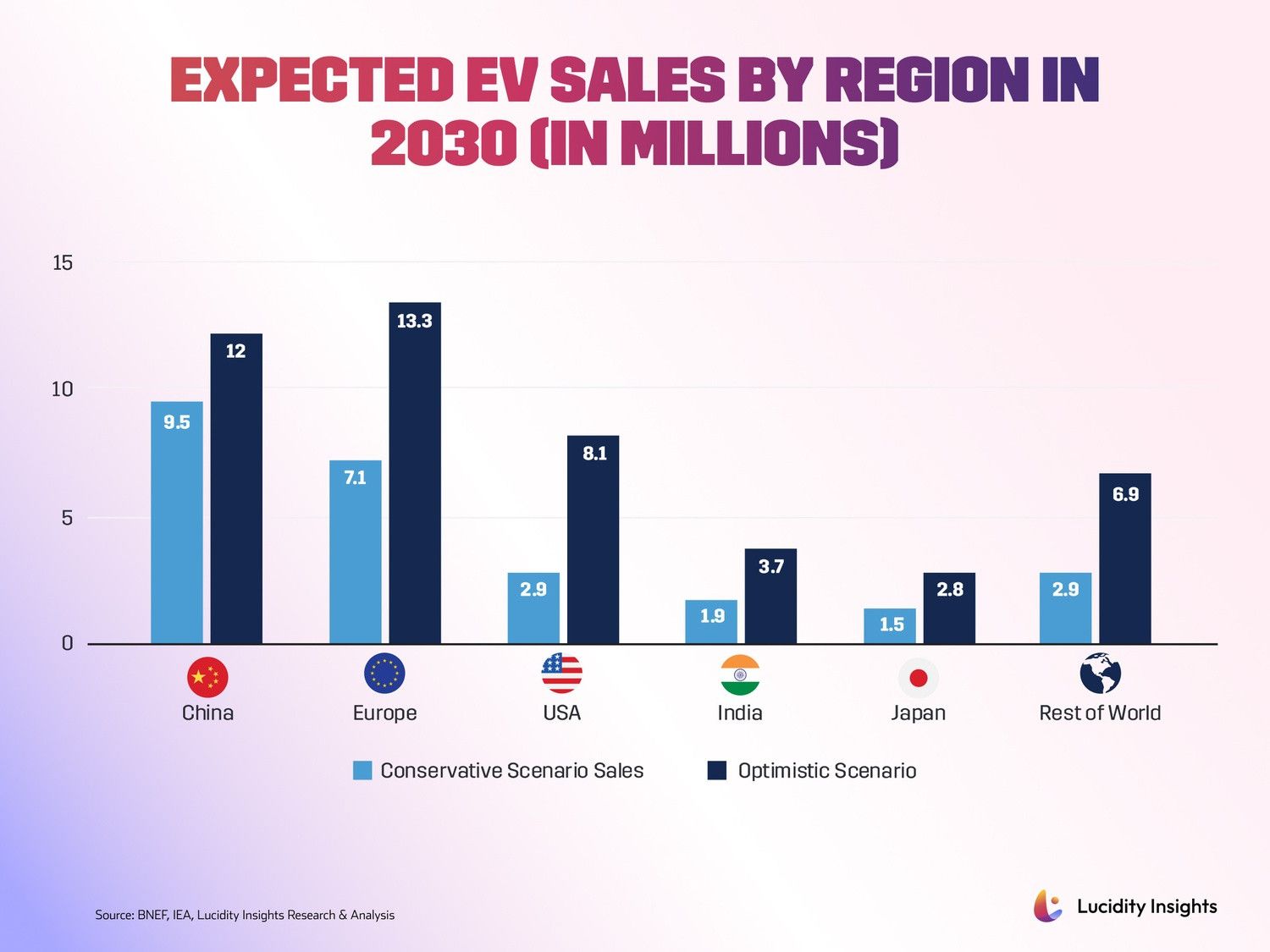
This chart illustrates the projected EV sales by region in 2030, capturing both conservative and optimistic scenarios. The data highlights a global race toward electrification—one increasingly shaped by policy pressure, consumer demand, and industrial strategy. While China is expected to maintain its lead, with up to 12 million EVs sold annually (note, China already sold 11 million EVs in 2024 alone), Europe as a region is poised for significant acceleration, particularly in the optimistic outlook where Europe could surpass 13 million EV sales per annum by 2030. The U.S. is expected to continue to grow, selling 8 million units by 2030 in the optimistic scenario. Emerging markets like India and Japan show slower but steady growth, underscoring the importance of infrastructure investment and local manufacturing incentives to drive adoption. The “Rest of World” category—covering Africa, Southeast Asia, Latin America, and others—shows major potential, with projections as high as 7 million annual EV sales in the best-case scenario. This signals a dramatic shift: as battery costs decline and climate urgency mounts, including air quality challenges - such as that which face many South Asian and African cities, the EV revolution is no longer just a developedworld phenomenon—it’s going global.
7. The Middle East’s Rising Rate of EV Adoption
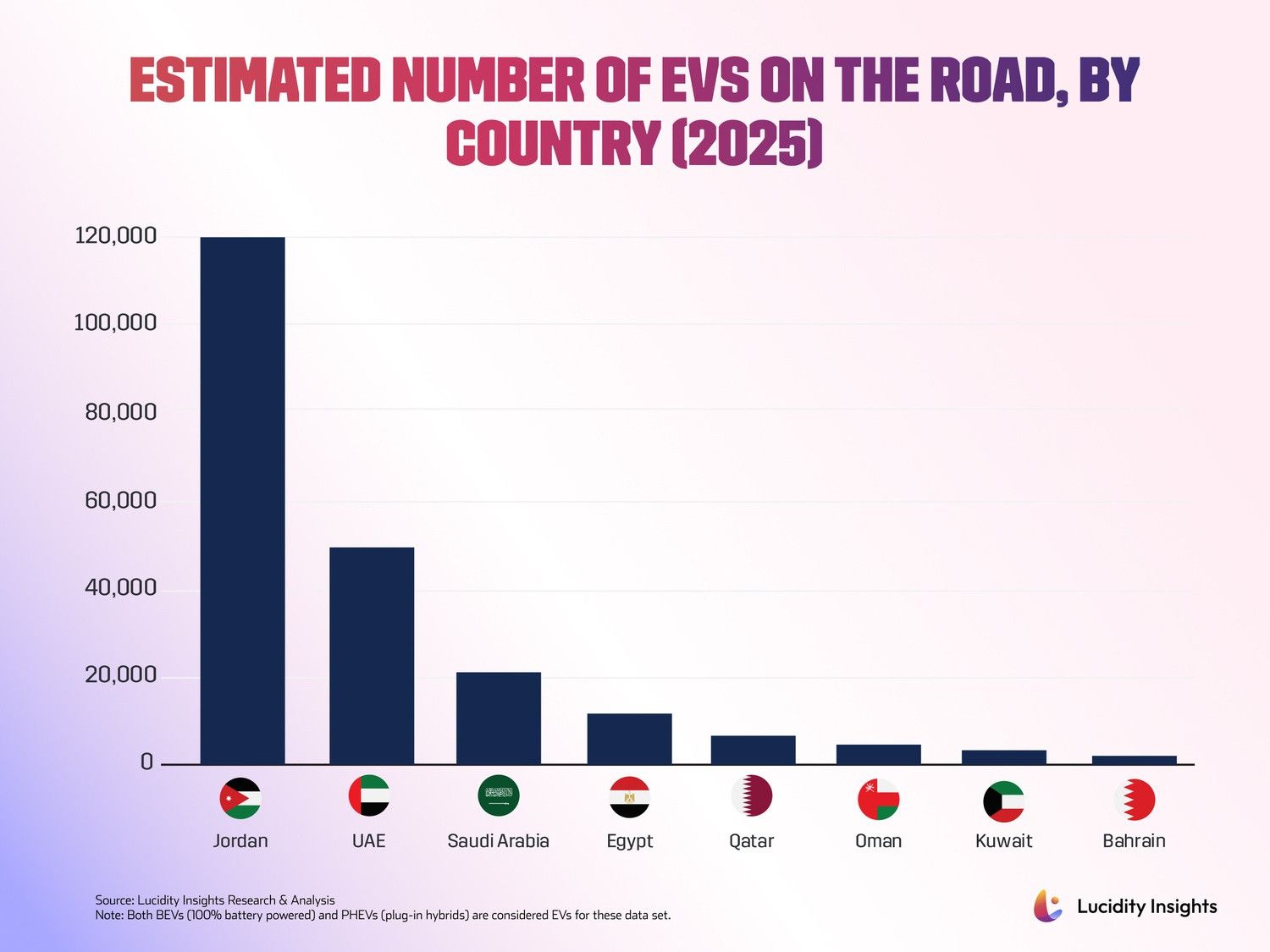
The Middle East is accelerating its shift toward electrified mobility, with Jordan, UAE and Saudi Arabia leading the regional charge. In 2025, Jordan has over 120,000 EVs (both 100% battery powered and plug-in hybrids) on its roads, thanks to strong government incentives, tax rebates, and charging infrastructure investments. The UAE has over 50,000 EVs registered in the country, due to its ambitious green mobility targets like Dubai’s Net Zero Emissions Strategy. Saudi Arabia, backed by massive investments like the PIF-funded Lucid Motors plant and Ceer Motors plant, alongside national EV infrastructure initiative EVIQ, is expecting to hit somewhere north of 25,000 EVs on its roads by the end of 2025.
Egypt also has a sizable and growing EV market, due to a growing middle class and rising fuel costs. This chart underscores how the EV transition is no longer a fringe movement in the region—it’s gaining traction reflecting both policy shifts and changing consumer sentiment.
%2Fuploads%2Fev-2025%2Fcover27.jpg&w=3840&q=75)